On June 22, 2026, U.S. President Trump signed Executive Order 14411, which fundamentally strengthens the national strategy for quantum information science and technology (QIST). Focusing on the domestic installation of large quantum computers to solve scientific problems and protecting the supply chain, the aim is to establish absolute superiority in technological competition with China.
- Launch of the national program “QC-ADDS”
- Six strategic priorities set by the executive decree
- Countering the “Collect Now, Decode Later” Attack
- Federal government decision to advance the 2035 deadline
- Responding to China’s Government Investment Exceeding Billion
- Domestic reshoring of supply chains and technological protection
- Expectations from tech giants like IBM and Google
- Industrial potential to create trillion in economic value
- Milestones for FTQC Realization as Envisioned by Private Companies
- The Role of National Centers in Standardizing Performance Evaluation
- Technical specification formulation by the Department of Energy and private sector collaboration
- Securing Quantum Human Resources and Expanding the Educational Infrastructure
Launch of the national program “QC-ADDS”
At the core of Executive Order 14411, signed by President Trump on June 22, 2026, is the creation of a new program called Quantum Computers for Applied Development and Discovery Science (QC-ADDS). Under the coordination of the President’s Assistant for Science and Technology (APST), this program aims to install at least one large quantum computer at the Department of Energy facility and open it to the scientific community as much as possible. At present, specific technical specifications such as the number of qubits have not been finalized, but it is envisioned to be able to solve scientific problems that classical computers cannot handle. Please refer to the diagram below.
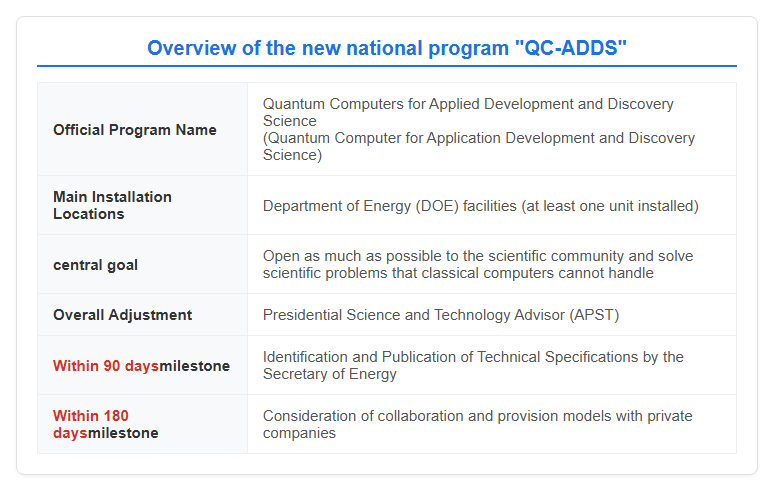
。 The Secretary of Energy is required to publish specific technical specifications within 90 days of signing and to consider a collaboration model with private companies within 180 days. This can be seen as a national directive to elevate quantum technology as a scientific milestone to the practical engineering stage.
Six strategic priorities set by the executive decree
This presidential decree goes beyond merely supporting technological development; it comprehensively updates the overall national strategy. Specifically, the following six pillars were defined. First, the development of large quantum computers using the aforementioned QC-ADDS. Second, accelerate the deployment of quantum sensors and networks. Third, strengthen domestic supply chains related to quantum technology. Fourth, technical protection through the expansion of the Quantum Counterintelligence Protection Team (QCPT). Fifth, formulate strategies for the recruitment and retention of quantum talent across the government. And sixth, strengthening international cooperation with comrade-friendly countries. The Secretary of Defense is also specifically required to identify at least three next-generation quantum sensor projects within 60 days, aiming for operational deployment by September 30, 2028, and other security deadlines.
[Core of Security] The Urgency of Transitioning to ‘Quantum-Resistant Cryptography’
Countering the “Collect Now, Decode Later” Attack
As the practical use of quantum computers approaches, the risk of current cryptographic technology being broken is becoming more serious. A particularly threatening technique is the Capture now, decrypt later (Collect now, decrypt later) attack, or Harvest now, decrypt later (HNDL). This involves attackers secretly collecting and storing encrypted data that is currently undecipherable, and then attempting to decrypt it all at once when high-performance quantum computers become available in the future. Among classified information are patient records and military secrets that must remain confidential for over 50 years, and it would be too late to begin countermeasures after quantum computers are completed. Quantum algorithms, represented by Shor’s, have already been shown to efficiently decrypt RSA ciphers and elliptic curve cryptography, which are the foundations of the current internet, and a fundamental overhaul of the information infrastructure is required.
Federal government decision to advance the 2035 deadline
On the same day, the Trump administration signed another executive order (EO14409) announcing a policy to accelerate the transition deadline to quantum-resistant cryptography (PQC). Until now, federal agencies have been required to fully transition by 2035, but the latest executive order also requires private networks to adopt new algorithms developed by the National Institute of Standards and Technology (NIST) more quickly. In August 2024, NIST officially announced three standard algorithms, ML-KEM and ML-DSA, and concrete implementation criteria are gradually being established. This order has increased compliance pressure, including obligations for agencies that fail to meet the transition deadline to report their reasons to the Office of Management and Budget (OMB). This is a strong will to strengthen the nation’s digital defenses before quantum technology falls into the hands of adversary nations.
[Strategic Background] Fierce Technological Hegemony Competition with China
Responding to China’s Government Investment Exceeding Billion
The biggest factor driving the U.S. to such a rapid national quantum technology strategy is the rise of China. The Chinese government is estimated to have invested about $15 billion in quantum technology research and development, and in its 15th Five-Year Plan from 2026 to 2030, quantum technology is designated as the leading seven future industries. China is a world leader in quantum communication and optical quantum technology, steadily advancing independent hardware development such as the 180-qubit superconducting quantum computer “Wukong-180” and the optical quantum computer “Jiuzhang 4.0.” According to a report from the U.S.-China Economic and Security Investigation Committee, China may be secretly developing quantum computers with cryptage-breaking capabilities, making it urgent for the U.S. to maintain its technological and military superiority. Behind the Trump administration’s “whole-of-government approach” lies a technological supremacy struggle that goes beyond mere academic interest and resembles the Cold War-era struggle for technological supremacy.
Domestic reshoring of supply chains and technological protection
To maintain the superiority of quantum technology, it is essential not only to secure hardware but also the supporting components, materials, and manufacturing equipment. The executive order directs the Secretary of Commerce to analyze the supply chain for Quantum Information Science and Technology (QIST) and develop plans to eliminate manufacturing barriers within the United States. Specifically, the plan is to strongly support private companies in the U.S. that develop and manufacture core quantum computer components by utilizing prize-winning challenges and the Buy-In Program (AMC). Additionally, to strictly prevent the leakage of technology overseas, the Quantum Counterintelligence Protection Team (QCPT) will be expanded, strengthening the system to protect the U.S. quantum ecosystem from cyberattacks and industrial espionage. Together with existing regulations (EO14105) that restrict U.S. overseas investment, a strict protectionist stance of “not leveraging U.S. technology to other countries” has become clear in all aspects of funding, expertise, and human resources.
[Impact on Market and Stock Prices] New Investment Opportunities Created by Public-Private Partnerships
Expectations from tech giants like IBM and Google
In response to the Trump administration’s new executive order, major U.S. tech companies have unanimously praised it. IBM CEO Arvind Krishna described this executive order as “a crucial step toward maintaining quantum leadership and technological resilience,” emphasizing the importance of public-private partnerships. Ruth Polatt, President and Chief Investment Officer of Google (Alphabet), also welcomed the government’s stance, stating that quantum computing is a transformative technology advancing national security, drug discovery, and solving energy issues. The investment market has also reacted sensitively, and on Monday, June 22, 2026, following the signing of the order, shares of major quantum-related companies such as IonQ and Rigetti Computing surged. The government’s indication of $2 billion in fiscal support through the CHIPS Act and other measures also provides strong reassurance for investors.
Industrial potential to create trillion in economic value
The economic value brought by quantum computing is extremely significant. According to McKinsey estimates, the added value quantum computers bring to the four major industries—chemicals, life sciences, finance, and mobility—could reach up to $2 trillion by 2035. Please refer to the diagram below.
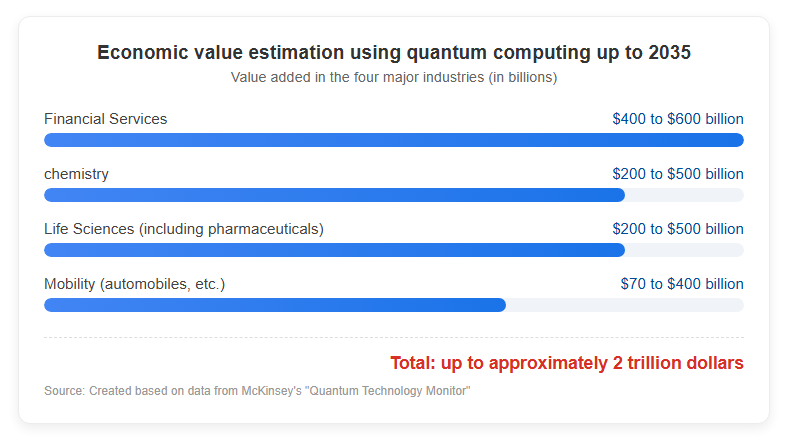
。 In the pharmaceutical field, the development period for new drugs is shortened by several years, while in materials science, it enables the development of next-generation battery materials and high-efficiency solar cells. In the financial sector, optimizing risk models is expected to generate enormous profits. The recent installation of large machines by the U.S. government and its opening to the scientific community are expected to dramatically accelerate the development of use cases in these industries and act as a catalyst for explosive growth in new quantum startups and related service markets.
[Industry Structure & Competition] Roadmap to ‘Error Tolerance’ by 2029
Milestones for FTQC Realization as Envisioned by Private Companies
For quantum computers to have true practicality, it is essential to realize “error-tolerant quantum computers (FTQC)” that can automatically correct errors during computation. IBM announced plans to launch a processor called “Starling” with 200 logical qubits in 2029, making it the first core milestone of FTQC. Additionally, QuEra, which adopts the neutral atom method, plans to cloud the FTQC “Libra,” which will achieve 256 logical qubits exceeding 256 logical qubits, via Amazon Braket in 2028. Microsoft also forecasts that commercial quantum data centers will be operational by 2029, and tech companies worldwide are competing to develop the late 2020s as the “practical entry point.” The presidential decree’s call for the installation of computers at a scale that enables scientific discoveries is precisely the kind of state capital supporting the ambitious roadmaps of these private companies.
The Role of National Centers in Standardizing Performance Evaluation
In the development of quantum computers, a major challenge is not only increasing the number of qubits but also how to evaluate their “quality.” Performance cannot be judged by having only a high number of qubits; many variables such as error rate, gate speed, and control system accuracy are intertwined. Therefore, this order requires the Department of Energy to establish a “National Center” within 180 days to develop tools and capabilities to accurately assess the performance of quantum computing systems. This means that in collaboration with initiatives such as DARPA (Defense Advanced Research Projects Agency) and the Quantum Benchmarking Initiative (QBI), the government will play the role of ‘referee’ in determining which technical methods are truly practical. With the establishment of standardized evaluation criteria, it is expected that industry will make investment decisions easier and promote healthy competition in technological development.
[Future Developments & Points to Watch] The Gateway to Practical Application and the Milestone 90 Days Later
Technical specification formulation by the Department of Energy and private sector collaboration
The first major milestone after the signing of the executive decree is the Department of Energy’s specification of technical specifications, which is due in 90 days. The specifications published here specify which methods (superconductivity, neutral atoms, ions, light, etc.) the U.S. government prioritizes and considers the computational power “necessary for scientific discovery.” Furthermore, three months later (within 180 days of signing), a concrete collaboration model with private companies is scheduled to be presented. This likely includes government pre-purchase guarantees and mechanisms for public access through cloud platforms, making this a critically important phase where the full scope of business opportunities becomes clear for quantum vendors. Along with the update to the National Quantum Strategy scheduled within 180 days, the latter half of 2026 will be a period when U.S. quantum policy takes shape at an unprecedented speed.
Securing Quantum Human Resources and Expanding the Educational Infrastructure
No matter how high-performance hardware is developed, if there is a shortage of personnel to use it, the nation cannot maintain its advantage. Currently, there is a global shortage of quantum experts, and many of the outstanding existing researchers have already been recruited by startups. The executive order orders the Personnel Management Office (OPM) to formulate a “government-wide QIST talent recruitment and retention strategy,” including special salary systems and retention incentives, within 90 days. Additionally, the Department of Labor is being asked to expand the apprenticeship program, define quantum-related occupations, and identify the required skill sets. Support for expanding master’s and doctoral programs at universities is also included, and strengthening the development of “quantum-native” talent across both the public and private sectors will be a key factor determining the long-term competitiveness of the United States.
[#量子コンピューター #経済 #ビジネス #トランプ政権 #サイバーセキュリティ #米国 #中国 #テクノロジー]
コメント