The Ukrainian government has jointly established an industrial recovery fund with Japan. The aim is to leverage Japan’s postwar reconstruction expertise and advanced technologies to attract private investment to meet the reconstruction demand, which is expected to reach 100 trillion yen over the next decade.
- Purpose and Scale of the Fund’s Establishment
- A Public-Private Integrated Technical Support Mechanism
- Seven pillars aiming for a better recovery
- Landmine Countermeasures and Agricultural Revitalization Initiatives
- Japanese companies’ technology supporting infrastructure infrastructure
- Challenges of Small and Startup Companies
- Financial Stability Support through the World Bank
- Anti-corruption measures to improve the investment environment
- Passing down Japan’s postwar reconstruction experience
- Expectations as a gateway to the European market
Purpose and Scale of the Fund’s Establishment
The Industrial Recovery Fund, which the Ukrainian government will jointly launch with Japan in 2024, is expected to reach tens of millions of dollars (several billion yen) in its initial scale. The greatest feature of this fund is its role as a ‘catalyst’ to strongly attract private investment from Japan, the US, and Europe to rebuild the industrial base that suffered severe damage from Russia’s invasion. Ukraine’s Minister of Economy, Environment, and Agriculture Sobolev revealed that details will be announced at the reconstruction conference to be held in Poland in June 2024. Ukraine’s reconstruction is expected to require a massive sum of about $486 billion (approximately 72 trillion yen) to 100 trillion yen over the next decade, making it a critical challenge to capture not only public funds but also the vitality of the private sector.
A Public-Private Integrated Technical Support Mechanism
The Japanese government is not merely providing funding; it has established a scheme for public-private collaboration to facilitate technology transfer. At the core of this initiative is the ‘Ukraine Green Industry Revitalization Project through Technology Transfer through Co-creation of New Businesses with Japanese Private Companies,’ led by UNIDO (United Nations Industrial Development Organization). This project has received approximately 26 billion yen from Japan’s supplementary budget for fiscal 2023 and will be executed over multiple years through UNIDO. At the ‘Japan-Ukraine Economic Recovery Promotion Conference’ held on February 19, 2024, a total of 56 cooperation documents were signed. These include signing tax treaties, relaxing visa issuance requirements, and establishing JETRO’s Kyiv office, with rapid progress in creating an environment where Japanese companies can operate locally.
Green Industry Revitalization and Seven Key Areas
Seven pillars aiming for a better recovery
This reconstruction project is not simply about restoring damaged infrastructure, but is based on the philosophy of ‘Build Back Better,’ which is less environmentally impactful and more energy-efficient. Specifically, the following seven priority areas have been designated.
-
(1) Agribusiness and Food Value Chain
-
(2) Biomass Production and Circular Economy
-
(3) Digital Transformation (DX) and AI Utilization
-
(4) Sustainable Energy Systems and Decarbonization
-
(5) Green Hydrogen and Ammonia
-
(6) Productivity improvement and logistics for small and medium-sized enterprises
-
(7) Welfare equipment and telemedicine services.
These areas are positioned as essential elements for Ukraine to enhance its environmental competitiveness as it aims to join the European Union (EU) in the future.
Landmine Countermeasures and Agricultural Revitalization Initiatives
As a prerequisite for reconstruction, removing landmines buried in vast farmland has become the top priority. Prodrone Inc., with support from UNIDO, signed a grant agreement for feasibility studies (F/S) of drones equipped with mine detectors. This project aims to achieve safer and more efficient mine detection activities by combining AI-based analysis with low-altitude stable flight technology. The grant amount is $400,000, and it will be implemented under a 12-month contract period. In agriculture, Kubota and Yanmar Agri have signed memorandums of understanding on supplying agricultural machinery and restoring productivity, supporting Ukraine, one of the world’s leading agricultural countries, in enhancing its export capacity.
Collaboration Expanding from Large Companies to Startups
Japanese companies’ technology supporting infrastructure infrastructure
The Ukrainian government has directly approached leading Japanese companies such as Hitachi, Ltd. and Toshiba for the provision of industrial equipment and technical cooperation. As a specific cooperation project, Mitsubishi Electric and Fuji Electric, together with Senko Shoji, signed a basic agreement on the Kyiv Metro vehicle modernization project. In the energy sector, Sumitomo Corporation and Kawasaki Heavy Industries have begun joint discussions with Ukraine’s gas transmission system operator (GTSOU) to modernize gas compressor stations. These large-scale projects support Ukraine’s main livelihoods, and Japan’s advanced infrastructure technology directly contributes to its reconstruction.
Challenges of Small and Startup Companies
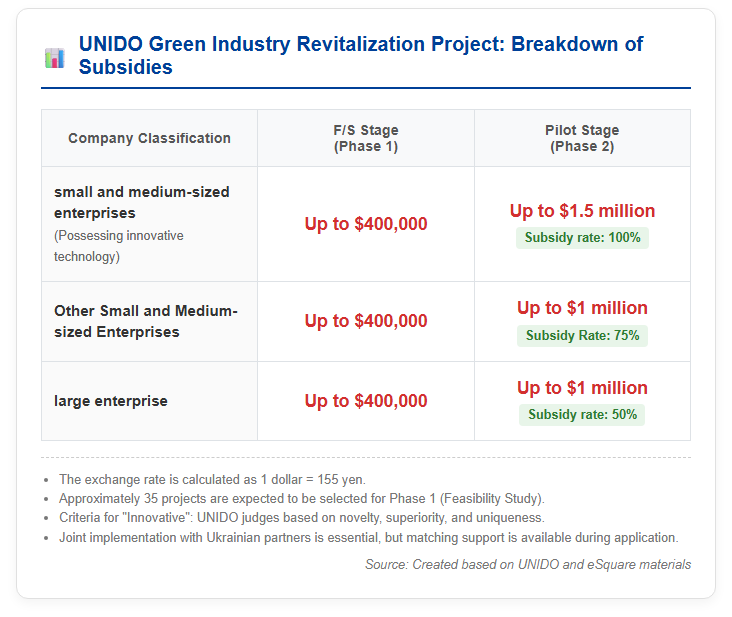
SMEs and startups with unique technologies are also actively engaged. On June 17, 2026, Soliton Systems signed a memorandum of understanding with the United Nations Development Programme (UNDP) to begin demonstrations aimed at promoting and implementing remote construction machinery technology. In the medical field, Agar Co., Ltd. is tackling social issues related to war-related damage, such as introducing digital treatments for PTSD (post-traumatic stress disorder) using VR. UNIDO’s open call allows applications even without a local partner, and the Ukrainian Ministry of Economy has established a system to support matching. This has given many Japanese companies the opportunity to take on business creation in new markets. Please refer to the diagram below.
Collaboration with International Financial Institutions and Legal Frameworks
Financial Stability Support through the World Bank
Japan also plays a central role in financial support through international organizations. On March 26, 2024, the World Bank Board approved a $1.5 billion Development Policy Operation (DPO) for Ukraine. In this project, Japan’s Ministry of Finance has provided $984 million in credit guarantees, making it part of a key international support package to meet Ukraine’s funding needs in 2024. This funding is intended to support structural reforms such as strengthening governance of state-owned enterprises, reforming the energy market, and promoting credit to the agricultural sector. In this way, not only direct investment but also support for macroeconomic stabilization ensures an environment where private companies can enter with confidence.
Anti-corruption measures to improve the investment environment
Regarding corruption, considered the biggest barrier to attracting foreign investment, the Ukrainian government is accelerating legal development. On July 31, 2025, President Zelensky signed a bill restoring and guaranteeing the independence of the National Anti-Corruption Service (NABU) and the Special Anti-Corruption Prosecutor’s Office (SAPO). This is a mandatory reform aimed at EU membership and has been highly praised by the European Commission. Strict measures to eliminate external interference were also explained, such as introducing polygraph inspections for staff with relatives in Russia. These reforms aim to provide overseas investors, including Japanese companies, with a highly transparent market environment, marking a milestone in enhancing the safety of medium- to long-term investments.
Future Outlook and Business Potential
Passing down Japan’s postwar reconstruction experience
The Ukrainian government is deeply interested in Japan’s miraculous postwar recovery experience after World War II. The Foreign Ministry spokesperson called Japan’s reconstruction method a “remarkable phenomenon” and expressed a desire to apply its insights to the largest reconstruction project in Europe of this century. Based on Japan’s long-cultivated philosophy of “creative reconstruction,” Hyogo Prefecture has begun supporting reconstruction at the municipal level, such as signing memorandums of understanding with Mikuliu and Ivano-Frankivsk regions. The process of not merely rebuilding facilities but adapting Japanese experience locally has become the key to building strong trust between Japanese companies and Ukraine.
Expectations as a gateway to the European market
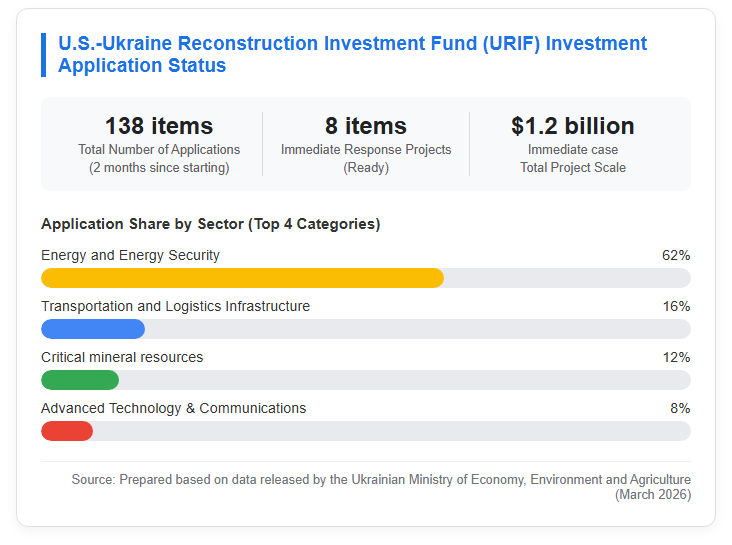
The future focus will be on the signing of concrete investment contracts that will begin in earnest from 2026. The U.S.-Ukraine Reconstruction Investment Fund (URIF) received 138 investment project applications within two months of the start of acceptance, of which 8 projects (with a total project scale of 1.2 billion dollars) have entered the concrete preparation stage. For Japanese companies as well, Ukraine is not just a recipient of aid; its value as a strategic base for the European market, with advanced IT talent and abundant resources, is increasing. Rather than waiting for the war to end, participating in the ongoing recovery process is expected to build a new business model with a postwar perspective. Please refer to the diagram below.


コメント