OpenAI, in collaboration with Harvard University, has released a detailed survey on ChatGPT usage by users. As of September 2025, with over 700 million weekly active users, it has become clear that half of the users’ purposes are information gathering, and the gender gap among users is being eliminated.
- Reached 700 million weekly active users
- Correcting disparities by region and income
- Analysis based on three categories: ‘Question, Execution, and Expression’
- The boundary between personal life and work use
- Accelerating enterprise adoption and expanding partnerships
- Future Focus and Organizational Challenges
Reached 700 million weekly active users
According to a survey released by OpenAI on September 15, 2025, the weekly active users (WAU) of ChatGPT’s consumer plans (Free, Plus, Pro) have seen remarkable growth. Within one year of its launch in November 2022, the service surpassed 100 million users, and by July 2025, it had exceeded 700 million users. This figure of 700 million represents a massive scale, equivalent to about 10% of the world’s adult population. This analysis was conducted in collaboration with Harvard University, based on over 1.5 million conversational data points. The chart below visualizes the trend in the number of users from the launch of the service to the present.
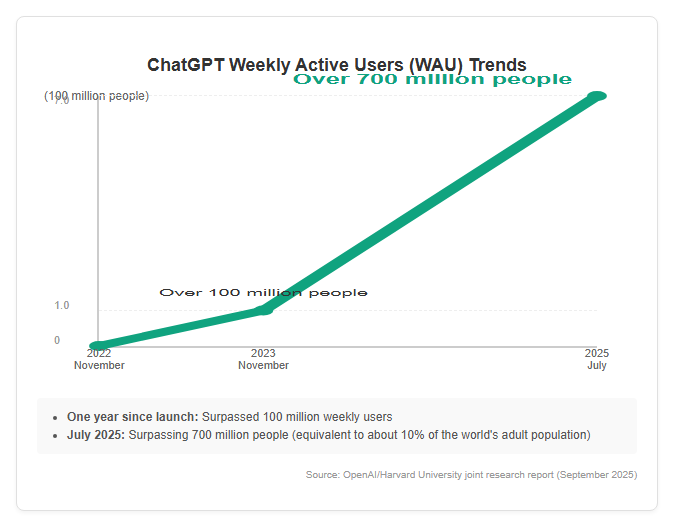
The explosive increase in user numbers suggests that AI is becoming more established as global infrastructure than just a temporary trend. In particular, the speed at which one in ten adults worldwide used it in just about two and a half years after launch is an extremely unusual pace compared to past social media platforms.
Correcting disparities by region and income
What stands out in this survey is that AI usage is diversifying globally, not limited to specific developed countries or wealthy individuals. In particular, penetration has increased significantly in low- and middle-income countries where per capita GDP ranges from $10,000 to $40,000, indicating that regional disparities are narrowing. OpenAI views this situation as a positive trend as the global adoption of AI is approaching, as the digital divide is being resolved and its penetration among diverse user groups is advancing.
There is also a noticeable shift in user attributes. At the start of the service, there was a bias in the user base, but as of July 2025, data shows that 52% of users have feminine names. As a result, it is analyzed that the gender gap seen in early AI usage has been almost eliminated. Data has confirmed that a wide range of people, regardless of income, region, or gender, are beginning to embrace ChatGPT as a daily tool.
Specific Uses and Actual Conditions of ChatGPT
Analysis based on three categories: ‘Question, Execution, and Expression’
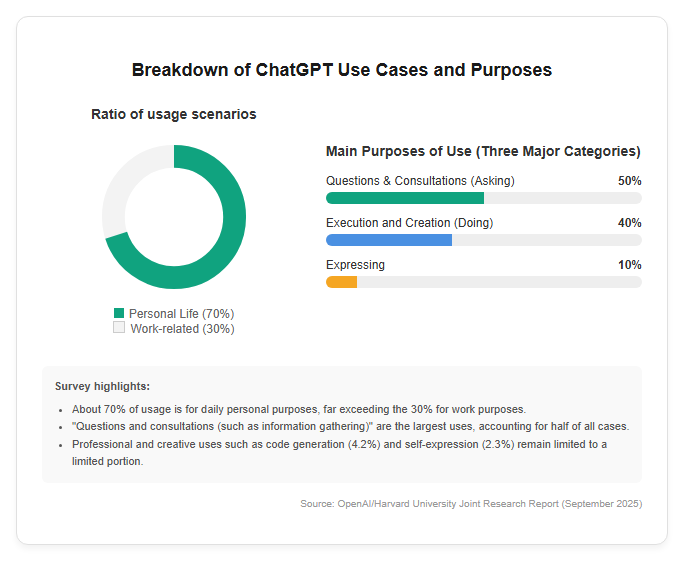
The survey categorizes and analyzes the purposes for which users use ChatGPT into three main categories: “Asking,” “Doing,” and “Expressing.” The analysis revealed that the most common use was “Asking,” which accounts for about half of the total, mainly for information gathering and daily consultations. Next is “Doing,” which includes practical tasks such as writing, planning, and programming, accounting for about 40%. On the other hand, ‘Expressing’ activities such as creation and play account for only about 10%.
Looking at the more detailed figures, the following characteristics emerge.
-
Information gathering and consultation (Asking): about 50%
-
Writing and Programming: about 40%
-
Creative and Entertainment (Expressing): about 10%
-
Code generation for specific purposes: 4.2%
-
Sending messages as self-expression: 2.3%
These results indicate that many users utilize ChatGPT as an “advanced search engine” or “close confidant,” while professional or creative uses such as programming and self-expression remain relatively minority.
The boundary between personal life and work use
Regarding the situations where ChatGPT is utilized, the ratio of personal life to work has also become clear. According to the survey, about 70% of overall usage is for personal life, while about 30% is related to work. In personal life, ChatGPT is used to solve trivial everyday questions and assist decision-making. On the other hand, in the work context, it has been reported to play a role in increasing productivity in knowledge-intensive tasks.
In particular, their value as a decision-making support tool is increasing, with more cases being used to organize complex information and gather judgment materials. The diagram below shows a breakdown of how ChatGPT is used in various everyday situations.
OpenAI predicts that with model improvements and new features, the scope and depth of use will expand even further in the future. Currently, the focus is on information acquisition and consultation, but in the future, as more creative activities and integration into advanced business processes progress, AI’s presence in both personal life and work is expected to grow even more.
Future developments and enterprise market trends
Accelerating enterprise adoption and expanding partnerships
OpenAI’s influence is expanding not only in the consumer market but also in the enterprise market. For example, Spain’s major bank BBVA signed a multi-year agreement to expand access to ChatGPT Enterprise from 11,000 employees to 120,000 employees. This is one of the largest examples of generative AI adoption in the financial services sector, and it is expected to be fully utilized for internal operations such as customer service, risk analysis, and software development.
Additionally, a strategic partnership with major payment provider Visa was announced. This enables secure payment functions within AI-powered shopping experiences, evolving AI assistants from mere conversational tools into infrastructure that directly supports commercial transactions. OpenAI is also advancing in-house hardware development, collaborating with Broadcom to develop the AI inference chip “Jalapeño.” This aims to reduce infrastructure costs and provide flexible responses to future demand growth.
Future Focus and Organizational Challenges
Regarding OpenAI’s future, alongside technological advancements, there is also significant attention on the organization’s structure and financial status. As of October 2024, the company has transformed into a massive enterprise valued at $157 billion. Going forward, discussions are underway about shifting from the current unique structure of “management by nonprofit organizations” to a model closer to that of general for-profit enterprises. There are reports that the initial public offering (IPO) will be postponed until after 2027, but Altman is reportedly considering a listing valued at $1 trillion.
Meanwhile, competition for market share with competitors is intensifying. In particular, research shows that in the enterprise market’s share of GenAI spending, competitor Anthropic captured 40%, surpassing OpenAI’s 27%. For OpenAI to maintain its leadership going forward, it is crucial not only to improve model performance but also to ensure safety (AI safety) and build a sustainable revenue model. The company’s efforts to balance accelerating development with a focus on the singularity (technological singularity) and social responsibility will remain a central global concern going forward.
[#OpenAI #ChatGPT #生成AI #AI利用実態 #テクノロジー #DX #データ分析 #人工知能]

コメント