A critical commentary in a specialized journal questioned the fundamental validity of the quantum computer technology Microsoft announced in 2025, questioning its validity at its core. Behind this lies a serious conflict between the credibility of the company’s 2029 practical roadmap and the transparency of research data.
- Shocking criticism published in Nature magazine
- At the heart of the criticism: Python code errors and data filtering
- Microsoft’s Rebuttal and Claims as a ‘Practical Tool’
- The high hurdle of “topological qubits”
- New Major Ana 2 Chip and Ambitious Goals for 2029
- Repeated patterns of paper retraction and verification scrutiny
- Future Focus: Third-Party Verification and the Future of National Strategy
Shocking criticism published in Nature magazine
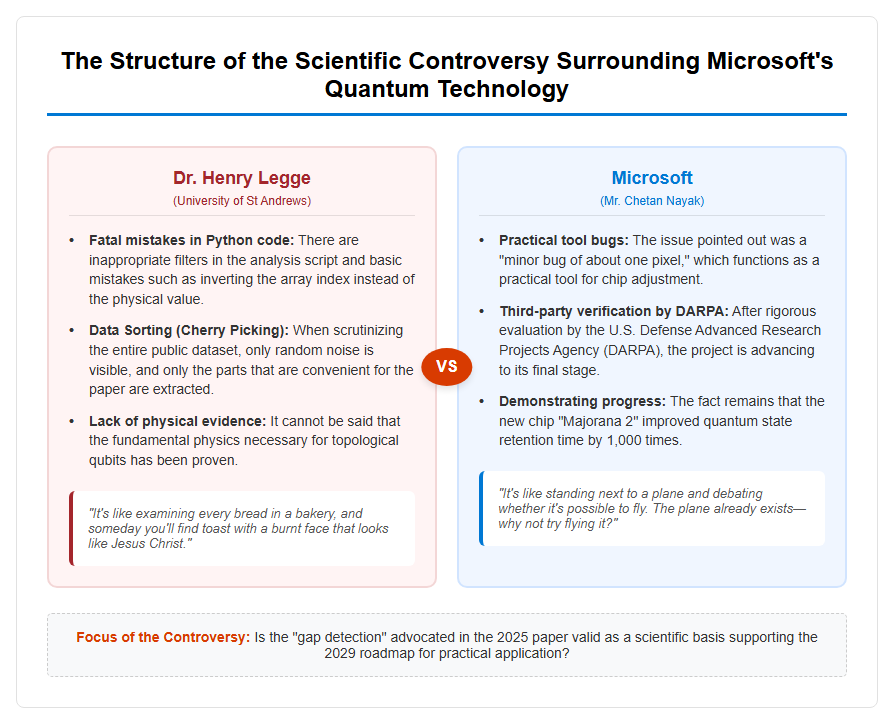
On June 24, 2026, Dr. Henry Legge of the University of St Andrews published an official objection to Microsoft’s quantum technology in the commentary section of the global journal Nature. This commentary targets Microsoft’s paper published in February 2025 in the same journal on detecting “gaps,” which underpins topological qubits. Dr. Legge pointed out that the software underlying Microsoft’s claims contains significant flaws, and that the published data does not indicate quantum progress but is merely random noise. This criticism, as Microsoft is touting a “1,000-fold increase in reliability” and accelerating its roadmap to commercialization through 2029, has shaken the very foundation of Microsoft’s technical foundation. The following diagram illustrates the structure of the current controversy.
At the heart of the criticism: Python code errors and data filtering
One specific issue Dr. Legge pointed out was the basic coding mistakes contained in the Python scripts used for data analysis. Specifically, specific filters were written directly into the code, hiding inconvenient measurement results and displaying only the largest topological regions. Additionally, in processing voltage data, a very basic error in physics research was found in reverting the array index rather than physical values. Furthermore, there is suspicion of ‘cherry picking,’ where only successful results are extracted from experimental data and noisy failed data are excluded. Dr. Legge sharply criticizes this situation with a sharp metaphor, saying that if you examine every bread in a bakery, one day you will find toast with a burnt face that looks like Jesus Christ.
Microsoft’s Rebuttal and Claims as a ‘Practical Tool’
In response to these criticisms, Microsoft immediately responded in the same journal Nature. Chetan Nayak, the company’s head of quantum hardware, dismissed the pointed coding issues as “minor bugs with a one-pixel shift” and did not influence the study’s conclusions. Microsoft claims that the software was designed not as a rigorous diagnostic tool for scientific proof, but as a ‘practical tuning tool’ for tuning actual chips. Mr. Nayak likened the current use of this tool daily for chip setup to standing next to an airplane debating whether it can fly, emphasizing that the technology is already in the practical stage. Additionally, independent verification by the U.S. Defense Advanced Research Projects Agency (DARPA) has led the project to its final stage, citing its legitimacy as evidence.
Technical background and Microsoft’s unique approach
The high hurdle of “topological qubits”
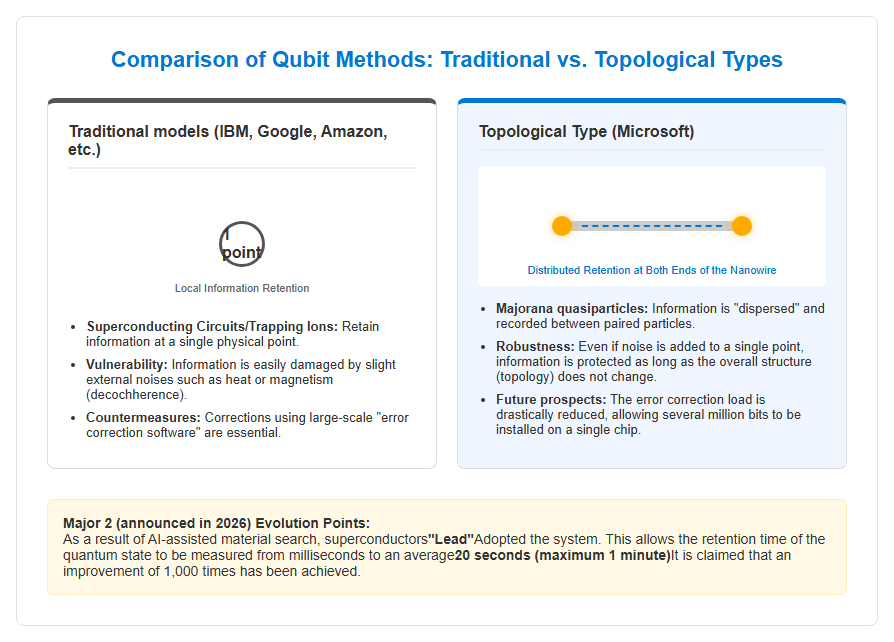
The “topological qubit” pursued by Microsoft is an extremely ambitious approach fundamentally different from the methods adopted by IBM and Google. This method utilizes the special properties of quassiparticles called ‘Majorana particles,’ which are also their own antiparticles. In theory, quantum information is distributed and stored at both ends of the nanowire rather than at a single point, giving it extremely high resistance to external noise such as heat and vibration. If successful, large-scale calculations with far fewer error corrections than existing methods would be possible, but the biggest problem is that no one has definitively proven that these Majorana particles exist in a useful form within real structures. This current debate is about whether this “physical reality” can be confirmed. For details on how the technology works, please refer to the diagram below.
New Major Ana 2 Chip and Ambitious Goals for 2029
Amid mounting criticism, Microsoft announced its second-generation quantum chip, the “Majorana 2,” in June 2026. This chip uses a unique approach by replacing traditional aluminum with “lead,” discovered using AI, as the superconducting material. The company claims that with this new chip, qubit stability can reach an average of 20 seconds, with some cases reaching 1 minute, achieving a 1,000-fold improvement over millisecond-level speeds of the original chip. Building on this achievement, Microsoft set the timeline for practical application—a date it had previously avoided—as “2029,” highlighting that it is on par with competitors like IBM. However, critics have taken a skeptical look, saying that “Majorana 2” is still just a prototype of a single device and that there is no evidence showing it is a genuine qubit capable of maintaining a superposition state.
Scientific Reliability and Future Developments
Repeated patterns of paper retraction and verification scrutiny
The harsh scrutiny of Microsoft’s quantum research lies in its bitter past. A paper on the Majorana particle published in Nature in 2018 was retracted in 2021 due to data shortcomings. Furthermore, other major journals such as Science have repeatedly issued editorial warnings about the company’s research. In response to this fifth serious criticism overall, the scientific community has voiced that “Microsoft’s claims lack a solid foundation based on a series of reliable experiments.” The gap between flashy press releases from large corporations and the scientific evidence that passes peer review has emerged as a major challenge in current advanced technology development.
Future Focus: Third-Party Verification and the Future of National Strategy
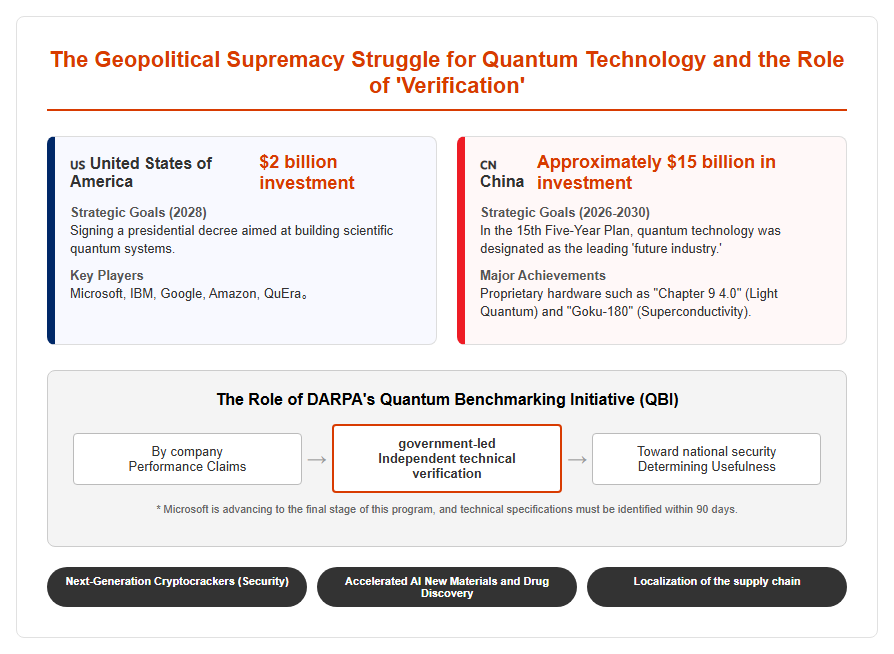
Quantum computing has now gone beyond mere academic interest and has become a top national security priority. The U.S. government has invested about $2 billion, aiming to build a practical quantum system by 2028. DARPA’s “Quantum Benchmarking Initiative,” in which Microsoft participates, is precisely a program for governments to independently verify whether corporate claims are true. Technical specifications scheduled for release within 90 days, as well as replication experiments by independent research institutions, will be key to determining whether Microsoft’s 2029 roadmap is “reality” or “illusion.” The geopolitical significance of quantum technology is illustrated in the diagram below.
[#量子コンピューティング #Microsoft #マヨラナ粒子 #科学検証 #Nature #先端技術 #Python #ロードマップ]


コメント