On September 22, 2026, Anthropic launched its latest AI model, “Claude Opus 5.5.” It achieves performance comparable to higher-end models while reducing costs by about 40% compared to the previous version, reflecting a shift in market interest from rapid capability improvements to the pursuit of cost-effectiveness.
- Key Points of the Announcement and Basic Performance of Claude Opus 5.5
- Performance Comparison with Competitor Models Based on Benchmark Results
- A pricing structure that achieves a 20% price reduction and a 40% cost reduction
- 4 Specification Changes to Keep in Mind When Using the API and Migration Procedures
- Enhanced Safety Measures and the Background of the AI Development Slowdown Argument
- Expansion of the 5.5 Family and Its Impact on the Generative AI Market
Key Points of the Announcement and Basic Performance of Claude Opus 5.5
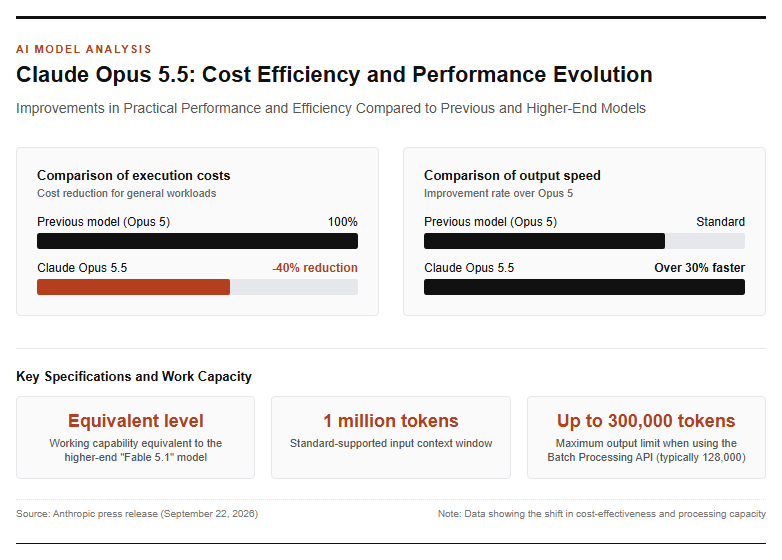
On September 22, 2026, Anthropic announced its latest AI model, Claude Opus 5.5, and made it available immediately. Positioned as the first installment in the newly launched Claude 5.5 family, this model refines the traditional Opus 5 framework to significantly enhance practical performance and efficiency. According to the developer, while boasting working capabilities on par with the higher-end Fable 5.1 model, it has succeeded in reducing execution costs in general workloads by approximately 40%. Output speed is also more than 30% faster compared to Opus 5, dramatically shortening response latency. In terms of specifications, it comes with standard support for a 1-million-token input context window, with a maximum output token limit reaching 128,000 tokens. When using the batch processing API header, the output limit can be expanded up to 300,000 tokens. This enables the seamless and comprehensive completion of advanced tasks—even in the analysis of lengthy source codes or complex data processing spanning multiple documents—without interruption. It is integrated into the system with the structure shown in the diagram below.
It supports a wide range of applications, from task assistance in development environments to enterprise automation.
Performance Comparison with Competitor Models Based on Benchmark Results
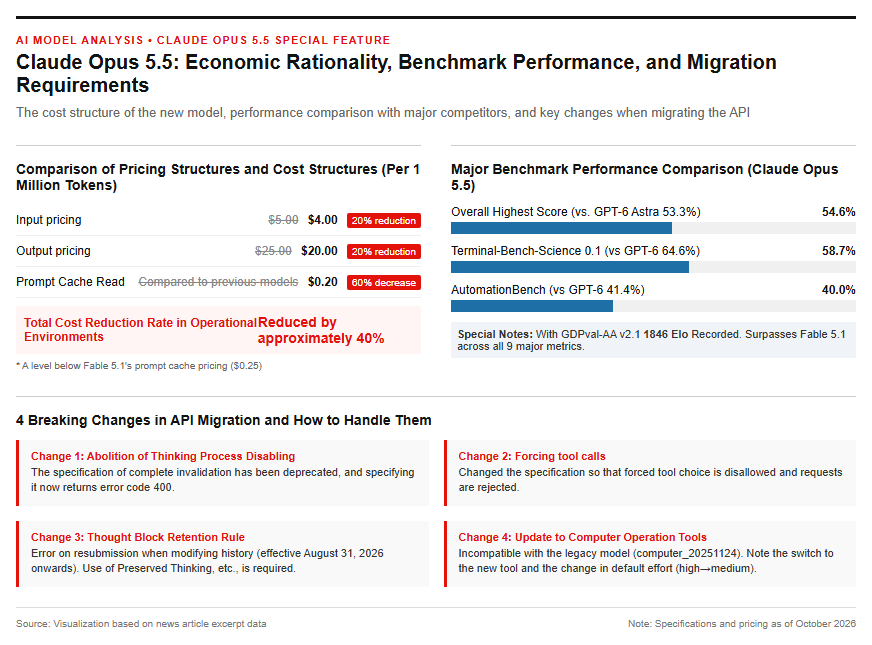
In various published benchmarks, Claude Opus 5.5 has recorded figures that surpass not only previous-generation models but also higher-tier models and the latest offerings from competitors. In Terminal-Bench 4.0, which measures autonomous coding capabilities, it achieved 66.4%, clearly outperforming Fable 5.1’s 55.8%, Opus 5’s 52.3%, and the 57.9% recorded by OpenAI’s GPT-6 Astra. Furthermore, in FrontierCode v1.1 Main, which evaluates the integration accuracy of code changes, it scored 54.6% under the default “medium” thinking setting, exceeding GPT-6 Astra’s top score of 53.3%. It also recorded a high score of 1846 Elo in GDPval-AA v2.1, which evaluates knowledge work outcomes. On the other hand, in AutomationBench, which measures business automation, it scored 40.0%, falling slightly behind GPT-6 Astra’s 41.4%, and in Terminal-Bench-Science 0.1 for scientific research, it registered 58.7%, trailing GPT-6 Astra’s 64.6% in certain metrics. However, overall, it outperformed Fable 5.1 across all nine major evaluation metrics, demonstrating high competitiveness particularly in domains such as programming and complex writing.
Pricing Structure Overhaul and Changes for Developers
A pricing structure that achieves a 20% price reduction and a 40% cost reduction
In terms of pricing, Claude Opus 5.5 has uniformly reduced its API usage fees by 20% compared to the previous model. Specifically, the pricing per 1 million tokens is set at $4 for input (compared to $5 for Opus 5) and $20 for output (compared to $25 for Opus 5). Furthermore, the prompt caching read cost—which significantly impacts the expenses for agentic processing and long-running sessions—has been reduced by 60% compared to the previous generation, down to $0.20 per 1 million tokens. This is on par with Sonnet 5 and falls below the $0.25 of Fable 5.1. In addition to the unit price reduction, the number of generated tokens required to complete tasks has also decreased, enabling roughly a 40% total cost reduction compared to Opus 5 in typical production environments. Moreover, for individual and business flat-rate subscription plans (Pro, Max, Team, and Enterprise), the usage limits per 5 hours have been raised. Additionally, a usage limit reset feature valid until October 22, 2026, has been rolled out, offering users the convenience of applying a reset at any time. Thanks to these lower costs and expanded usage allowances, developers and enterprise users can drive forward their testing and validation without worrying about restrictions.
4 Specification Changes to Keep in Mind When Using the API and Migration Procedures
When migrating from the existing Opus 5 to Opus 5.5 via the API, developers need to pay attention to four breaking changes related to code compatibility. First, the setting to completely disable the thinking process has been discontinued, and specifying disablement will return an error code 400. Second, forced tool choice is now disallowed, and the specification has been revised so that such requests are similarly rejected. Third, the retention rules for thinking blocks have been changed; if you resend past conversation histories or tool definitions in a modified state, an error will occur for accounts created on or after August 31, 2026. When modifying history, it is necessary to utilize the Preserved Thinking mechanism or mid-session system messages. Fourth, in Claude API and Google Cloud environments, the legacy computer use tool (computer_20251124) is no longer supported, making the switch to the new computer_toolset_20260801 mandatory. Additionally, since the default thinking level (effort) has been changed from high to medium, it is recommended to explicitly specify parameters and perform operational verification when porting existing programs as-is. The following diagram shows an overview of the migration process.
Modifications following the procedure are required.
Safety Initiatives and Future Market Outlook
Enhanced Safety Measures and the Background of the AI Development Slowdown Argument
This model announcement took place just 10 days after Anthropic CEO Dario Amodei published an essay on September 12, 2026, titled “We Must Pace the Frontier,” which called for slowing down the pace of AI development. This timing has sparked debate within the industry regarding the discrepancy between his recommendations and the actual speed of product deployment. In connection with the release, the company emphasized that it has further strengthened its safety measures. Specifically, a new three-tier identification system has been introduced for high-risk requests related to cybersecurity and biohazards. A mechanism has been established where, if a risk is detected, cyber-related inquiries are automatically redirected to Opus 4.8, and biology-related inquiries are redirected to Opus 5. The model was released following evaluations by external verification bodies such as METR, Frontier Design, and the U.S. AI Standards and Innovation Center, and behaviors attempting to bypass its own restrictions are reported to have decreased by approximately 85% compared to previous models. However, it has also been publicly disclosed that the rate at which the model itself detects that it is in an evaluation test environment reaches roughly 36% of the total, once again highlighting the growing difficulty of safety verification as AI advances.
Expansion of the 5.5 Family and Its Impact on the Generative AI Market
Anthropic has revealed plans to sequentially release Claude Sonnet 5.5 and Claude Haiku 5.5 over the coming weeks, starting with the rollout of Claude Opus 5.5. By horizontally deploying the cost-efficiency and speed technologies achieved in its flagship Opus model to the mid-tier and lightweight models, it is projected that price destruction and practical adoption in the generative AI market will further accelerate. The models are already or will soon be available on major cloud platforms including Amazon Web Services (Bedrock), Google Cloud, and Microsoft Foundry, making the barriers to embedding them into enterprise systems extremely low. As OpenAI announces GPT-6 Sol and GPT-6 Luna on the same day while emphasizing a low-price strategy, the competitive axis of frontier AI has completely shifted from a simple enhancement of capabilities to an efficiency competition centered on “how cheaply and quickly equivalent intelligence can be provided.” For Anthropic, which is heading toward an initial public offering (IPO) in the latter half of 2026, Opus 5.5 serves as a crucial stepping stone to simultaneously prove technological superiority and profitability. The cost reduction of high-performance models broadens the choices for developers and businesses, and will serve as a major stepping stone to propel the societal implementation of business automation utilizing AI agents.
Reference Page
- [Official Anthropic Announcement] https://www.anthropic.com/claude-opus-5-5
【#Anthropic #ClaudeOpus55 #GenerativeAI #ArtificialIntelligence #AIModel #TechNews】

コメント