Ricoh is strengthening its efforts to implement “multi-skilled humanoids” that autonomously perform physical tasks. The background is to evolve the OA philosophy of ‘leaving what machines can do to machines,’ which has continued since 1977, using the latest physical AI technology.
- The philosophy of ‘What machines can do is done by machines’ philosophy since 1977
- Transition to “Physical AI” that understands and acts in the real world
- Achievement of 72% production automation rate achieved at the Atsugi Plant
- “NEXTAGE” coexists with people and flexible control with 15 axes
- Safety regulations and humanoid legislation in 2026
- Global Major Account Strategy Targeting 6,000 Companies Worldwide
The philosophy of ‘What machines can do is done by machines’ philosophy since 1977
Ricoh is intensifying its challenge to realize a “multi-skilled humanoid” that autonomously handles a variety of tasks. At the heart of this movement is the concept of “Office Automation (OA),” which the company first proposed in the world in 1977. At the time, Ricoh’s slogan, “Leave what machines can do to machines, and let humans do more creative work,” has, after nearly half a century, entered a new phase in today’s era where AI and robotics have converged. Mr. Risa, President of Ricoh Digital Services, stated that the future of “working” aims to be a state where people are freed from simple tasks and can express their unique creativity and gain a sense of accomplishment. By 2026, the company expects that the era of “physical AI,” which will go beyond generative AI writing and image generation, will fully enter through robots and autonomous systems that understand the real world and actually operate. As companies rapidly transform from simple office equipment manufacturers to “workplace DX companies,” humanoids—which complement physical labor—have become a crucial piece of the puzzle in Ricoh’s vision for the “future of work.”
Transition to “Physical AI” that understands and acts in the real world
Ricoh’s goal is not just to be a robot that repeats programmed actions, but to be a humanoid as a ‘physical AI’ that can independently assess the situation on site. Chairman Yamashita points out that the idea of leaving what AI can do to AI is in Ricoh’s DNA, and that AI’s evolution is an extension of that philosophy. The image processing and optical technologies Ricoh has cultivated so far serve as the robot’s “eyes” to perceive their surroundings, and when combined with the latest large language models (LLMs), advanced autonomy is achieved. For example, even vague commands like “Take that,” which were difficult for conventional robots to handle, are envisioned in a future where finger movements and the position of objects are read in real time to perform appropriate physical tasks. This is a truly interactive form of AI utilization that does not require keyboards or prompt input. In this way, by implementing digital intelligence into physical bodies (robots), it is expected to be utilized as a versatile worker to solve labor shortages in all kinds of workplaces, such as offices, factories, and even logistics sites. Please refer to the diagram below.
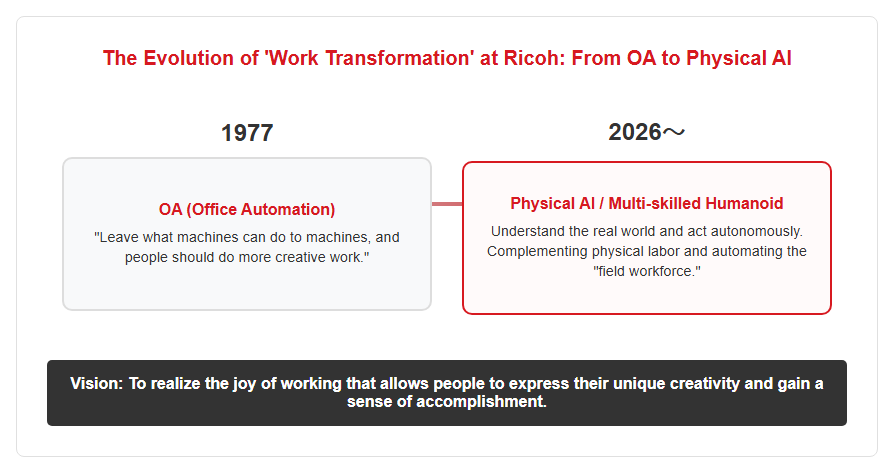
[Technical Basis] Multi-skilled Workers on Site Using Autonomous Robots
Achievement of 72% production automation rate achieved at the Atsugi Plant
Ricoh’s robot utilization is not just an ideal; advanced practices are already being implemented in its own factories. At Ricoh Industry Atsugi Plant, cutting-edge automation technology has been introduced in the assembly process of key units, which are the heart of copiers. According to a report as of March 2021, the production automation rate at the facility has reached 72%, with about 200 robots operating across the entire line. Here, the challenge has been how robots can respond to unexpected changes that humans would easily notice. Ricoh continues to question the current situation, “Is this really okay?” and maintains a highly efficient production system by predicting anomalies based on data management and analysis. Notably, under harsh conditions where even one stop would halt the entire line, they have thoroughly implemented preventive maintenance and achieved quality improvement by eliminating personal dependence. The automation know-how gained at the Atsugi plant is planned for global expansion and is expected to play a central role in manufacturing reform across the entire Ricoh Group. This proven track record of “overutilization” within the company is a strong source of persuasiveness in providing solutions to customers.
“NEXTAGE” coexists with people and flexible control with 15 axes
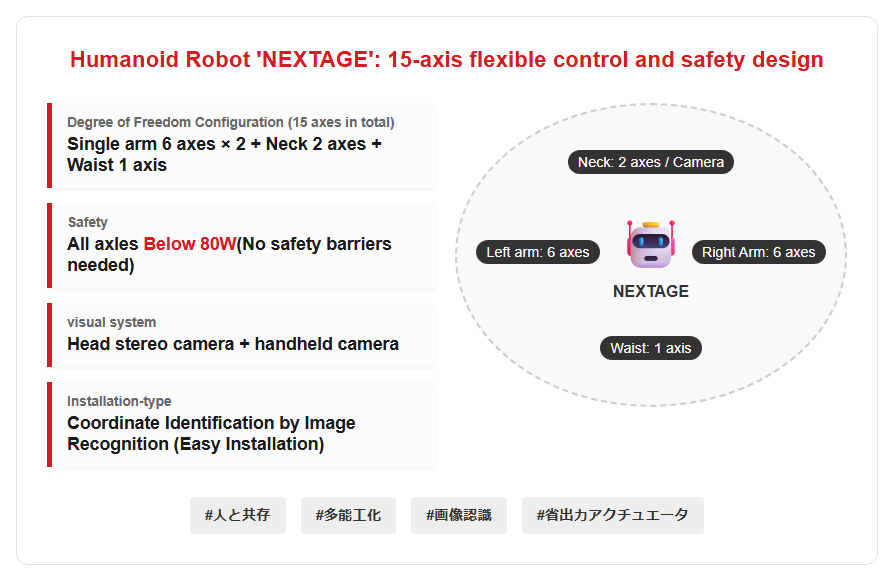
One of the robot technologies Ricoh is promoting is the humanoid robot “NEXTAGE,” developed by Kawada Robotics. Unlike conventional industrial robots that operate in isolated spaces enclosed by safety fences, this robot is designed with the premise of “collaborating” within the same space as humans. NEXTAGE features 15 moving axes: two axes on one arm (six axes), two axes on the head, and one axis on the waist, allowing it to work at speeds and power comparable to humans. All movable shafts are made up of low-output actuators under 80W, ensuring safety even in the event of contact, and operation without regulatory safety barriers. Furthermore, the stereo camera mounted on the head can accurately recognize the surrounding environment and the position of objects, enabling a “multi-skilled” approach where robots are moved to work in different processes. Leveraging the unique versatility of these humanoid robots, Ricoh aims to streamline labor-intensive processes not only for assembling and inspecting electrical and electronic components, but also for picking in cosmetics, pharmaceuticals, and logistics warehouses. By dividing tasks between humans and robots and redefining roles, an approach is being taken to maximize productivity on site. Please refer to the diagram below.
[Future Outlook] The Future of ‘Work’ Pioneered by Workplace OS
Safety regulations and humanoid legislation in 2026
As humanoid robots permeate society, 2026 marks a significant turning point in legal development and the formulation of safety standards. Currently, there is no comprehensive global law specifically for humanoids; existing industrial robot standards (such as ISO 10218) are applied mutatis mutandis. However, since humanoids walk and operate autonomously in the same space as humans, it has been pointed out that conventional fixed arm standards are insufficient. In Japan as well, the Ministry of Economy, Trade and Industry and the Ministry of Health, Labour and Welfare are scheduled to publish provisional safety guidelines for autonomous mobile robots, including humanoids, by fiscal year 2026. In particular, the responsibility for accidents caused by “AI misjudgments” (whether the manufacturer, the AI model provider, or the operating company) is a major focus of debate, including the PL Act (Product Liability Act). In Europe, the EU AI Regulation Act (AI Act) has already been enforced, and many of humanoids’ AI judgments are expected to be classified as “high-risk AI.” For global companies like Ricoh, regulatory compliance in these countries is an unavoidable challenge, and the demand for “robot safety managers,” professionals in safety management, is rapidly increasing.
Global Major Account Strategy Targeting 6,000 Companies Worldwide
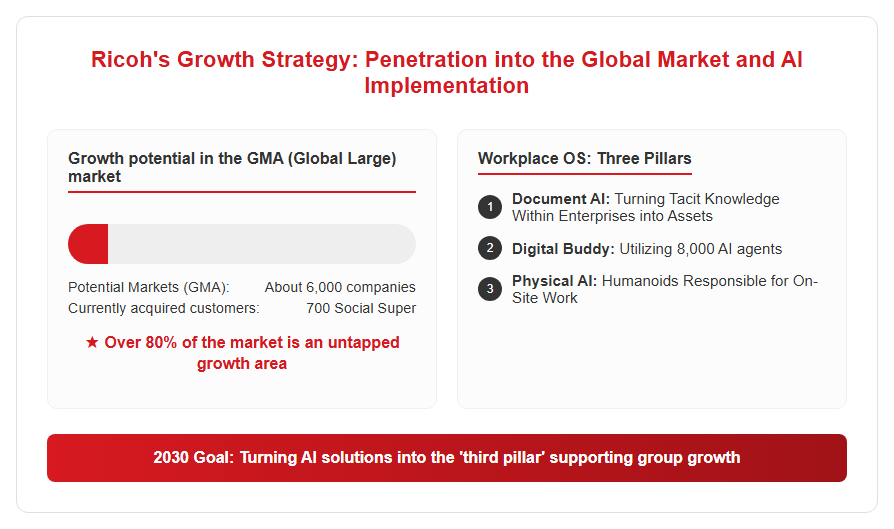
Ricoh envisions a global deployment of AI and humanoid technologies not just as tools, but as ‘workplace OS’ supporting corporate workplaces. The company is focusing on a major customer market called “GMA (Global Major Account),” where it operates across countries. According to Ricoh’s research, there are about 6,000 companies available to enter the global market, but currently only over 700 companies—just over 20% of the market—have been acquired, leaving enormous room for growth. Ricoh is accelerating solutions that combine its strength of 1.4 million customer bases with AI technologies from natif.ai companies acquired in 2024, turning vast amounts of ‘tacit knowledge’ dormant within companies into assets through AI. Looking ahead, the goal is to create a future where multiple AIs collaborate as “multi-AI agents” and humanoids performing physical tasks become partners integrated into daily office life as “digital buddies.” By 2030, the company plans to make these AI-related businesses one of the pillars supporting Ricoh’s growth, leveraging its strength in hardware manufacturing capabilities to establish itself as a “field-strong AI implementation company,” distinct from competing IT companies. Please refer to the diagram below.
[#リコー #ヒューマノイド #フィジカルAI #ワークプレイスDX #ロボティクス #生産自動化 #生成AI #2026年]

コメント