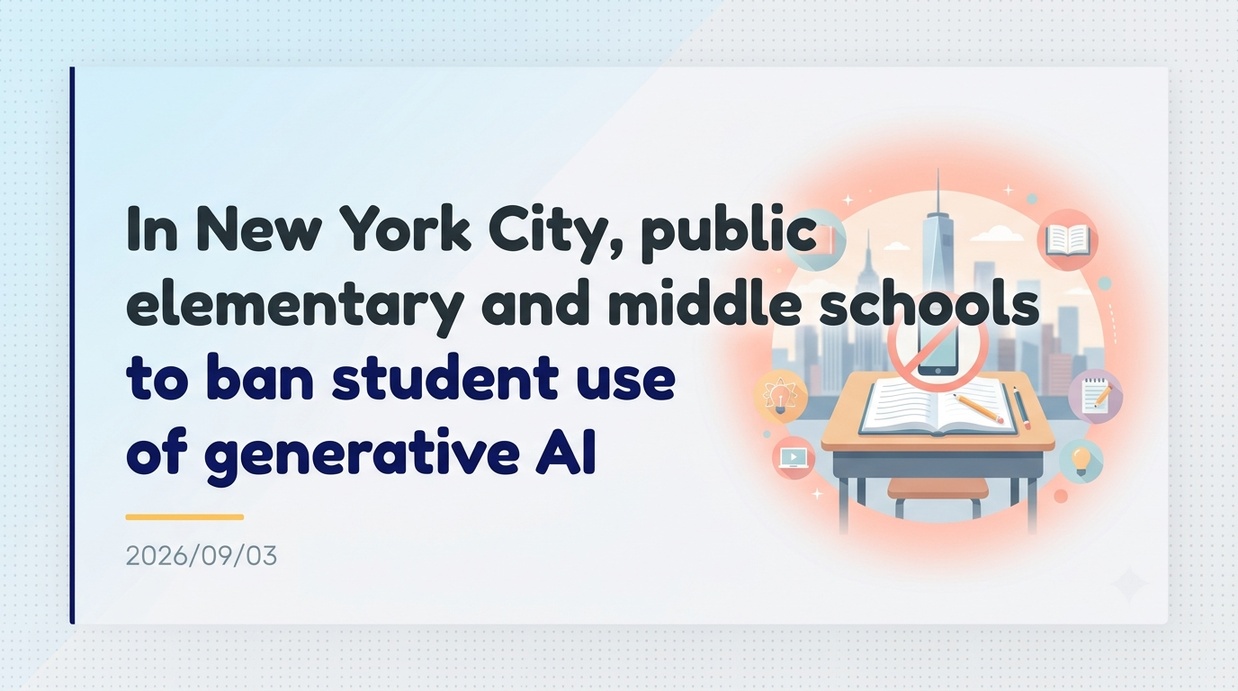
New York City public schools have issued a sweeping ban on student use of generative AI in elementary and middle schools. The decision stems from deep-seated concerns regarding children’s cognitive development and growing demands for student data privacy.
- A Comprehensive One-Year Moratorium for the 2026–2027 School Year
- A Differentiated, Graduated Approach for High Schoolers
- Guarding Against Cognitive Surrender in Early Development
- Intense Grassroots Lobbying by Parents and Advocacy Groups
- Reversing Course After a Trepidatious Policy Trajectory
- High-Profile Failures and the Threat of Unconsented Data Mining
- Technical Purges of Educational Software and Grading Bans
- Severe Screen Time Restrictions and EdTech Market Shocks
- Post-Moratorium Evaluation and the Strategic Task Force
- Standing as a Global Outlier in Digital Education Policy
A Comprehensive One-Year Moratorium for the 2026–2027 School Year
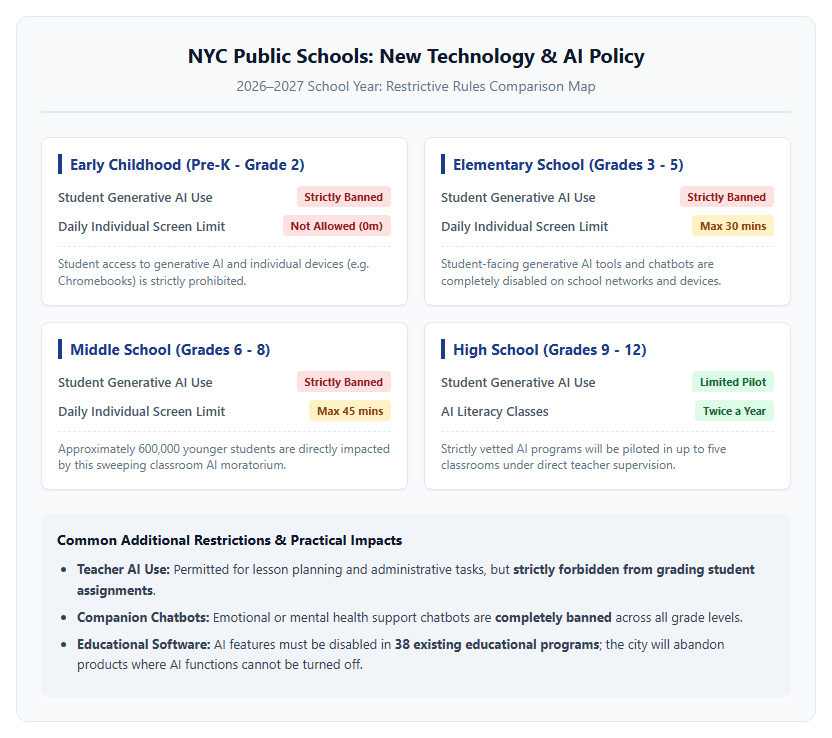
On September 2, 2026, the New York City Department of Education announced a sweeping one-year moratorium banning student-facing generative AI tools for the upcoming 2026–2027 school year. This prohibition affects approximately 600,000 students from pre-kindergarten (2-K) through the eighth grade. As the nation’s largest school district with around 900,000 total students, this move restricts access for roughly two-thirds of its student population, making it the most restrictive classroom technology policy in the country. Mayor Zohran Mamdani officially announced the decision at a press conference in Brooklyn, directly rejecting the tech industry’s premise that AI integration in early education is either inevitable or necessary. Scheduled to take effect with the start of the school year on September 10, 2026, this landmark policy is expected to redefine the boundary between emerging technology and foundational learning across public classrooms.
A Differentiated, Graduated Approach for High Schoolers
In contrast to the blanket ban imposed on younger students, New York City is adopting a graduated educational strategy for high school students in grades 9 through 12. Mayor Mamdani emphasized that older teenagers already navigate an AI-saturated world, and that pretending these tools do not exist would be an irresponsible way to prepare them for the future. Consequently, high schools will mandate a twice-yearly AI literacy curriculum focusing on critical thinking, helping students evaluate algorithmic outputs objectively before they become overly dependent on them. Furthermore, the school district will launch highly controlled pilot programs in up to five high school classrooms using strictly vetted educational AI platforms under direct teacher supervision. These platforms—including Quill for English instruction, Edia for mathematics, Brisk Teaching for guided learning, and Playlab and Intel AI-Ready Schools for multi-disciplinary studies—have been selected under strict guidelines that mandate usage time limits to ensure students remain the primary thinkers.
Underlying Educational Concerns and Grassroots Pushback
Guarding Against Cognitive Surrender in Early Development
The primary driver behind the elementary and middle school ban is a profound concern among educators, parents, and researchers regarding the psychological and developmental impacts of AI on young minds. Chief among these is the risk of cognitive surrender, a psychological phenomenon where students outsource their critical thinking, reasoning, and problem-solving processes to automated software. Schools Chancellor Kamar Samuels emphasized that innovation should not be conflated with merely introducing more classroom technology. He argued that children must learn to wrestle with complex problems independently, collaborate with their peers, and form authentic relationships with human educators to truly grow. Proponents of the ban assert that safeguarding these irreplaceable human connections and foundational learning processes is essential to preventing early-stage developmental deficits that cannot easily be undone.
Intense Grassroots Lobbying by Parents and Advocacy Groups
The moratorium represents a significant victory for local advocacy groups, parents, and teachers who mounted aggressive grassroots campaigns against premature AI integration. Organizations like the NYC-based AIM Coalition had actively petitioned the Department of Education for a suspension of generative AI in public classrooms, collecting thousands of parent signatures. Many parents expressed intense anxiety over subjecting their children to opaque algorithmic systems that are poorly understood and difficult to control, particularly after the Department of Education began finalizing its formal AI roadmap in May 2026. Upon the announcement of the new policy, AIM Coalition member Alexis Kaloyanides characterized the moratorium as a vital first step, though she emphasized that the broader battle to eliminate unregulated technological risks from public school classrooms remains ongoing. The following chart illustrates the sentiment surrounding AI in schools nationwide.
A Turbulent Regulatory History and Hidden Cybersecurity Risks
Reversing Course After a Trepidatious Policy Trajectory
This new moratorium marks a dramatic shift in New York City’s erratic history of regulating artificial intelligence. In 2023, the city initially banned ChatGPT on its school networks, only for former Schools Chancellor David Banks to lift the ban months later. Banks argued at the time that a knee-jerk fear of the technology overlooked its immense potential to support classroom debates and assist educators with lesson planning. This led to a more permissive framework published in March 2026, which allowed students to use generative AI for research, creative exploration, and academic projects under teacher supervision. However, this lenient guidelines package sparked massive outrage among parents and teachers who felt the policy left classrooms exposed. Chancellor Samuels ultimately admitted that the district had missed the mark in its initial communication, paving the way for the current total temporary ban as a corrective measure.
High-Profile Failures and the Threat of Unconsented Data Mining
Severe technological failures in other school districts and growing alarm over student data privacy also forced the city’s hand. Educators pointed to the catastrophic failure in the Los Angeles Unified School District, which spent millions on an AI-powered student assistant chatbot named Ed only for the developer to suddenly collapse into bankruptcy, triggering an ongoing FBI fraud investigation. Locally, a joint City Council hearing in June 2026 exposed that Google’s Gemini chatbot had been pre-installed on school-issued Chromebooks, allowing elementary school students to interact with the AI without parental consent. Independent evaluations subsequently ranked Gemini as one of the least safe AI applications for children. These issues, combined with the refusal of the Department of Education’s Chief Privacy Officer to publicly disclose data-processing agreements with AI vendors, raised critical red flags regarding corporate data-mining and systemic algorithmic bias.
Direct Classroom Constraints and Commercial Ramifications
Technical Purges of Educational Software and Grading Bans
The newly enacted moratorium goes far beyond a simple firewall block on web browsers. The Department of Education is actively auditing and altering its existing software contracts to completely disable student-facing generative AI capabilities. According to Irish Brady, an education adviser to the mayor, the city has already modified or cut 38 educational software programs due to their embedded AI features, entirely abandoning products where the AI functions cannot be deactivated. Furthermore, companion chatbots designed to offer psychological or mental health support to students are completely banned across all grade levels. To maintain human accountability and professional standards, teachers are also strictly forbidden from using AI tools to grade student assignments, although they may still utilize them for administrative tasks like lesson planning.
Severe Screen Time Restrictions and EdTech Market Shocks
To reinforce the AI ban, the Department of Education is enforcing strict screen-time limits: elementary students in grades 3 through 5 are restricted to 30 minutes of individual device use per day, while middle schoolers are capped at 45 minutes. Students below the third grade are prohibited from using individual screens entirely. While Michael Mulgrew, president of the United Federation of Teachers, praised these screen limits, he warned that the Department of Education must be more aggressive in auditing school-level, individual app purchases that may bypass citywide contracts. On a commercial level, this comprehensive ban deals a massive financial blow to educational technology startups. By locking edtech firms out of the nation’s largest school district, New York City has disrupted the growth strategies of numerous firms whose business models relied on rapid, unchecked classroom AI adoption.
Future Outlook and the Shifting Landscape of AI Governance
Post-Moratorium Evaluation and the Strategic Task Force
New York City officials view this one-year moratorium not as a permanent retreat from technology, but as a critical pause to gather empirical data and construct robust guardrails. The Department of Education will establish a joint task force consisting of teachers, union representatives, elected officials, and parental advocates to monitor the moratorium’s impact. This task force is scheduled to release a comprehensive assessment report in April 2027, which will serve as the factual foundation for the city’s permanent, long-term AI policies starting in the 2027–2028 school year. Mayor Mamdani framed the pause as a necessary investment to ensure the future of public education is built safely, methodically, and with proper oversight.
Standing as a Global Outlier in Digital Education Policy
By taking this conservative path, New York City has positioned itself as a major outlier in the rapidly evolving landscape of educational technology. While at least 37 states have issued loose AI guidelines and school districts like Broward County and Miami have rapidly integrated Microsoft Copilot and Google Gemini into classrooms, NYC’s moratorium sets up a massive natural experiment that the entire academic sector is watching closely. Internationally, however, New York’s policy aligns with a growing movement in European and Nordic countries—such as Sweden, Norway, and the Netherlands—where national governments have begun rolling back classroom screen time and restricting digital device usage to protect early childhood development. The success or failure of New York’s rigorous experiment could dictate whether public schools globally double down on algorithmic tutoring or return to human-centric instructional models.
References
- 【New York City Council – Int 0214-2024】https://legistar.council.nyc.gov/LegislationDetail.aspx?ID=8073278&GUID=B5815159-45A0-4A5D-90ED-BAEBF61D9759
【#NewYorkCity #AIBan #EducationTechnology #CognitiveSurrender #ScreenTimeLimits #EducationGovernance #2026Education】

コメント