
IHI has signed a basic agreement with India’s leading renewable energy company ACME Group regarding the supply of green ammonia. The background includes expanding demand for fuel ammonia for Japan’s decarbonization efforts and a strategy to secure India, which has one of the world’s leading low-cost renewable energy environments, as a supply base.
- 1.1 Overview of the Supply Agreement: From Odisha to Japan
- 1.2 India’s Supply Capacity Supported by Low-Cost Renewable Energy
- 2.1 Challenges toward Carbon Neutrality Using Fuel Ammonia
- 2.2 Progress in the Japan-India Clean Energy Partnership
- 2.3 Participation of Six Japanese Companies in Building Value Chains
- 3.1 Internal Controls and Governance: Restoring Trust as the Key to Growth
- 3.2 Milestones and Investor Trends Toward 2030
1.1 Overview of the Supply Agreement: From Odisha to Japan
In January 2024, IHI signed a basic agreement (term sheet) with ACME Group, a leading renewable energy provider in India, regarding the receipt of green ammonia produced in India. Furthermore, in September 2025, IHI reached an agreement to invest 30% in ACME Clean Energy, the operating company promoting this project, accelerating development as a joint venture.
This project involves producing green ammonia in Gopalpur, Odisha, eastern India, using solar-powered electricity. From 2028, the company plans to begin accepting up to 400,000 tons annually, and the produced ammonia will be supplied to domestic power plants and the chemical industry in Japan.
Please refer to the diagram below.
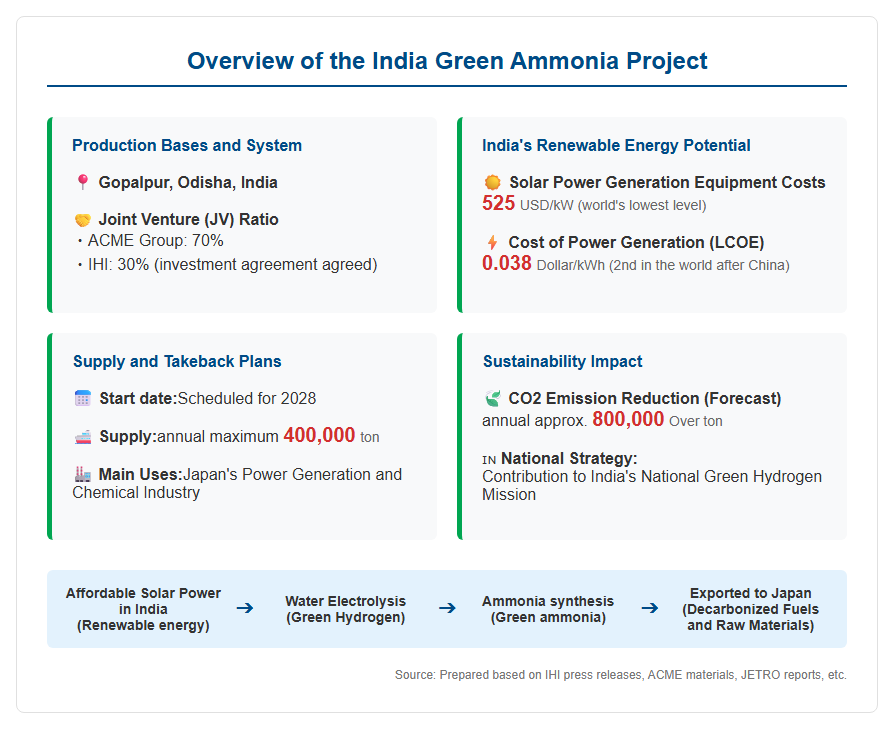
This project is positioned as one of India’s largest green ammonia projects, with land securing and basic design (FEED) already completed. Regarding funding, the plan is to combine investments from Japan’s Export Credit Agency (ECA), international financial institutions, and partner companies, making it a symbolic project to strengthen energy security in both countries.
1.2 India’s Supply Capacity Supported by Low-Cost Renewable Energy
The main reason India is attracting attention as a supply base for green ammonia is its extremely low global renewable energy prices. While renewable electricity prices are the largest component in green ammonia production costs, India’s solar power equipment costs $525 per kW, ranking among the lowest in the world.
In fact, India’s cost of solar power (LCOE) is $0.038 per kWh (as of 2024), making it the world’s second most cost-competitive after China. Against the backdrop of such cheap electricity, the Indian government approved the “National Green Hydrogen Mission” in January 2023, setting an ambitious goal to export 10 million tons, equivalent to 10% of global demand, by 2030.
India is the world’s third-largest energy consumer, but currently faces the challenge of relying on imports for about 86% of its ammonia demand. Therefore, producing green hydrogen and ammonia domestically by utilizing the country’s abundant solar resources is extremely important from the perspective of India’s own energy security, which leads to securing a stable supply source for Japanese companies.
The Core of the Decarbonization Strategy and the Framework of Japan-India Cooperation
2.1 Challenges toward Carbon Neutrality Using Fuel Ammonia
The background behind IHI’s urgent efforts to secure supplies from India is its promotion of the “Ammonia Value Chain” initiative. Ammonia is not only expected to serve as a carrier for efficiently transporting hydrogen but also as a next-generation clean energy source that does not emit CO2 during combustion, especially in the thermal power generation sector.
IHI, in collaboration with JERA, succeeded in a demonstration test of 20% conversion of fuel ammonia at the world’s first large-scale commercial coal-fired power plant (Hekinan Power Plant Unit 4). In April 2024, it has been confirmed that 20% combustion at a rated output of 1 million kW has been achieved, and nitrogen oxide (NOx) emissions can be kept at or below the previous level.
Please refer to the diagram below.
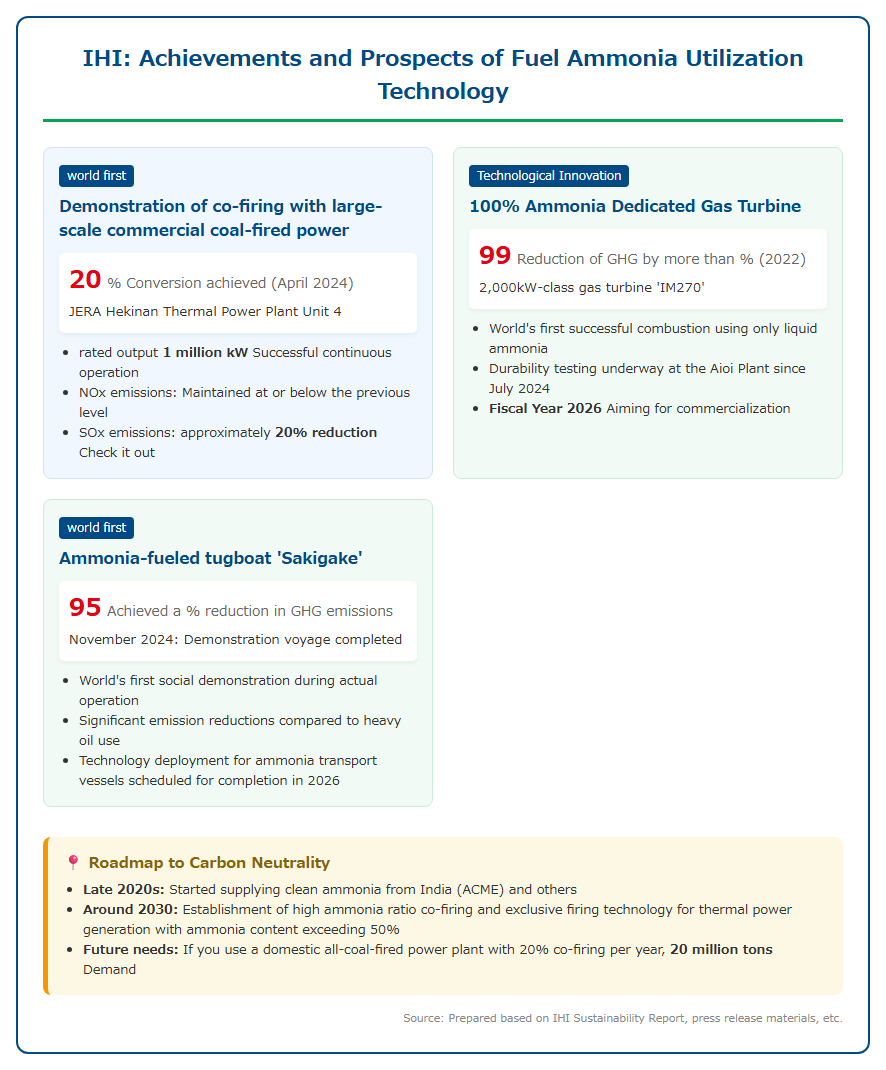
Furthermore, IHI aims to commercialize ammonia-only gas turbines by fiscal year 2026, successfully reducing greenhouse gas emissions by over 99% in 2,000kW-class gas turbines. Alongside establishing such utilization technologies, building routes to procure large quantities of inexpensive green ammonia from supply hubs like India is an essential step toward achieving a carbon-neutral society.
2.2 Progress in the Japan-India Clean Energy Partnership
This project is positioned not merely as a private company partnership, but also as a key initiative under the ‘Japan-India Clean Energy Vision’ promoted by both the Japanese and Indian governments. At the 15th Japan-India Annual Summit held in Tokyo in August 2025, Prime Ministers Modi and Ishiba adopted a joint statement of purpose on clean hydrogen and ammonia.
This intergovernmental cooperation framework aims to combine India’s vast renewable energy potential with Japan’s engineering technology, ammonia handling, and expertise in international markets. As part of its ‘Make in India’ policy, the Indian government is promoting manufacturing and aims to balance self-sufficiency with export expansion in the energy sector.
For Japan as well, based on the “Policy on Country-by-Country Development Cooperation with India,” which promotes offer-based cooperation and mobilizing private capital, it holds great significance in supporting the strengthening of industrial competitiveness and clean socio-economic development. Building a value chain based on such strong bilateral relations serves as a strategic cornerstone for diversifying geopolitical risks and ensuring stable clean energy supply.
2.3 Participation of Six Japanese Companies in Building Value Chains
In March 2025, six Japanese companies, including IHI, signed a memorandum of understanding to consider investing in green ammonia imports from India. The following companies are included in this consortium.
-
IHI (Building the entire value chain and developing utilization technologies)
-
Hokkaido Electric Power (Utilization at Tomato-Atsuma Power Plant and Development of Reception Base)
-
Mitsubishi Gas Chemical (expansion of existing ammonia business)
-
Mitsui O.S.K. Lines (Building Maritime Transport Supply Chains)
-
Mizuho Bank (support as part of a 2 trillion yen hydrogen and ammonia-related finance)
-
Tokyo Century (Considering Participation as a New Business)
These companies have begun concrete discussions to realize Japan’s first green ammonia import, centered on the ACME Group’s project in Odisha. In particular, Hokkaido Electric Power has set a vision not only for ammonia co-firing at coal-fired power plants but also to make the Tomakomai area a base for receiving and storing ammonia. In this way, by leading Japanese companies collaborating in production, transportation, finance, and final use, a ‘Japan Coalition’ is gradually being established to launch the immature green ammonia market.
Overcoming management risks and medium- to long-term business outlook
3.1 Internal Controls and Governance: Restoring Trust as the Key to Growth
While the IHI Group is expanding its new energy business, it is facing serious governance challenges. In February 2024, falsification of engine fuel consumption rate and nitrogen oxide (NOx) data was discovered at IHI Prime Engines (IPS), a wholly owned subsidiary. This fraud had become routine for decades, and the investigation report pointed out that the quality control department’s checks and balances were not functioning.
A particularly serious issue is that in 2019, fraud was discovered in the aircraft engine division, and while efforts were underway to improve organizational culture, misconduct continued and was concealed in another division. It is analyzed that this stems from a disconnect between management and the field, as well as a distorted culture that believes reporting is against the interests of the organization.
As a solution, IHI has set out recurrence prevention measures, including a fundamental review of the organization and personnel system and “surgical procedures” such as the continuous introduction of external personnel to the field. To succeed in the next-generation green ammonia business, accurate certification of environmental performance is essential, and restoring trust and strengthening governance across the entire group are urgent issues related to the survival of the business.
3.2 Milestones and Investor Trends Toward 2030
The green ammonia project in India is undergoing detailed development with the goal of becoming operational around 2029 to 2030. This project is estimated to contribute to an annual reduction of more than 8,000 tons of CO2 emissions and is one of IHI’s key pillars toward achieving its carbon neutrality goals.
In the stock market, expectations for IHI’s decarbonization-related businesses are rising, and analysts at securities firms are issuing bullish forecasts. According to data from June 2026, Morgan Stanley has upgraded its rating to ‘Buy’ and set a target price of 3,300 yen. Citigroup and Nomura Securities also maintain ‘Buy’ ratings, with target prices ranging from 3,700 yen to 3,800 yen.
Going forward, the focus will be on the progress of infrastructure development toward the handover start in 2028 and the effectiveness of governance reforms in response to subsidiary fraud issues. Investors are closely monitoring whether the growth potential of new energy businesses can be balanced with the sound quality control of existing businesses.
[#IHI #インド #グリーンアンモニア #脱炭素 #再生可能エネルギー #ガバナンス #経済ニュース]


コメント