Hitachi Construction Machinery has decided to change its company name to Landcross Co., Ltd. starting April 2027. Behind this brand renewal lies a major strategic turning point: increased capital involvement by Itochu Corporation, substantial independence from the Hitachi Group, and a shift into a solution provider beyond manufacturing.
- Timeline for the Landcross Launch in April 2027
- The four values embedded in the new brand “LANDCROS”
- An additional investment of 180 billion yen and the seizure of the “veto power”
- Hitachi’s “Independence” and Capital Exit
- Growth investments worth 500 billion yen and an “open strategy”
- Transformation of Business Structure Centered on North America and Mining Operations
- Specific timeline for brand transition and impact on the ground
- Potential and Key Points for Major Restructuring in the Construction Machinery Industry
Timeline for the Landcross Launch in April 2027
Hitachi Construction Machinery announced that it will change its trade name to ‘Landcros Corporation’ (English name: LANDCROS Corporation) effective April 1, 2027. Since developing Japan’s first purely domestically produced cable excavator in 1950, we will be giving up the brand bearing the ‘Hitachi’ name, which has been cherished for over 75 years. With the change to the new company name, the display on construction machinery bodies, parts, and authorized dealers worldwide will also be gradually reflected in the new brand.
On the other hand, the aircraft color “Reliable Orange,” which has long been a symbol of trust from operators, has been clearly stated to remain even after the change. The brand change will not affect our organizational structure, manufacturing system, product warranty policy, service, or support core operations, and relationships with existing customers and dealers will continue. Hitachi Construction Machinery positions this brand transformation not merely as a name change, but as a new starting point to redefine the way we work in the future of the field.
The four values embedded in the new brand “LANDCROS”
The new company name, “LANDCROS,” is a coined term combining “LAND,” meaning rich land, with four core values the company cherishes. Specifically, the acronyms “Customer” for customer, “Reliable” for trust, “Open” for openness, and “Solutions” symbolize problem-solving. This reflects a strong commitment to transforming from a manufacturing-centered business model into an “innovative solution provider” utilizing AI and digital technologies.
As a symbolic initiative, the next-generation excavator concept model, the “Landcros One,” has already been announced. The following image shows the future construction machinery the company aims to envision.
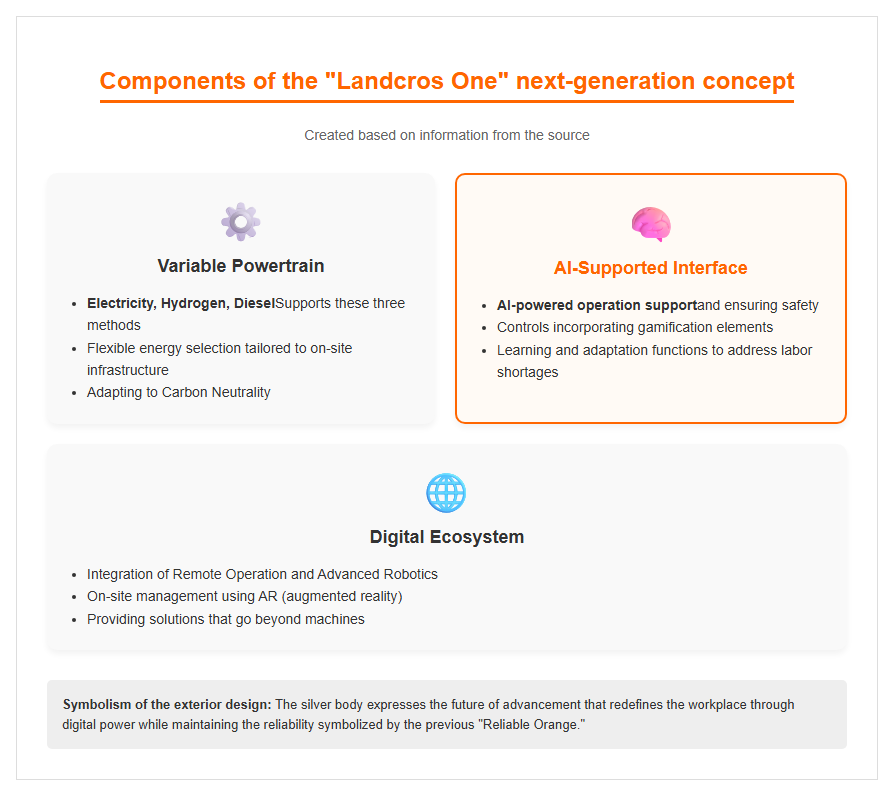
。 This concept model features a variable powertrain compatible with electric, hydrogen, and diesel systems, as well as an AI-assisted interface, symbolizing technological integration to address social issues such as labor shortages. The core direction of the new brand is to realize “intelligent machines” that go beyond simply providing machines and optimize entire sites through digital power.
Behind Itochu Corporation’s Leadership and Capital Strategy
An additional investment of 180 billion yen and the seizure of the “veto power”
Behind this name change was a major move in terms of capital. In February 2026, Itochu Corporation announced it would raise its stake in Hitachi Construction Machinery from the current approximately 18.4% to 33.4%. The funds invested in this additional acquisition amount will be a massive amount of approximately 180 billion yen, and it is expected to be completed by April 2026. Raising the shareholding ratio to 33.4% or higher means seizing the “veto power” that can unilaterally block special resolutions at the shareholders’ meeting, indicating that Itochu Corporation has firmly established leadership in Hitachi Construction Machinery’s management.
While there are concerns in the market about “grabbing at a high price” amid rising stock prices, Itochu argues that “the essence lies in securing management control rather than the price itself.” Since its capital participation in 2022, Itochu Corporation has deepened its partnership with Hitachi Construction Machinery, and with this additional investment, we are accelerating the completion of the “Itochu Model,” which integrates manufacturing into the trading company’s platform. Going forward, we plan to leverage the ITOCHU Group’s expertise in logistics, finance, and ESG initiatives to strengthen Hitachi Construction Machinery’s management foundation and enhance its global competitiveness.
Hitachi’s “Independence” and Capital Exit
Hitachi Construction Machinery’s removal of the “Hitachi” brand signifies effective independence from its parent company, Hitachi, Ltd. Currently, Hitachi, Ltd. still holds about 25% of Hitachi Construction Machinery’s shares, but in 2022, Itochu Corporation and Japan Industrial Partners (JIP) jointly acquired about 26% of the shares, and Hitachi Construction Machinery transitioned to an equity-method affiliate. Market insiders analyze that this name change is a preparation for Hitachi, Ltd.’s remaining shares to be sold to the market or other companies as an “exit.”
Masafumi Senzaki, President of Hitachi Construction Machinery, avoided making specific comments about Hitachi’s moves at the press conference, but hinted that “capital movements may occur in cooperation with other companies.” In the construction machinery industry, competition with giant manufacturers such as U.S. companies like Caterpillar and Komatsu is intensifying, and to accelerate an “open strategy” that does not belong to any particular corporate group, breaking away from the Hitachi Group framework has been strategically essential. This move to “de-Hitachi” has the potential to trigger a large-scale restructuring in the construction machinery industry going forward.
“LANDCROS 2028”: Growth Strategy to Become the Top 3 in the Industry
Growth investments worth 500 billion yen and an “open strategy”
Prior to the company name change, Hitachi Construction Machinery announced its new medium-term management plan, “LANDCROS 2028,” which will begin in fiscal 2026. This plan sets an ambitious goal to rank among the world’s top three in the construction machinery industry by 2030. To achieve its goals, the company plans to execute bold growth investments totaling 500 billion yen over the next three years. These funds will be used not only for organic growth but also to accelerate in-organic growth through collaborations with other companies and M&A.
One of the major pillars of our strategy is our ‘open strategy,’ which does not cling to self-centeredness. Leveraging our existing strengths of a global network of about 300 distributors and around 9,000 skilled mechanics, we aim to expand our asset-light business by collaborating with partner companies to create new value. Additionally, R&D investment is planned to reach 130 billion yen over three years (about 25% increase compared to the previous and medium-term total), thoroughly differentiating itself by integrating digital value and manufacturing technology.
Transformation of Business Structure Centered on North America and Mining Operations
In the new medium-term management plan, four key businesses are positioned as North America, Latin America, mining, and parts and services. In particular, the North American market is considered the second phase of growth, and by expanding its lineup of core products—hydraulic excavators and wheel loaders—we aim to further increase our sales share. For the mining business, we have set a sales target of 700 billion yen for fiscal 2030 (about 1.6 times the actual performance for fiscal 2025), and plan to strengthen key regions such as North Central and South America and Africa, where resource demand remains strong.
The chart below shows changes in sales composition toward the 2030 target.
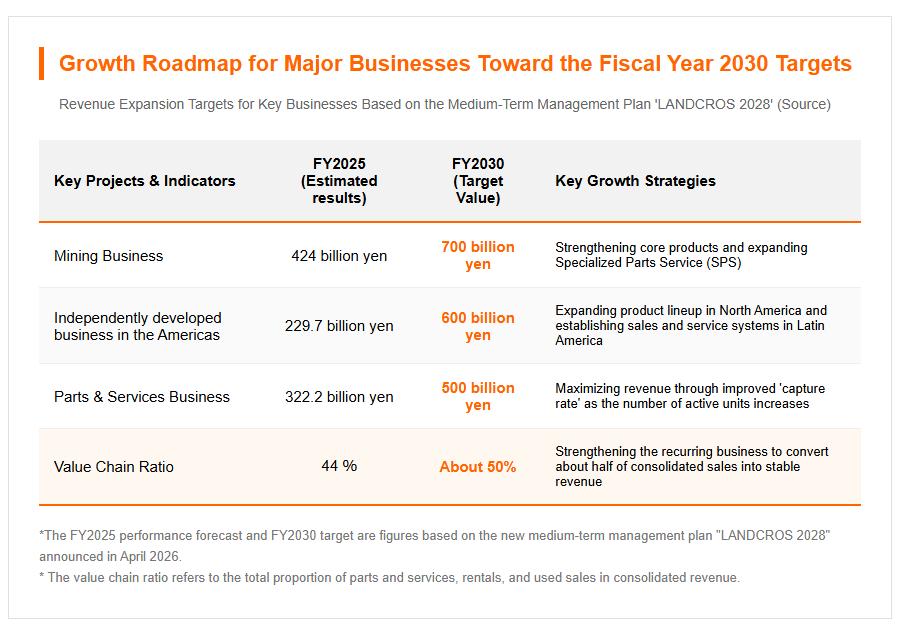
。 In addition to machine sales, we are also strengthening the recurring business, which raises the proportion of the “value chain business” earned through post-operation parts supply and maintenance to about half of consolidated sales revenue. This is an important strategy to build a stable revenue base without relying solely on sales of machinery that are vulnerable to economic fluctuations. The results in North America, where we dissolved our joint venture with John Deere in 2022 and have built our own dealer network, will be the key to our future growth.
Future Developments and Impact on the Construction Machinery Industry
Specific timeline for brand transition and impact on the ground
Ahead of the official company name change in April 2027, Hitachi Construction Machinery is formulating a phased brand transition schedule. At 22 sales companies in the US and Canada, they first use dual-brand logos such as “Reliable Solutions – Landcros” to allow customers time to get used to the new name. Additionally, at ConExpo-Con/Agg 2026, one of the world’s largest construction machinery trade fairs, we plan to begin full-scale operation of dual-brand logos in 2026.
Regarding the product quality and service system that customers care about most, it is emphasized that the current system will be fully maintained. The model name and the highly visible orange decals on site remain unchanged. Hitachi Construction Machinery is committed to minimizing the risk of existing customers losing interest due to brand renewal by persistently conveying the message that “on-site operations, basic product specifications, and warranty systems remain unchanged” even though the name changes. This meticulous transition will be key to restoring brand awareness beyond 2027.
Potential and Key Points for Major Restructuring in the Construction Machinery Industry
Hitachi Construction Machinery’s transformation into a “Land Cross” could significantly reshape the global landscape of the construction machinery industry. Currently, the industry is dominated by the two dominant companies Caterpillar in the U.S. and Komatsu in Japan, with Chinese manufacturers fiercely chasing after them. Hitachi Construction Machinery gaining a strong partner like Itochu Corporation and being redefined as a “land cross” not bound by any particular corporate group makes it easier to engage in neutral M&A and partnerships with other industries.
What is particularly noteworthy is how the “trading company-led” manufacturing management led by Itochu Corporation differentiates itself from traditional manufacturer management. Itochu aims to transform its business model into a business model that supports the entire customer lifecycle by combining Hitachi Construction Machinery’s products as mere “goods” by combining rentals, financing, and logistics solutions using operational data. Having left the Hitachi Group and adopted a free “open strategy,” Landcross can achieve its goal of being among the “top 3 in the industry” by 2030, and each step will serve as a touchstone for the industry’s overall restructuring.


コメント