A research team at Soochow University has developed a tandem-type solar cell with a conversion efficiency exceeding 30% without using the rare metal indium. Behind this is a global technological race aimed at breaking free from dependence on expensive resources and dramatically reducing the manufacturing costs of next-generation solar cells.
- Innovation in Indium-Free Use Achieved by Soochow University and Others
- Resource risks posed by indium, a metal rarer than gold
- Technical details of the tin oxide composite layer that reduces costs by 80%
- Breaking the limits of silicon with tandem structure
- China’s Volume and Speed Rise to Lead in Number of Patents
- Early Commercialization Accelerated by Compatibility with Existing Lines
- Barriers to Durability and Debates on Environment and Safety Barriers to Commercialization
Innovation in Indium-Free Use Achieved by Soochow University and Others
On June 19, 2026, a joint research team consisting of Soochow University, based in Suzhou, Jiangsu Province, China, the prestigious Monash University in Australia, and several domestic solar power companies in China, announced that they had developed a new solar cell with an astonishing performance of over 30% conversion efficiency. Led by the teams of Professors Zhang Xiaohong and Yang Xinbo, this research achievement was published in the electronic edition of the internationally prestigious journal Science, shocking energy researchers worldwide. The biggest breakthrough in this announcement is the realization of an indium-free structure that does not use indium, a rare metal that has previously been considered essential for next-generation solar cell manufacturing but has been a source of supply risks and price surge concerns. The developed perovskite/crystalline silicon tandem solar cells have the potential to break through the limitations of conventional mainstream standalone silicon cells and fundamentally transform the cost structure of renewable energy.
Resource risks posed by indium, a metal rarer than gold
Because indium possesses the rare property of simultaneously achieving both transparency and conductivity, it has been widely used in smartphone LCD screens and transparent conductive films in solar cells, and its rarity surpasses that of gold. According to Professor Yang Xinbo of Soochow University, indium is an associated mineral found in small amounts among minerals such as tin, lead, and zinc; for example, even if one ton of zinc ore is mined, the indium contained is only a few dozen grams. Traditional tandem solar cells require large amounts of indium to form electrodes and composite layers, which has been a major factor accounting for about 10% to 15% of the overall manufacturing cost of the cell. The uneven distribution of resources in certain regions also carries the risk of supply instability, and breaking dependence on indium has long been a long-cherished wish of the solar power industry.
Technical details of the tin oxide composite layer that reduces costs by 80%
To overcome this serious resource problem, the research team spent four years independently developing a new tin oxide composite layer and transparent electrode. Until now, indium-based transparent conductive films were deposited using magnetron sputtering technology, but this new method has succeeded in forming a layer of alternative materials that do not require indium at all. Outdoor demonstration tests reported that compared to conventional batteries using indium, photoelectric conversion efficiency improved by about 4%, and remarkably, operational stability improved by up to seven times. Furthermore, the economic impact is significant, with about 80% reduction in costs for the transparent electrode section alone, providing extremely strong price competitiveness for future commercialization.
Paradigm Shift in Solar Cells and International Competition
Breaking the limits of silicon with tandem structure
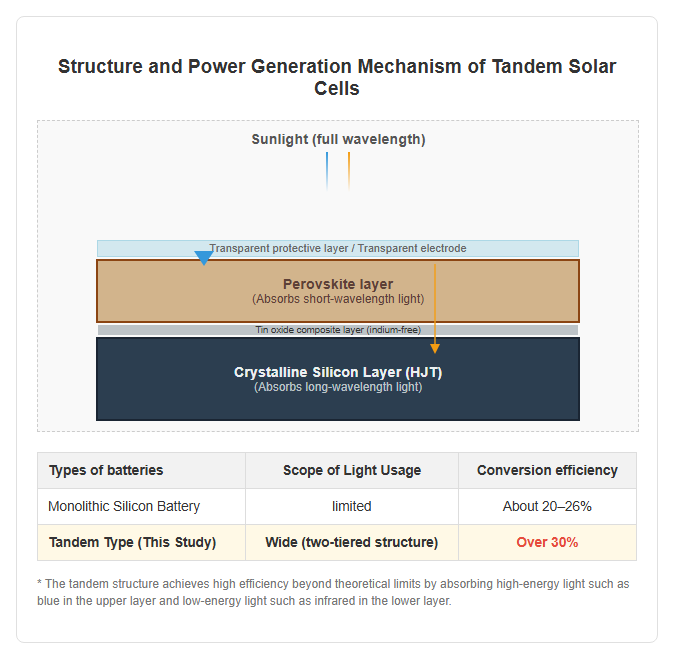
Tandem-type solar cells are a next-generation mainstream technology that absorbs a wide range of solar energy wavelengths by stacking multiple power generation layers with different properties. Specifically, the perovskite layer placed in the upper layer absorbs short-wavelength light, and the long-wavelength light passing through it is converted into electricity by the crystalline silicon layer below, forming a two-stage structure. There are physical limitations to the power generation efficiency of silicon alone, but by adopting this stacked structure, it is possible to significantly overcome the limitations of conventional solar cells. Industry roadmaps position heterojunction (HJT) technology as the most suitable foundational platform for stacking perovskite layers, and this achievement of exceeding 30% reaffirms that the HJT-perovskite tandem structure is the kingpin for ultra-high efficiency. Please refer to the diagram below.
China’s Volume and Speed Rise to Lead in Number of Patents
In the IP strategy surrounding next-generation solar cells, China is now showing overwhelming momentum over Japan in both the number of patents and mass production achievements. By the end of 2025, China has finally surpassed Japan in the cumulative number of valid patent applications filed in more than two countries worldwide, taking the top spot globally. Perovskite solar cells themselves are a Japanese-originated technology invented in 2009 by Professor Riki Miyasaka, and Japan still holds a strong intellectual property portfolio in terms of the diversity of foundational patents related to core materials and initial structures. However, the Chinese government has invested enormous national budgets to rapidly launch GW-level mass production demonstration lines, leading the way by rapidly scaling lab research results to industrial scale. This breakthrough by Soochow University can be seen as the result of a focus on practical application through industry-academia collaboration.
Challenges for Social Implementation and a Sustainable Future
Early Commercialization Accelerated by Compatibility with Existing Lines
According to Professor Zhang Xiaohong, who led the development, the greatest strength of the newly announced indium-free technology lies in its extremely high compatibility with existing production equipment. In theory, it is possible to introduce the currently widespread solar cell manufacturing lines without significantly rebuilding, which is a major factor driving early commercialization. The research team is already working closely with several solar power companies and plans to transition to small-scale production processes based on actual industrial standards. Several pilot lines of 100MW (megawatts) are already operating domestically in China, but if this low-cost technology that avoids the use of rare metals is introduced, the adoption speed of next-generation batteries could accelerate dramatically worldwide.
Barriers to Durability and Debates on Environment and Safety Barriers to Commercialization
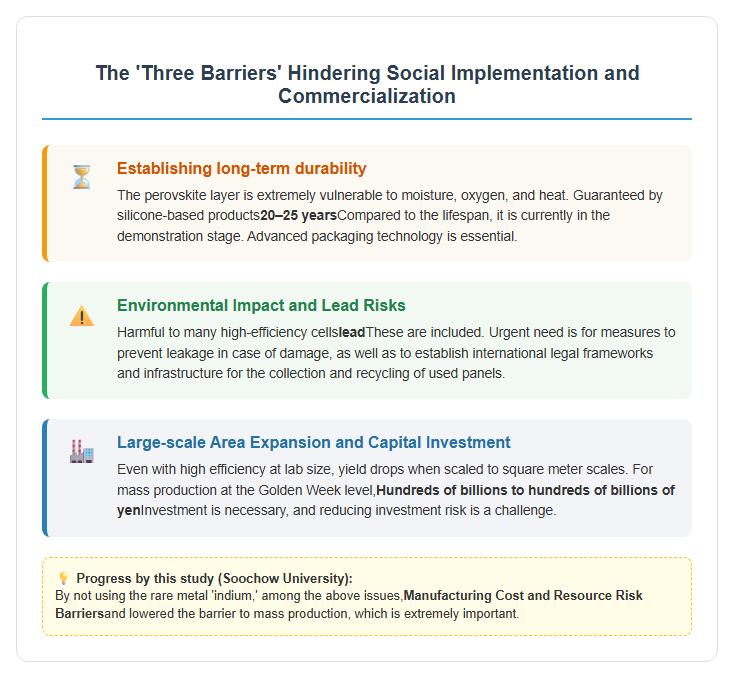
While technological breakthroughs continue, challenges remain to be resolved to achieve widespread market penetration. The biggest barrier is low durability, and since perovskite materials degrade rapidly due to oxygen, moisture, and heat, establishing strict sealing technologies to achieve the long service life of over 20 years guaranteed by current silicon systems has become an urgent task. Additionally, many high-efficiency perovskite batteries contain lead, which is a concern for the environment, and internationally, standards are required to prevent leakage in case of damage and to require post-use collection and recycling. Going forward, the true outcome of this technology will likely be determined by overcoming resource costs such as being indium-free while ensuring long-term reliability and social acceptance of safety. Please refer to the diagram below.
[#ペロブスカイト太陽電池 #蘇州大学 #インジウムフリー #再生可能エネルギー #次世代技術 #タンデム型太陽電池 #科学ニュース]


コメント