The Takeo City Board of Education in Saga Prefecture launched a pilot study in August 2026, deploying official-use smartphones and a dedicated administrative support app to accelerate work-style reforms and School Digital Transformation (DX). This initiative addresses critical challenges, including reducing chronic teacher overwork and mitigating security risks associated with the use of personal devices for school business.
- Deploying 40 Official-Use Smartphones in an Elementary School Setting
- Duration, Training, and Diverse Target Roles
- Teacher Overwork and the Gravity of Local Staff Shortages
- Shifting Away from BYOD and Minimizing Information Security Risks
- Real-Time Collaboration and Secure, Device-Free Photo Management
- Upgraded Emergency Response and Task Optimization via ToDo Functions
- The March 2025 Revision of the MEXT Security Guidelines
- Implementing Multi-Factor Authentication and Access Controls
Deploying 40 Official-Use Smartphones in an Elementary School Setting
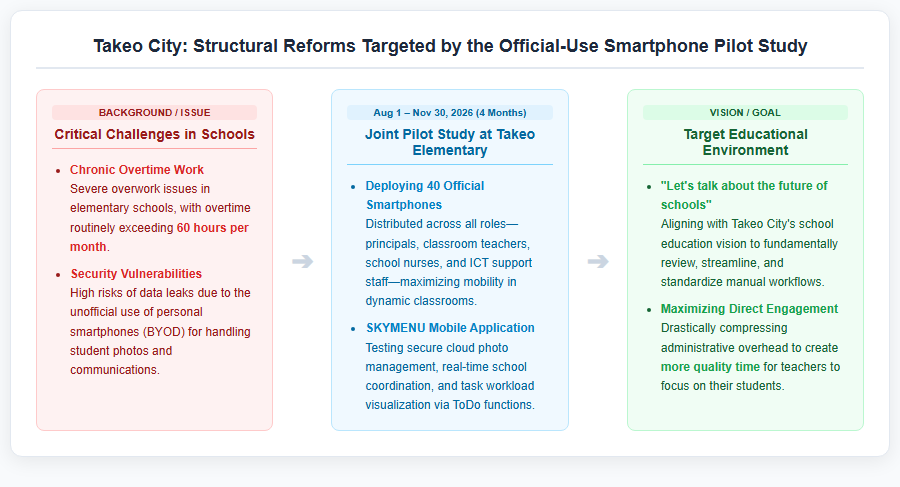
The Takeo City Board of Education has launched an innovative pilot program to distribute official-use smartphones to school staff, marking a major milestone in work-style reform and educational Digital Transformation (DX). Conducted in partnership with Sky Co., Ltd., a leading developer of educational software, the initiative aligns with Takeo City’s overarching educational vision: “Let’s talk about the future of schools” (これからの学校の話をしよう). The primary objective is to review, streamline, and standardize highly inefficient manual workflows and fragmented communication within schools. By automating routine administrative processes, Takeo City aims to drastically reduce the time teachers spend on clerical chores, thereby maximizing the invaluable hours they can devote directly to supporting and teaching students.
Takeo Municipal Takeo Elementary School was selected as the testing ground for this study. Elementary schools represent a particularly dynamic environment; unlike junior high school teachers, elementary teachers spend very little of their day at desks in the staff room, as they are constantly moving between classrooms and outdoor areas. Utilizing a mobile device in this fast-paced environment is expected to showcase the true value of smartphone-driven portability and real-time connectivity. A total of 40 smartphones are being deployed, equipping a broad range of staff to test the devices under realistic, daily operating conditions.
An conceptual diagram illustrating Takeo City’s educational vision and the pilot study can be found below.
Duration, Training, and Diverse Target Roles
This joint pilot study is scheduled for a four-month period running from August 1 to November 30, 2026. To ensure a smooth rollout, the Board of Education hosted an intensive training session for the faculty of Takeo Elementary School on August 28, 2026, at 1:30 PM. The session went beyond basic technical operation, providing thorough instruction on information security protocols, the strict handling of student personal data, and the legal responsibilities associated with utilizing official communication channels. This proactive training ensured that the participating staff were fully prepared to adopt the technology from day one.
The pilot’s target group is remarkably inclusive, reflecting a holistic approach to school management. Rather than limiting smartphone distribution to homeroom teachers, devices have been issued to the principal, vice principal, head curriculum coordinator, classroom teachers, part-time instructors, administrative clerks, the school nurse, and even the school’s dedicated ICT support staff. By placing these secure terminals in the hands of all key stakeholders in the school ecosystem, the study aims to measure how unified mobile communication transforms school-wide synchronization, breaks down administrative silos, and optimizes workloads across different professional roles.
Background: Pressing Challenges in Public Education
Teacher Overwork and the Gravity of Local Staff Shortages
The educational landscape in Japan is facing an existential crisis characterized by severe teacher shortages and historically low application rates for public teaching positions. Once considered a highly stable and widely respected career path, the teaching profession has struggled in recent decades with a reputation for extreme workloads, complex parent communications, and unpaid overtime. Consequently, teacher recruitment exam ratios have plummeted nationwide. The ratio for elementary school positions has dropped to approximately 2.0x, a critical threshold widely considered by experts to threaten the quality of public instruction.
The root cause of this decline is the overwhelming volume of non-instructional responsibilities placed on educators. Beyond classroom teaching and lesson preparation, teachers must manage extensive student counselor duties, parent inquiries, athletic club supervision, community relations, facility maintenance, and endless administrative paperwork. A survey conducted by the Takeo City Board of Education revealed that elementary school staff routinely perform over 60 hours of overtime per month. This baseline of chronic exhaustion has made digital transformation a necessity rather than a luxury. The smartphone pilot represents a vital step toward reclaiming teachers’ professional focus by stripping away redundant administrative burdens.
Shifting Away from BYOD and Minimizing Information Security Risks
For years, many schools tacitly relied on Bring Your Own Device (BYOD) practices. Teachers routinely used their personal smartphones to take photos of classroom activities, message colleagues, or receive emergency school updates. While convenient, using private devices to handle highly sensitive student information—such as academic records, medical histories, and behavioral logs—created severe security vulnerabilities. Personal phones lack centralized administrative control, exposing schools to massive risks of data leaks due to device loss, theft, malware infections, or accidental sharing via personal social media accounts.
Furthermore, public trust has been repeatedly shaken by cases of inappropriate conduct involving educators’ personal devices. In response, the Ministry of Education, Culture, Sports, Science and Technology (MEXT) issued a strict nationwide directive in July 2025, fundamentally prohibiting teachers from using personal devices to photograph students or engage in private messaging with them. Under these stringent regulations, schools can no longer ignore the digital divide. Providing managed, secure, official-use mobile infrastructure has become absolutely critical to maintaining compliance, protecting children’s privacy, and rebuilding the public’s trust in the safety of educational environments.
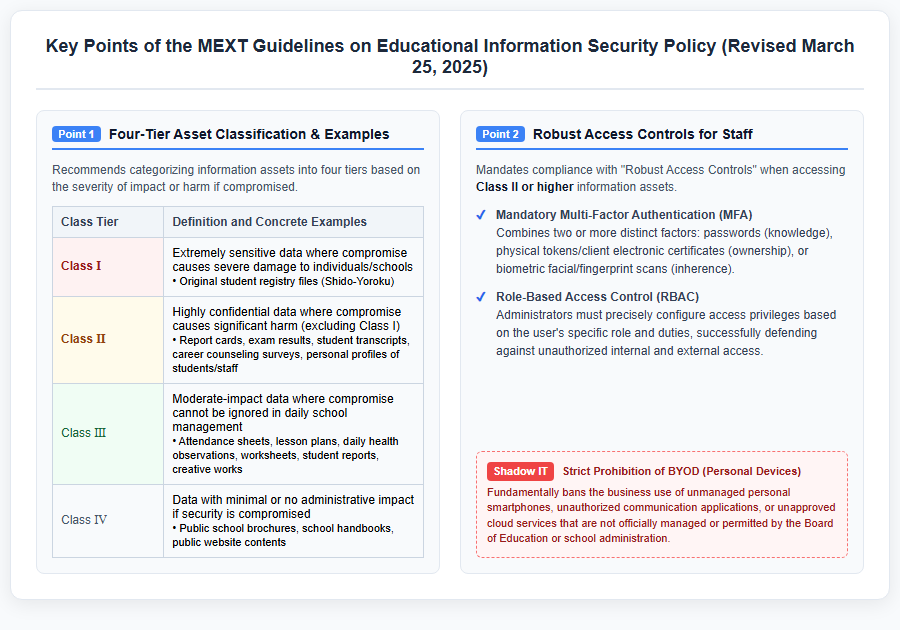
The following diagram details the security framework and directives established by the Ministry of Education.
Key Features and Core Functions Tested in the Pilot
Real-Time Collaboration and Secure, Device-Free Photo Management
At the heart of Takeo City’s pilot study is “SKYMENU Mobile,” a dedicated school administrative support application developed by Sky Co., Ltd. The app is designed to run securely over managed school networks, offering robust encryption and administrative controls. The first major focus of the pilot is the optimization of real-time communication. By utilizing secure voice calls, video conferencing, and instantaneous group chats, teachers can coordinate student absences, health issues, and urgent parental messages without needing to return to the staff room. Whether a teacher is in a classroom, on the schoolyard, or guiding a field trip, information flows smoothly and securely.
The second core function under evaluation is the app’s secure photography system. Photographing student progress and classroom activities is a daily routine in modern schools, yet storing these images on a device’s local memory is a major liability. SKYMENU Mobile solves this by utilizing a specialized camera function that uploads photos and videos directly to a secure, centralized cloud repository. No media files are ever saved onto the physical storage of the smartphone. Even if a device is lost or stolen, there is absolutely zero risk of student images leaking to the public, achieving a seamless balance between pedagogical convenience and absolute data security.
Upgraded Emergency Response and Task Optimization via ToDo Functions
The third key area being evaluated is the school’s emergency response and crisis management protocols. Traditional methods of alert dissemination, such as overhead PA systems or staff room bulletin boards, often fail to reach educators who are outdoors, in noisy gymnasiums, or assisting students during drills. Through the pilot, Takeo Elementary is implementing a centralized notification system on official smartphones. In the event of an emergency—such as a fire, an active intruder, or a heatstroke warning—critical alerts and tactical instructions can be broadcast instantly to all staff, ensuring rapid, coordinated action to protect the lives and safety of students.
Fourthly, the study evaluates the modernization of task management through a shared ToDo feature. Teachers can log, categorize, and prioritize their daily tasks within the app, allowing school administrators to visualize the actual workloads of their staff. This shared visibility helps prevent task duplication, allows for a more equitable redistribution of duties, and fosters an objective, data-driven approach to work-style optimization. Throughout the trial, the Board of Education will analyze device usage logs and conduct comprehensive pre- and post-pilot surveys to measure the quantitative and qualitative impacts on teachers’ daily schedules and overall mental well-being.
National Frameworks: Next GIGA DX and Security Guidelines
The March 2025 Revision of the MEXT Security Guidelines
Takeo City’s local efforts are closely aligned with a national shift toward modernized educational security. On March 25, 2025, MEXT officially revised its “Guidelines on Educational Information Security Policy.” This update addresses the realities of the “Next GIGA” era, where every student is equipped with a personal digital device and school systems are heavily reliant on public cloud services. The updated guidelines strongly recommend that school boards move away from rigid, local perimeter networks and embrace secure cloud environments to support modern, flexible workflows.
A key pillar of the revised guidelines is the systematic classification of school information assets into four distinct tiers based on the severity of consequences if compromised (Class I through Class IV). Class I covers extremely sensitive materials like official student registry records. Class II includes highly confidential data such as report cards, exam papers, test scores, career counseling forms, and detailed student and staff personal profiles. Under the new mandate, any access to Class II or higher information assets must comply with strict access controls, including Multi-Factor Authentication (MFA), placing a heavy compliance burden on local school boards to modernize their identity access management systems.
Implementing Multi-Factor Authentication and Access Controls
To protect critical Class II and Class I information assets, the revised MEXT guidelines mandate the implementation of Multi-Factor Authentication (MFA) and granular, role-based access controls for all school staff. MFA requires a user to present at least two distinct authentication factors—such as traditional passwords (knowledge), physical tokens or device-specific digital client certificates (ownership), or biometric scans like fingerprints or facial recognition (inherence)—before granting system access. This approach prevents unauthorized access and identity spoofing, which have historically compromised educational networks.
As schools shift to integrated zero-trust architectures, administrators must dynamically verify the legitimacy of every user and device trying to access the network. This includes defining precise user roles and restricting access privileges based strictly on job functions. Takeo City’s deployment of official-use smartphones as primary vehicles for MFA client certificates serves as an exemplary model of how to achieve state-of-the-art security compliance without sacrificing operational convenience. It establishes a repeatable blueprint for other municipalities seeking to transition to secure, location-free school DX environments that protect student data while empowering teachers to work flexibly and efficiently.
Reference Pages
- 【Official-Use Smartphone “SKYMENU Mobile” Pilot Study Launched – Takeo City】https://www.city.takeo.lg.jp/
- 【School DX Under the GIGA School Concept – MEXT】https://www.mext.go.jp/
【#SchoolDX #OfficialSmartphones #TakeoCity #EducationalICT #SecurityGuidelines #WorkstyleReform #MultiFactorAuthentication #ScienceTechnology】


コメント