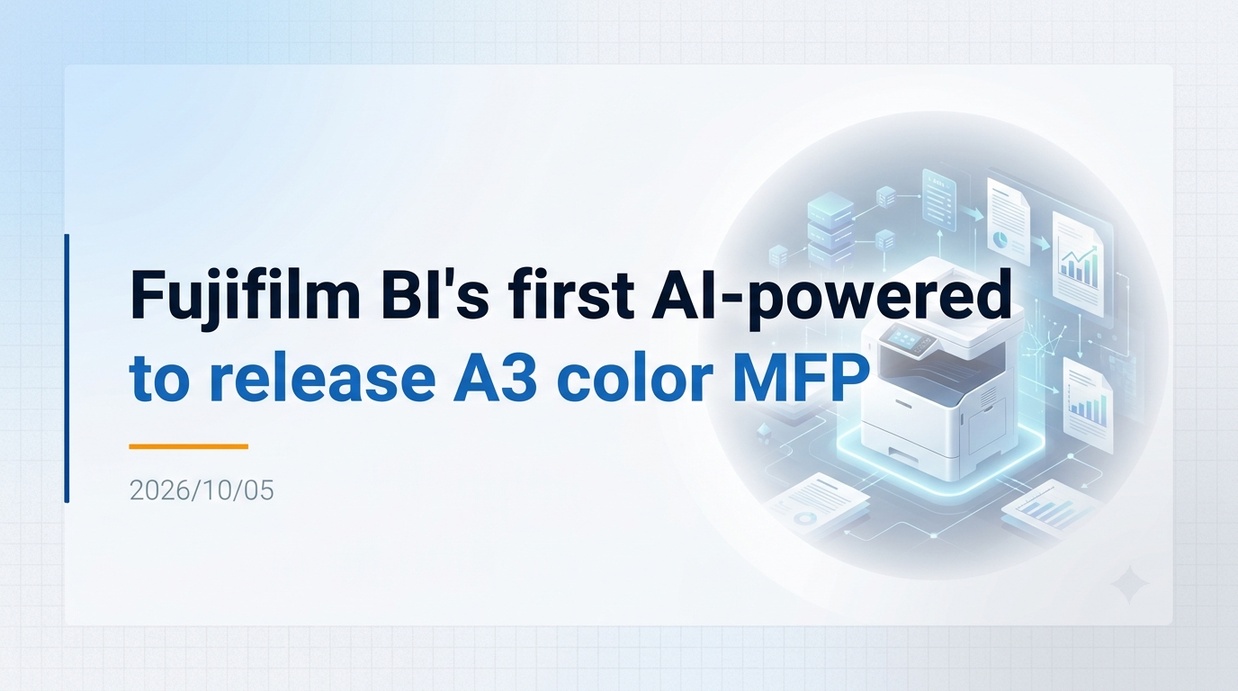
Fujifilm Business Innovation is releasing the new-generation A3 color multifunction printer “Apeos C7072 series,” which features AI technology for the first time. The background behind this is the goal to redefine multifunction printers as “data hubs” amid the progress of paperless operations, transforming information scattered across the company into structured data that can be utilized by AI.
- Fujifilm BI Announces First AI-Powered Model and Key Events Summary
- “Paper Digitization and Structuring” via Ultra-High-Speed Scanning and Automated Cloud Integration
- Significant evolution in environmental and operational aspects through “AI Automatic Power Saving” and AI Abnormal Sound Detection
- The Current State of the Multifunction Printer Market Transforming Amid Industry Restructuring and Paperless Trends
- Proprietary AI Brand “REiLI Business” and the Integrated Strategy for Building the “Corporate Brain”
- The Future Vision Through API and MCP Integration: Future Developments and Key Points to Watch
Fujifilm BI Announces First AI-Powered Model and Key Events Summary
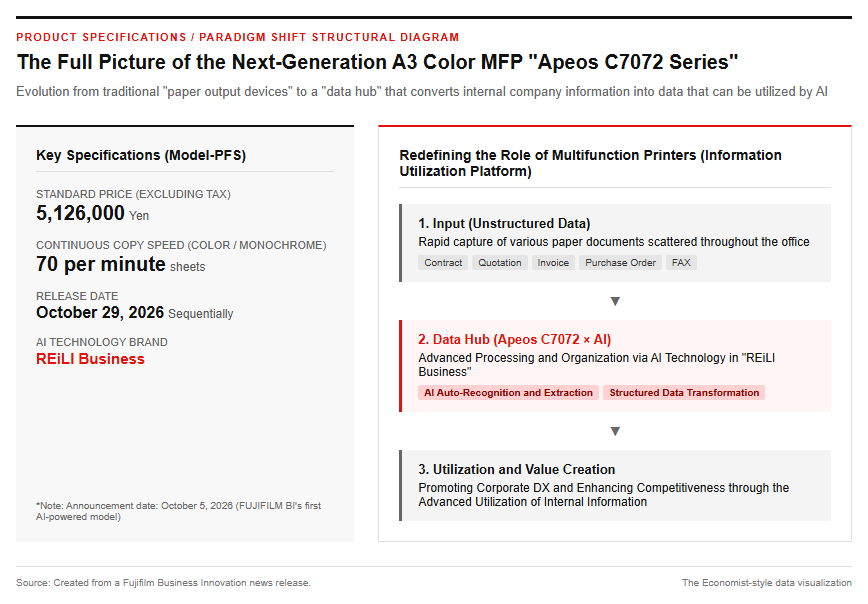
Fujifilm Business Innovation Corp. announced on October 5, 2026, that it will release the “Apeos C7072 series,” its first new-generation A3 color multifunction device equipped with full-scale AI technology, starting October 29, 2026. The top-of-the-line model, the “Apeos C7072 (Model-PFS),” boasts a continuous copying speed of 70 pages per minute for both color and monochrome, with a standard price set at 5,126,000 yen (excluding tax). Breaking away from the traditional positioning of multifunction devices as mere paper output devices for printing and copying, the series clearly establishes its role as an information utilization platform that converts the vast amount of information accumulated within enterprises into data that can be utilized by AI. By swiftly capturing, organizing, and structuring paper documents scattered across offices—such as contracts, quotes, invoices, purchase orders, and faxes—it supports companies in strengthening their competitiveness in the AI era. The company plans to fully deploy the technology cultivated in its proprietary AI technology brand “REiLI Business” and strongly drive the promotion of DX in office environments. The image below is a conceptual design of the new series’ chassis.
“Paper Digitization and Structuring” via Ultra-High-Speed Scanning and Automated Cloud Integration
The greatest strength of this series lies in its advanced digitization and structuring capabilities, which rapidly capture paper documents and convert them into data that business systems and AI can utilize immediately. The newly developed automatic duplex document feeder, included as a standard feature across all models, achieves an industry-leading ultra-high-speed scan of up to 300 pages per minute during 1-pass duplex reading. It efficiently scans small-size documents such as business cards and receipts, as well as mixed-size documents, all at once. Furthermore, the standard-equipped cloud service “Apeos Cloud Extension” allows scanned data and received faxes to be automatically saved to the cloud without the need for complex system configuration. It is also equipped with OCR-based automatic file naming and a “multi-crop” function that individually splits and saves multiple receipts. In addition, by utilizing separately contracted optional functions, generative AI-powered OCR technology extracts itemized information from invoices and estimates, automatically converting it into structured data such as CSV. This transforms information previously buried in paper into valuable data assets that directly drive analysis and business automation.
Significant evolution in environmental and operational aspects through “AI Automatic Power Saving” and AI Abnormal Sound Detection
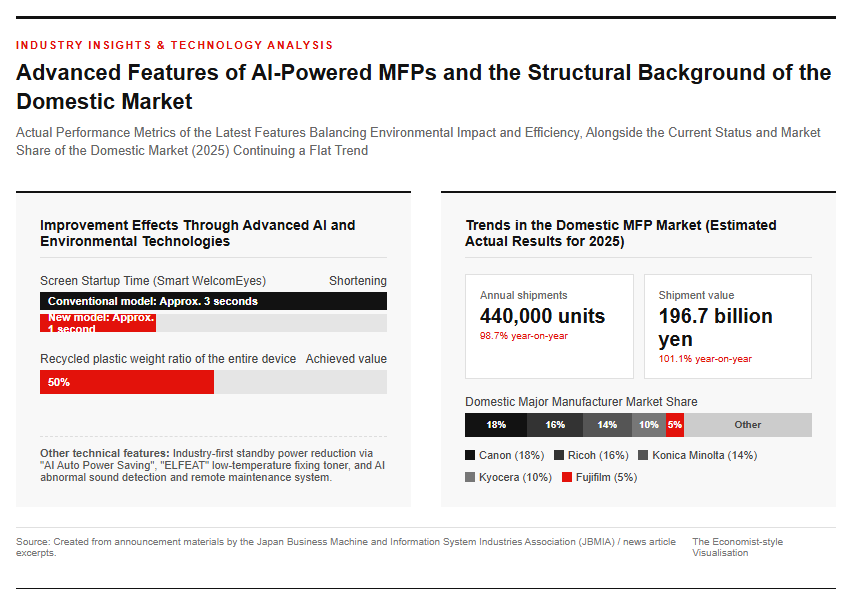
Along with performance improvements, advanced AI technology has been introduced to enhance environmental consideration and operational efficiency. The industry-first “AI Auto-Power Saving” feature reduces standby power without compromising convenience by having AI learn device usage status and usage trends by time of day to automatically optimize the transition time to low-power or sleep modes. In addition, “Smart WelcomEyes,” which adopts spatial sensing technology, shortens the screen wake-up time when a user approaches from about 3 seconds on conventional models to approximately 1 second. The toner adopts “ELFEAT,” which excels in low-temperature fusing, suppressing power consumption during fusing to achieve industry-leading low power consumption. In terms of maintenance, a mechanism where AI learns the operating sounds of the machine to detect abnormal noises and a system to remotely monitor status information such as paper jams have been introduced. By helping engineers understand the cause and necessary parts before their visit, it has achieved a reduction in the number of visits and machine downtime. Furthermore, it contributes to resource circulation, such as achieving a recycled plastic weight ratio of 50% for the entire device.
Market Background Accelerating the Role Transformation of Multifunction Printers and Their Shift into “Data Hubs”
The Current State of the Multifunction Printer Market Transforming Amid Industry Restructuring and Paperless Trends
Behind the emergence of these AI-equipped multifunction printers (MFPs) lies a structural change facing the domestic MFP market. According to an announcement by the Japan Business Machine and Information System Industries Association (JBMIA), domestic annual shipments of copiers and MFPs in 2025 are projected at 440,000 units (98.7% year-on-year) with a value of 19.67 billion yen (101.1% year-on-year). While this represents a recovery from the stagnation of the COVID-19 pandemic, the market continues to trend sideways. As the paperless movement and the entrenchment of hybrid work drive a continuous decline in pure print volume, hardware spec competition alone is no longer sufficient for differentiation. Consequently, manufacturers are rushing to transform from printing equipment vendors into high-value-added solution providers that integrate software, cloud services, and AI. In terms of market share, companies such as Canon (approx. 18%), Ricoh (approx. 16%), Konica Minolta (approx. 14%), Kyocera (approx. 10%), and Fujifilm (approx. 8%) are in fierce competition, while industry restructuring is actively progressing through moves like the establishment of the manufacturing joint venture “ETRIA” and business alliances in component procurement. Fujifilm Holdings is also considering a business spin-off, marking a new phase for the market.
Proprietary AI Brand “REiLI Business” and the Integrated Strategy for Building the “Corporate Brain”
At the core of the AI strategy promoted by FUJIFILM BI are its proprietary AI technology brand “REiLI Business” and the concept of a “corporate brain” built through it. By expanding the high-quality image processing and natural language processing technologies cultivated in the medical and healthcare fields into the office domain, the company has achieved high accuracy in recognizing blurred fax characters, handwritten documents, and unstructured data. While general-purpose generative AI excels at learning from publicly known data, it faces the challenge (the “valley of death” in PoCs) of being difficult to integrate into actual operations because it cannot understand company-specific terminology or the gritty business context of the workplace. In response to this, the company positions multifunction printers as “edge gateways” that securely capture information, deploying a three-layer architecture that integrates with cloud workspaces such as “FUJIFILM IWpro”. This allows users to convert their tacit knowledge and past document data into a structured knowledge database without changing their conventional paper-based workflows, enabling advanced utilization as a “corporate brain” in autonomous AI and business systems. Please refer to the conceptual diagram below.
The Future Vision Through API and MCP Integration: Future Developments and Key Points to Watch
The introduction of the “Apeos C7072 series” is not merely the launch of a single product, but serves as an important milestone showing how office equipment will evolve in the future. Moving forward, the company plans to leverage APIs for collaboration with external programs and MCP (Model Context Protocol), a common protocol connecting AI and databases, to aim for seamless integration with diverse AI agents and SaaS. This presents a future where data captured via multifunction devices consistently automates everything from internal intent and decision-making to the autonomous execution of tasks across various external business services. In parallel, expansion into global markets such as Southeast Asia, supply chain optimization using AI, and the improvement of environmental quality (Green Value Products) will also be promoted. In the office of the AI era, the greatest focus in the market going forward will be whether multifunction devices can completely transform from mere “print exits” into corporate “information entrances” and “data hubs” supporting knowledge circulation.
Reference Page
- [News Release] Next-Generation A3 Color Multifunction Printers That Continue to Evolve with Cloud and AI | FUJIFILM Business Innovation https://www.fujifilm.com/fb/ja/news
[#FujifilmBI #MultifunctionDevice #AITech #Apeos #DataHub #DXInitiatives #CorporateBrain]


コメント