It has become clear that Meta Platforms plans to enter its own cloud infrastructure market through an internal organization called “Meta Compute.” By selling the vast AI computing resources accumulated for the SNS business externally, we are entering a new phase of “asset efficiency,” turning massive capital investments into revenue.
- The Two Pillars of the New Business: Meta Compute
- Restrictions from Google and the urgency of infrastructure self-sufficiency
- Accelerating the in-house development of MTIA chips toward 2027
- Strengths of the B2C Large Language Model “Muse Spark”
- The Story of Asset Efficiency and Shifts in Market Valuation
- Diversifying Monetization and Completing an AI Empire
The Two Pillars of the New Business: Meta Compute
Meta’s new business under development, Meta Compute, is led by a senior executive team including Santosh Janardan, Head of Infrastructure, and Daniel Gross from the Superintelligence Lab. This business is expected to consist mainly of two powerful business models. The first pillar is a model hosting service similar to Amazon Web Services (AWS’s Bedrock). This system sells access rights to the company’s latest AI models like “Muse Spark” to developers and charges usage fees. The second pillar is a model that directly sells the computing power of so-called “bare metal.” This is close to the business model of emerging cloud operators like CoreWeave, where customers can directly lease Meta’s massive hardware infrastructure to perform their own tasks. CEO Mark Zuckerberg revealed that he receives requests from external companies almost weekly to provide computing resources, and he places great importance on this external sales plan as a safety valve when the company reaches a state of “overconstruction” that exceeds its own usage.
Restrictions from Google and the urgency of infrastructure self-sufficiency
The reason Meta is rushing to enter the cloud market at this time is the emergence of serious risks posed by dependence on infrastructure from competitors. In late June 2026, it was reported that Google, a subsidiary of Alphabet, restricted the provision of its AI model “Gemini” to Meta due to insufficient computing power. Until now, Meta had deeply integrated Gemini into core business processes such as online fraud detection and moderation of harmful content, but this restriction caused delays and disruptions across multiple internal projects. Please refer to the diagram below.
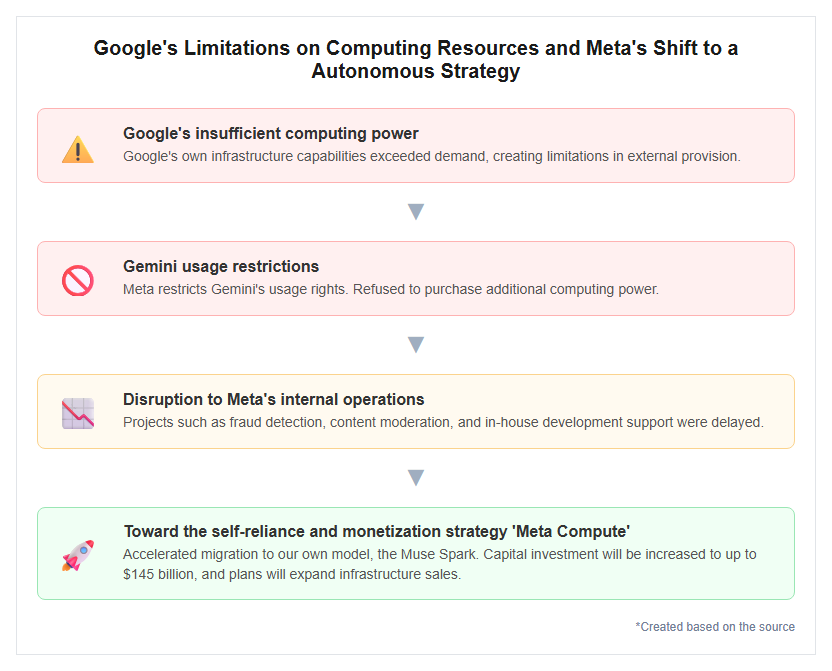
In response to this situation, Meta is instructing employees to save on token consumption while accelerating a strategic shift to reduce dependence on external providers. Specifically, they are rapidly migrating workloads that previously relied on external models to their in-house developed “Muse Spark.” Painfully aware of the risk that the core of the business would be dominated by the allocation of resources by other companies, this became a powerful driving force behind the “Meta Compute” initiative, which aims to balance monetization through in-house infrastructure and self-sufficiency.
A unique technological foundation supporting the AI infrastructure race
Accelerating the in-house development of MTIA chips toward 2027
The core that supports the competitiveness of the cloud business is Meta’s independently advanced AI chip roadmap. The company has unveiled an ambitious plan to launch four models of its proprietary “Meta Training and Inference Accelerator (MTIA)” series by the end of 2027. Currently, the latest generation “MTIA 300” is already in mass production and is mainly used for training Instagram’s recommendation system. As a successor model, the “MTIA 400 (Iris)” for inference tasks is scheduled to be deployed soon, with “MTIA 450 (Arke)” expected in early 2027 and “MTIA 450” in mid to late 2027, and “MTIA The deployment of the “500 (Astrid)” is scheduled. Unlike general-purpose GPUs, these chips are designed to meet Meta’s platform-specific needs, enabling significant cost savings and improved energy efficiency by eliminating unnecessary features. Meta is also maintaining multi-trillion yen procurement from NVIDIA and AMD, and through a dual-pillar strategy of “in-house development + external procurement,” it is stabilizing its supply chain and optimizing cost management.
Strengths of the B2C Large Language Model “Muse Spark”
At the core of Meta’s software is the new large language model “Muse Spark,” announced on April 8, 2026. This model was developed as a thorough B2C (consumer) assistant, while Google’s Gemini is strengthening its position as a B2B (enterprise and developer) infrastructure. Muse Spark features a multi-agent “Reflection Mode,” allowing multiple sub-agents to work concurrently on complex tasks like travel planning. Additionally, having trained in collaboration with over 1,000 doctors, it is highly specialized in the medical and health fields, and its deep integration with social media platforms includes a “shopping mode” that understands Instagram and Facebook posts. Please refer to the diagram below.
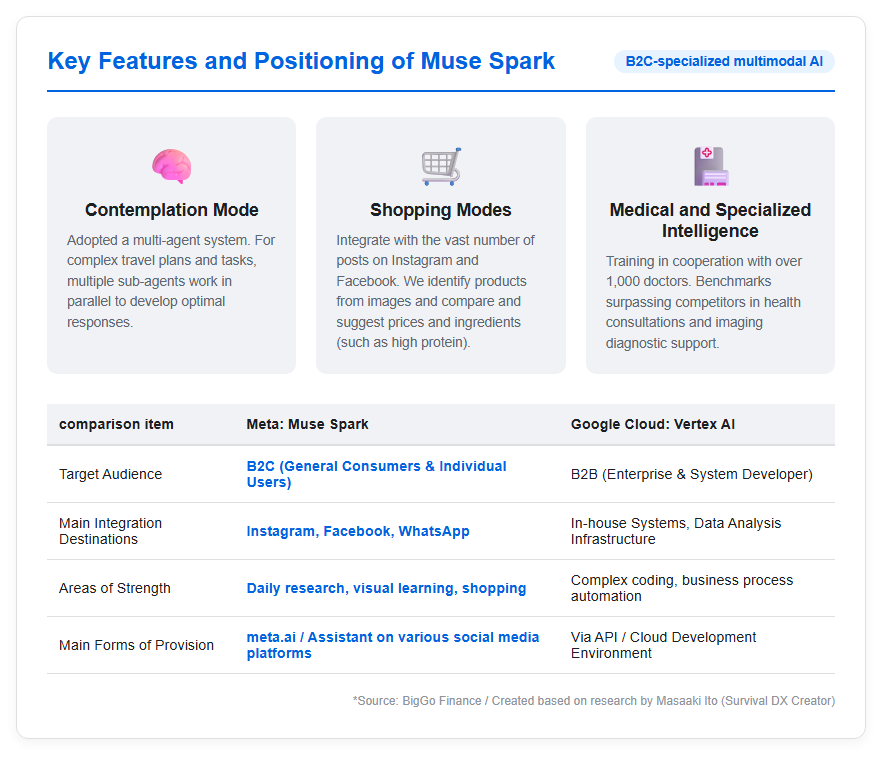
By offering this powerful proprietary model through Meta Compute, Meta aims to provide developers who want to build consumer AI applications with unique added value that AWS, Azure, or Google Cloud cannot offer.
Restructuring the Business Model and Future Outlook
The Story of Asset Efficiency and Shifts in Market Valuation
Meta’s recent move symbolizes a shift in the AI industry’s focus from simply “model performance competition” to a “story of asset efficiency” about efficiently monetizing massive investments in assets. Meta has raised its capital expenditure forecast for 2026 to an astronomical figure of up to $145 billion (approximately 23.1 trillion yen), making establishing a channel to recover this massive expenditure a top priority for maintaining investor confidence. Following reports of its entry into the cloud business, Meta’s stock price surged nearly 10% in after-hours trading, while emerging cloud companies specializing in computing power, such as CoreWeave, plunged more than 10%. This reflects the potential for super platforms like Meta, which own hyperscale data centers, to reassess the scarcity of computing power in the market and reshape the industry structure as they venture into external sales of surplus resources. Whether Meta’s future corporate value will be determined not only by stacking GPUs but also by linking them to high-value application scenarios and transforming them into stable commercial revenue.
Diversifying Monetization and Completing an AI Empire
In addition to its cloud business, Meta is rapidly rolling out a diversified monetization model. In places like Singapore, Meta AI has begun testing paid subscription plans ranging from $7.99 to $19.99 per month, exploring direct billing for AI features. Furthermore, the introduction of value-added plans for social media such as Facebook Plus and Instagram Plus is being considered, clearly moving away from a single-track advertising approach. CEO Zuckerberg is betting that AI infrastructure itself will become the next massive platform business, much like cloud computing once did. Ten years ago, the company defended its position in social media by imitating other companies’ functions, but its current entry into the cloud market aims to build a “tech empire” in the new domain of enterprise technology. If Meta succeeds in monetizing its surplus computing power, it will reign as the fourth giant in the current three-way cloud market dominated by Amazon, Microsoft, and Google, marking a historic turning point that dramatically improves the company’s balance sheet.
[#Meta #クラウドコンピューティング #人工知能 #MetaCompute #MuseSpark #DX #米国株 #資産効率]

コメント