The Financial Services Agency has launched a survey on the review of contracts at non-life insurance agencies. This move aims to correct the improper relationships between insurance companies and large agencies and restore a healthy market environment where customer interests are prioritized.
- Key Points of the Incident: An Unusual Investigation by the Financial Services Agency
- Risks faced by in-house and large-scale agencies
- Excessive Favoritism and the End of the ‘Territory System’
- Resolving collusion through reduction of policy-held shares
- Renewing the fee system and emphasizing self-sufficiency
- Future Developments and Key Points: Industry Restructuring Toward 2026
Key Points of the Incident: An Unusual Investigation by the Financial Services Agency
The Financial Services Agency is currently conducting a large-scale survey on how major non-life insurance companies review or terminate contracts with insurance agents. The main purpose of this investigation is to verify whether excessive favors provided by non-life insurance companies to specific agents, or conversely, unfair contract termination, violate the Insurance Business Act or Antimonopoly Act.
Behind this is the fraudulent insurance claim case involving Big Motor, a major used car dealer, which became a major social issue in 2023. This issue revealed a back-and-forth pattern where non-life insurance companies, in order to maintain their own share of insurance sales, either tolerated fraud by Big Motor, the agent, or provided convenience by introducing accident vehicles. Additionally, scandals such as advance adjustment of premiums (cartels) in corporate insurance have been uncovered one after another, causing a significant loss of trust in the entire non-life insurance industry. Please refer to the diagram below.
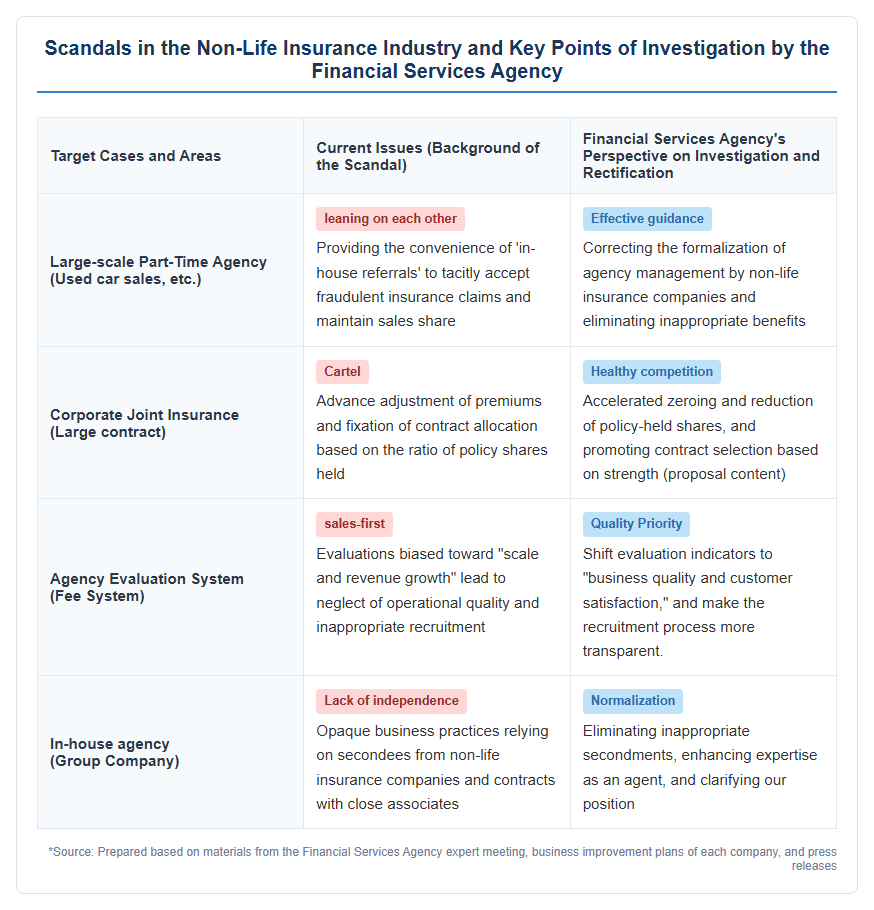
The FSA views these scandals not as isolated incidents but as structural challenges within the industry. Therefore, we decided to conduct this survey to rigorously verify whether non-life insurance companies are effectively guiding and managing agents, and whether customers’ appropriate product choices are being distorted.
Risks faced by in-house and large-scale agencies
The particular focus of this survey is on in-house agents that exist as group companies of large corporations, as well as large-scale part-time agents such as automobile dealerships. In-house agencies often serve as a source for the parent company’s employees, and there is a frequent shortage of highly specialized personnel. As a result, opaque business practices have persisted, relying on secondees from non-life insurance companies for practical operations, with priority treatment of products from specific non-life insurance companies in return.
Additionally, there are concerns that large agencies, leveraging their strong sales networks, demand favorable contract terms or excessive sales cooperation from non-life insurance companies. The Financial Services Agency has pointed out that such relationships may fall under the category of “provision of special benefits” prohibited under the Insurance Business Act. In particular, when non-life insurance companies second-staff in ways that hinder the agency’s independence or by purchasing excessive goods or services to encourage priority handling of their own products, customers lose the opportunity to maximize their benefits.
This investigation will closely examine the actual standards by which agency contracts are reviewed to break off such inappropriate relationships. This is not just a confirmation of legal compliance, but an important process for fundamentally rebuilding the governance framework of the entire industry.
Traditional Practices That Hinder Healthy Competition
Excessive Favoritism and the End of the ‘Territory System’
Japan’s non-life insurance industry has unique business practices that have long hindered healthy competition. Typical examples include the “territory system,” where a specific non-life insurance company exclusively supplies products to specific agents such as car dealers, and the effectively “one-company recommended sales.” As a result, consumers have lost the opportunity to compare and choose multiple products, and agents have abandoned their neutral stance in exchange for the benefits they receive from specific insurance companies.
Dispatching secondees from non-life insurance companies to agencies is also a major target for correction. Until now, secondees have been used as tools to build close relationships by taking over agency duties, which has led to leaks of customer information and a factor that leads to preferential recommendations for certain insurance products. The Financial Services Agency is calling for agencies to establish a system that enables them to independently carry out their duties, and inappropriate secondments are moving toward resolution. Please check the following structural diagram.
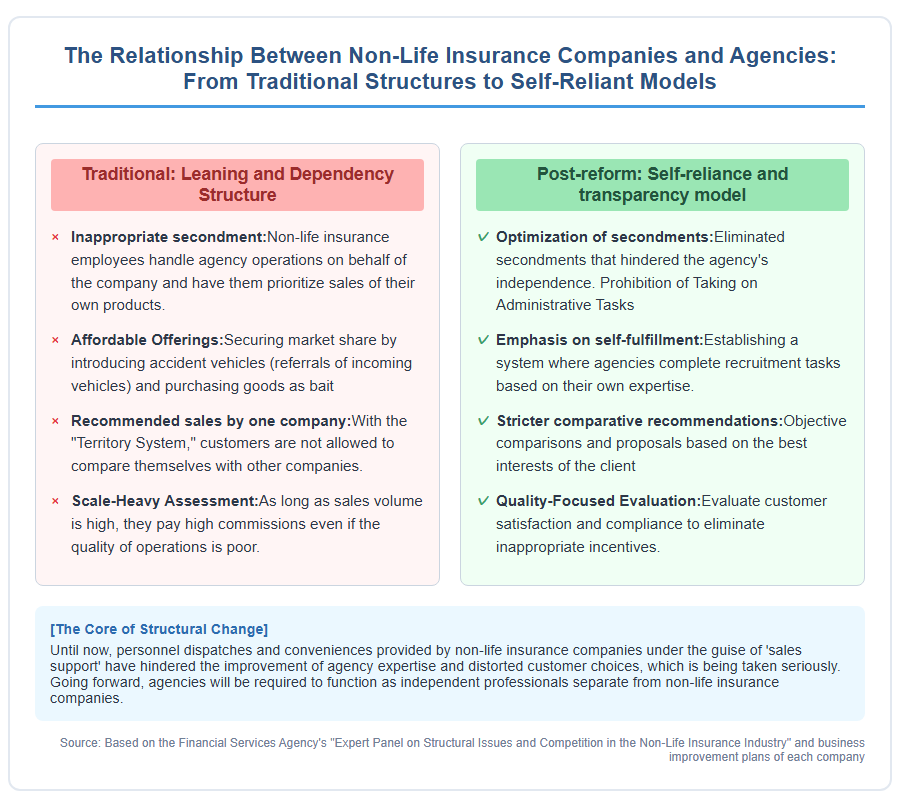
Furthermore, when non-life insurance companies evaluate agents, they have so far used criteria that have been extremely biased toward “scale,” such as sales volume and revenue growth. This is analyzed as an incentive for agencies to prioritize sales over quality of operations. The Financial Services Agency has instructed a review of this evaluation system, and currently, the transition to a new fee point system is underway, emphasizing the quality of customer service and thorough compliance.
Resolving collusion through reduction of policy-held shares
The existence of “policy shareholdings” has been a strong link between non-life insurance companies, client companies, and their in-house agents. The four major non-life insurers (Tokio Marine & Nichido, Sompo Japan, Mitsui Sumitomo Insurance, and Aioi Nissay Dowa) have held shares of approximately 6.5 trillion yen at market value, totaling 5,900 companies, in order to maintain relationships with their business partners. This cross-shareholding was a breeding ground for unhealthy transactions, where the share of the insurance contract was determined by the ownership ratio rather than the superiority of the proposal.
The Financial Services Agency is strongly urging these policy holdings to approach zero, and non-life insurers have announced accelerated sales. If cross-shareholding is resolved, companies will be compelled to select insurance companies from a fairer perspective, promoting healthy competition based on merit. This is attracting attention from investors as a positive move that leads to improved capital efficiency.
However, due to the rapid revision of agency contracts that have previously assumed stock ownership, some agencies face management crises or risk disputes over contract termination. This survey by the Financial Services Agency serves as an important breakthrough to monitor such disruptions to ensure they do not disadvantage consumers and to promote transparent contract reviews.
Market transparency and future prospects
Renewing the fee system and emphasizing self-sufficiency
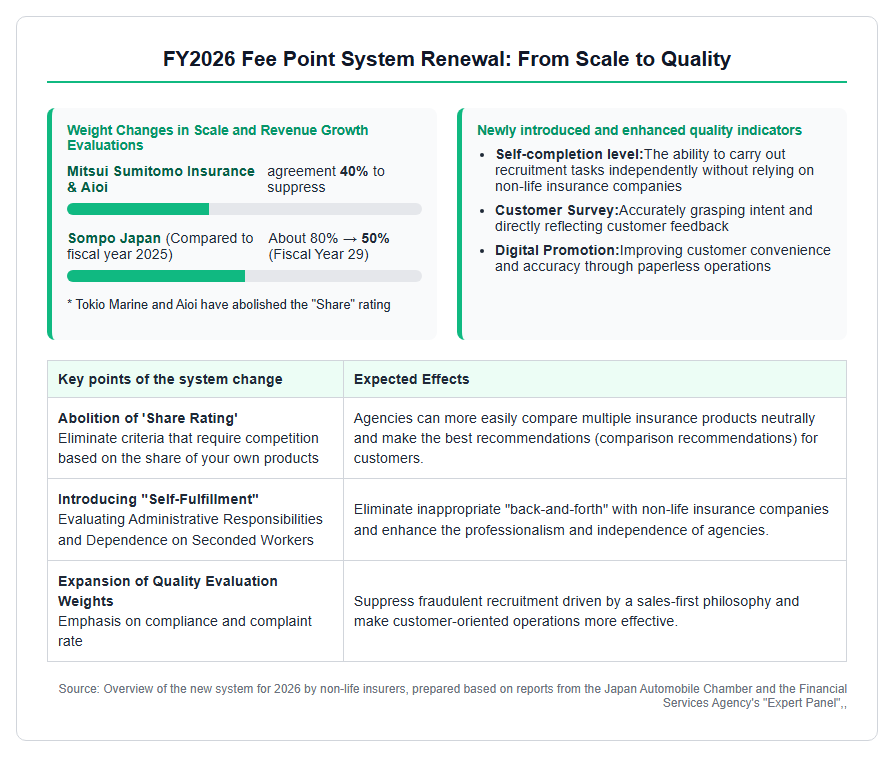
In the structural reform of the non-life insurance industry, the new “Fee Point System” to be introduced from fiscal 2026 will play an extremely important role. The four major non-life insurers have significantly reduced the proportion of insurance sales scale and growth rate, which had been the main factors in evaluations, and instead decided to place “operational quality” at the center of their evaluations. Specifically, Mitsui Sumitomo Insurance and Aioi Nissay Dowa will keep their scale valuations to about 40%, and Sompo Japan also plans to reduce their valuations to around 50% in the future.
A new evaluation metric attracting attention is the agency’s “self-sufficiency.” This is an indicator that measures how well an agency can complete appropriate recruitment tasks on its own, without relying on secondees from non-life insurance companies or administrative staff. As a result, capable agencies are fairly recognized, while those that have relied on collusion with non-life insurance companies are forced to be eliminated or reorganized.
Additionally, to objectively measure customer satisfaction, there is a growing trend to incorporate survey results into evaluations. In some areas, the promotion of paperless operations is also being evaluated, and improvements in customer convenience through digitalization are progressing. These reforms mark a shift from an era when agents “sold to insurance companies” to an era where “customers face the best proposals.” Please refer to the following trends.
Future Developments and Key Points: Industry Restructuring Toward 2026
The results of this survey by the Financial Services Agency will directly lead to a full-scale revision of the recruitment rules scheduled for 2026. In particular, the rules for “comparative recommended sales” have become stricter, making it practically difficult for car dealers and others to recommend products from a single company. Consumers will benefit greatly from being able to choose the most suitable insurance for their needs from multiple options.
The industry as a whole may undergo major restructuring in the coming years. It is expected that small agencies unable to adapt to stricter regulations, or in-house agencies that have relied solely on relationships with specific non-life insurance companies, will be consolidated or consolidated into large, specialized agencies. This is an essential process to enhance market transparency and build a healthy insurance market that stands up to international standards.
From an investor’s perspective, administrative penalties due to scandals have temporarily weighed on stock prices, but there are also expectations that ongoing structural reforms will lead to increased corporate value in the medium to long term. Under strict supervision by the Financial Services Agency, how sincerely non-life insurance companies can implement business improvement plans and renew the old sales-first organizational culture will be the biggest focus in restoring trust in the Japanese market.
[#金融庁 #損害保険 #代理店 #ガバナンス #政策保有株 #経済ビジネス]

コメント