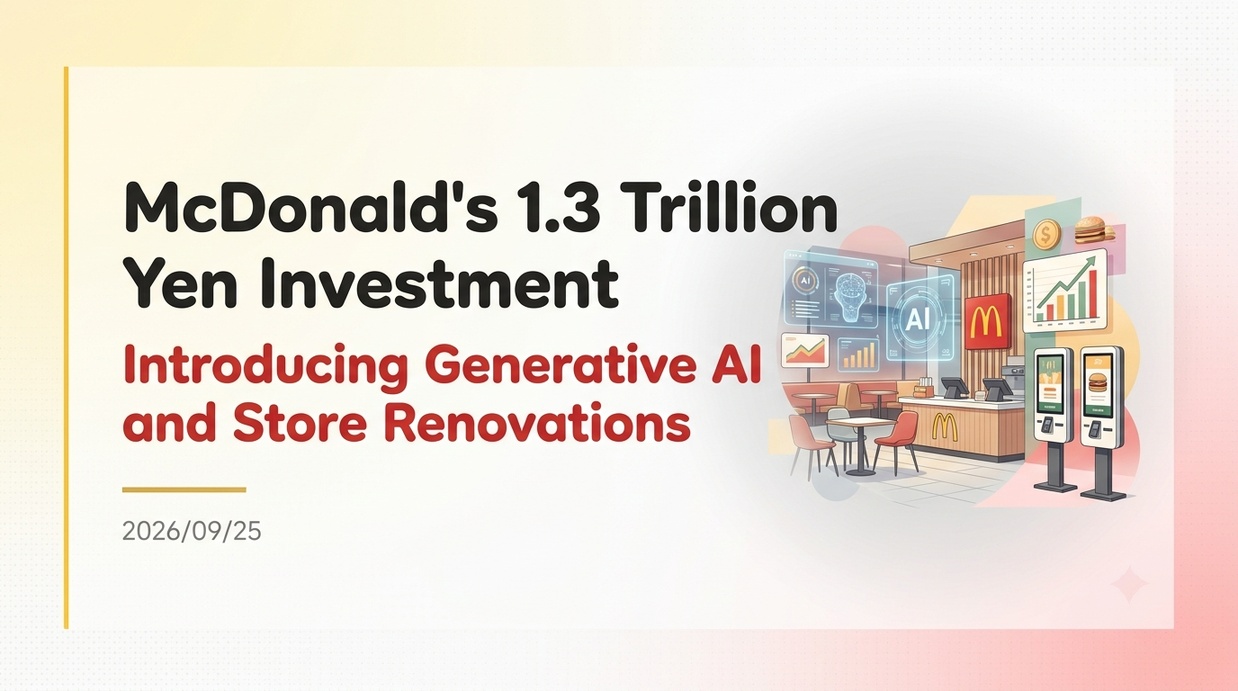
In September 2026, McDonald’s Corporation unveiled “McDonald’s > NEXT,” a global growth strategy pledging up to \$8.5 billion in franchisee investments through 2036. By deploying advanced generative AI and modernizing restaurant design, the fast-food giant aims to streamline store operations, reclaim lost market share, and drive long-term margin expansion.
- $8.5 Billion Franchisee Support and the Rollout of “ArchIQ” Generative AI
- Pivoting from Past Failures: The Strategic Partnership with Google
- Modernizing Store Layouts and Restoring the Elements of “Play”
- Reclaiming Market Share in Poultry and Beverage Segments
- Slower U.S. Growth and Contrast with Competitor Burger King
- 2030 Financial Targets and the Standout Performance of McDonald’s Japan
- Global Execution Risks and Strategic Road Ahead
$8.5 Billion Franchisee Support and the Rollout of “ArchIQ” Generative AI
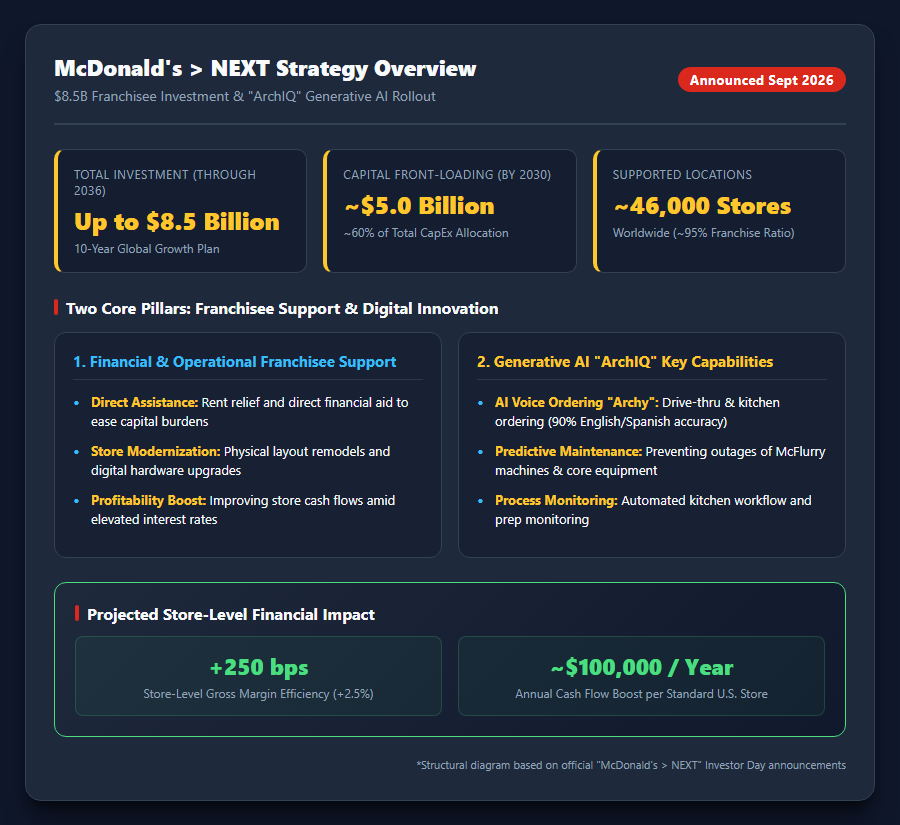
At its Investor Day on September 23, 2026, McDonald’s Corporation unveiled “McDonald’s > NEXT,” a strategic roadmap pledging up to \$8.5 billion in capital expenditure over the ten-year period leading to 2036. The primary objective of this massive capital injection is to bolster support for its franchise network, which accounts for roughly 95% of its 46,000 locations across more than 100 countries. By 2030, McDonald’s plans to front-load approximately \$5 billion—or nearly 60% of the total budget—to accelerate store digitization through rent relief and direct financial assistance. At the heart of this initiative lies the wide-scale deployment of “ArchIQ,” a proprietary generative AI ecosystem. Its automated voice-ordering assistant, “Archy,” deployed across drive-thrus and kitchens, boasts an order-taking accuracy rate of 90% in both English and Spanish. Furthermore, generative AI will be leveraged for predictive maintenance to prevent frequent outages of McFlurry ice cream machines, as well as for automated monitoring of kitchen prep operations. McDonald’s estimates that these advanced technology integrations will improve store-level gross margin efficiency by approximately 250 basis points (2.5%). For a standard U.S. location, this translates to an estimated annual cash flow improvement of around \$100,000, significantly alleviating financial burdens for franchisees facing elevated interest rates. The diagram below illustrates the overall structure of franchisee support and generative AI integration.
Pivoting from Past Failures: The Strategic Partnership with Google
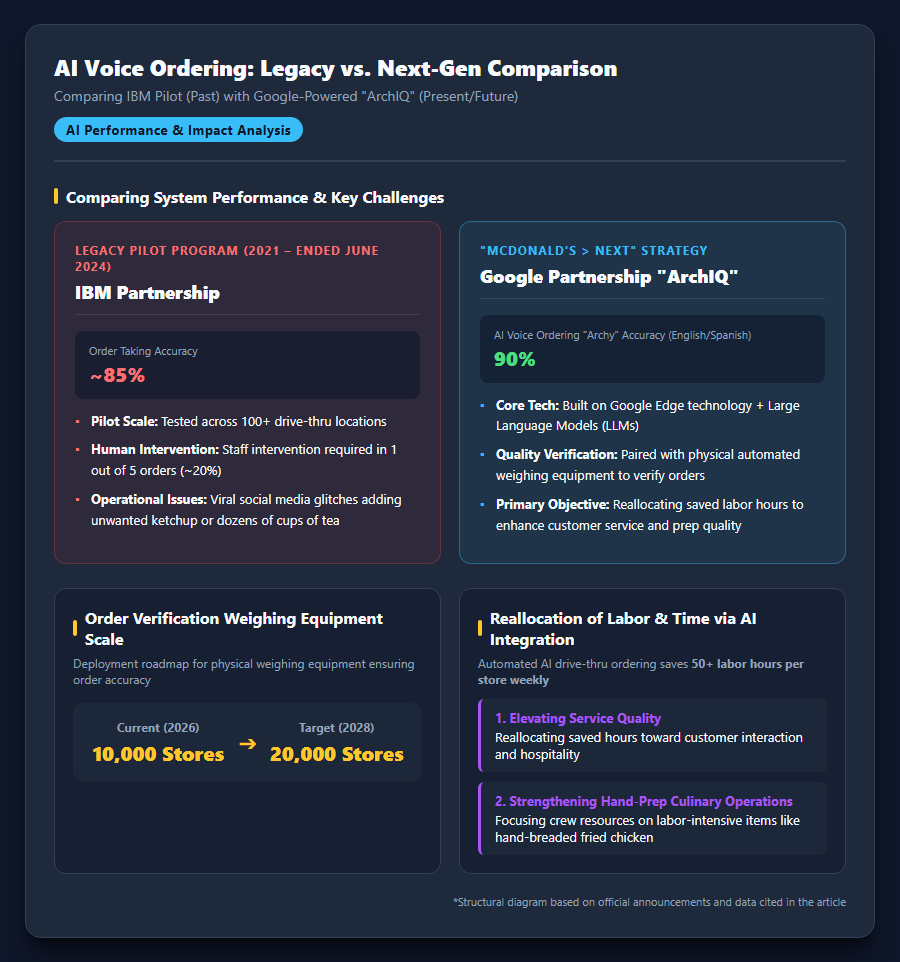
This is not McDonald’s first foray into AI-driven operational automation. Since 2021, the fast-food giant had partnered with IBM to pilot automated voice ordering at over 100 drive-thru locations. However, the system gained notoriety after viral social media videos captured bizarre ordering glitches—such as adding ketchup or dozens of cups of tea to an ice cream order. With order accuracy hovering around 85%, requiring human intervention in one out of every five orders, McDonald’s officially ended the IBM test in June 2024. To overcome these technological hurdles, McDonald’s established a new strategic alliance with Google. Built upon Google Edge technology and advanced Large Language Models (LLMs), ArchIQ delivers vastly superior learning capabilities and natural language processing precision compared to systems from just a few years ago. In addition, McDonald’s is expanding its deployment of physical automated weighing equipment to verify order accuracy. Having installed these systems in 10,000 stores globally as of 2026, the company plans to scale this footprint to 20,000 stores by 2028. Crucially, company leadership emphasizes that this AI rollout is not intended for workforce reduction. While AI drive-thru ordering saves more than 50 labor hours per store weekly, those saved hours will be reallocated toward elevated customer service and labor-intensive prep processes. The chart below provides a comparative overview of the legacy vs. next-generation AI ordering systems.
[Business & Store Strategy] Redefining Customer Experience & Elevating Core Categories
Modernizing Store Layouts and Restoring the Elements of “Play”
“McDonald’s > NEXT” extends far beyond IT infrastructure, delving deep into store architecture and physical customer experience. McDonald’s franchisees typically operate under 10-year remodeling agreements, spending \$400,000 to \$450,000 per location on standard upkeep such as repainting, roof repairs, and parking lot maintenance. Under the new strategy, corporate headquarters is introducing a higher-grade productivity package, requiring an additional investment of approximately \$800,000 per store in the U.S. and \$650,000 to \$750,000 internationally. Corporate will co-fund a portion of this burden through rent subsidies and direct incentives. From a design standpoint, McDonald’s is moving away from the sterile, gray-dominated aesthetic of recent years, modernizing and reintroducing nostalgic 90s-inspired design elements favored by loyal consumers. By bringing back updated indoor Playplaces featuring slides and climbing frames, the brand seeks to boost visit frequency among family demographics. Furthermore, McDonald’s is launching a proprietary retail media network utilizing drive-thru digital display boards. Third-party ad delivery tests are currently underway across 450 corporate-owned restaurants, with the potential to grow into a new, high-margin revenue stream generating \$1 billion over time.
Reclaiming Market Share in Poultry and Beverage Segments
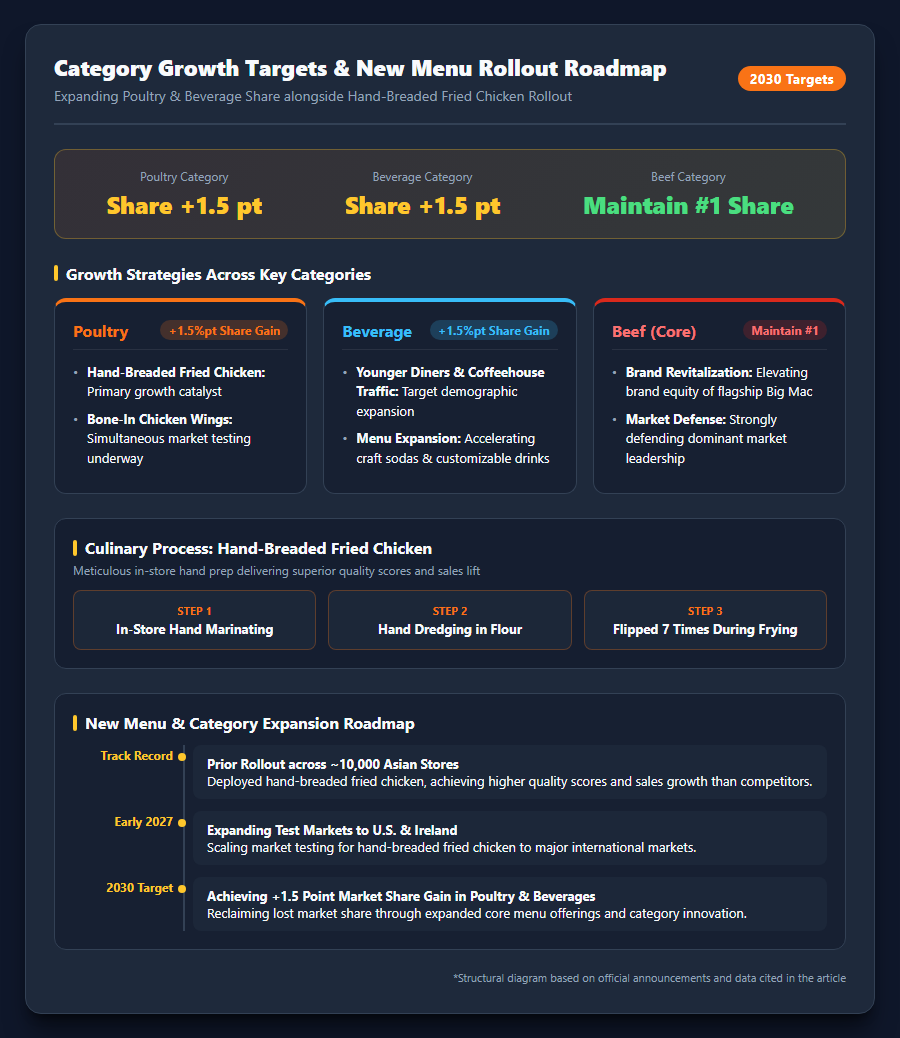
Product innovation serves as another fundamental pillar driving sales velocity. McDonald’s has set clear quantitative targets for 2030, aiming to expand its market share by 1.5 percentage points in both the poultry and beverage categories. The flagship catalyst for this push is its hand-breaded fried chicken program, which has already yielded strong results across approximately 10,000 locations in Asian markets. The culinary process involves store employees manually marinating raw chicken, hand-dredging it in flour, and flipping it seven times during frying to achieve a uniform, crispy texture. Having recorded superior quality scores and sales lift over competitors during Asian trials, full-scale market testing will expand to locations in the United States and Ireland starting in early 2027, alongside ongoing tests for bone-in chicken wings. In beverages, McDonald’s is accelerating the development of craft sodas and customizable drinks to capture younger consumers and coffeehouse traffic. Meanwhile, in its core beef portfolio, the company plans to preserve its market-leading position while revitalizing the brand equity of its flagship Big Mac. The visual below details category growth targets and the new menu rollout roadmap.
[Market Impact & Outlook] Turnaround Strategy Amid Growth Headwinds
Slower U.S. Growth and Contrast with Competitor Burger King
The decision to execute an overhaul costing up to \$8.5 billion stems from a pronounced growth slowdown and declining foot traffic in McDonald’s home U.S. market. Recent quarterly metrics indicate that U.S. same-store sales grew by a modest 0.8% year-over-year, while customer foot traffic contracted by 3.1%. In stark contrast, primary rival Burger King posted an 8.5% increase in same-store sales and a 7.1% surge in guest counts, outperforming a broader fast-food industry average that suffered a 2.8% traffic decline. While Burger King successfully captured value-conscious diners through aggressive menu pricing and a comprehensive chicken nugget reboot, McDonald’s cumulative price hikes amid persistent inflation led to consumer pushback. This operational divergence is reflected in equity valuations: McDonald’s stock dropped 18% year-to-date in 2026, including a nearly 5% intraday slide on the day of the Investor Day presentation. Conversely, Restaurant Brands International (QSR), parent company of Burger King, saw its shares rise 4.6%, contrasting sharply with McDonald’s underperformance relative to the S&P 500’s 13% gain over the same period. Additionally, as franchisees face higher borrowing costs under sustained elevated interest rates, substantial corporate co-investment has become essential.
2030 Financial Targets and the Standout Performance of McDonald’s Japan
In tandem with its investment announcement, McDonald’s published long-term financial targets through 2030. Driven by enterprise-wide operational efficiencies, the company aims to expand its operating margin from 46.1% in 2025 to the mid-50% range by 2030. Furthermore, it targets reducing General & Administrative (G&A) expenses as a percentage of systemwide sales from 2.2% in 2026 to approximately 1.9%, while driving free cash flow conversion into the mid-to-high 80% range. Annual baseline capital expenditures are projected at approximately \$3 billion from 2027 through 2030, with top-line sales growth contributions from new store openings expected to normalize from 2.5% in 2027 to around 2.0% by 2030. Standing in notable contrast to global franchise headwinds is McDonald’s Japan. Listed on the Tokyo Stock Exchange, McDonald’s Holdings Company (Japan) operates under an independent Medium-Term Management Plan (FY2025–2027), advancing over 1,000 store renovations and more than 100 net new openings. While the U.S. market grapples with traffic contraction, McDonald’s Japan has sustained 43 consecutive quarters of positive same-store sales growth, operating 3,031 restaurants nationwide as of late March 2026 with resilient profitability.
Global Execution Risks and Strategic Road Ahead
The ultimate success of the \$8.5 billion “McDonald’s > NEXT” transformation hinges on operational execution at the store level and alignment across its global franchisee base. On October 5, 2026—coinciding with the 124th anniversary of founder Ray Kroc’s birth—McDonald’s will launch “Make It Golden,” a comprehensive multi-year global training initiative for corporate staff, restaurant crew, and franchise owners designed to re-anchor store-level quality and hospitality. While technology investments like ArchIQ are modeled to yield a franchise payback period of approximately four years, macro headwinds such as sticky interest rates and rising wage pressures remain critical variables. In the near term, value-driven promotions—such as \$2 breakfast sandwiches offered via the mobile app—will be deployed to win back cost-sensitive customers. As McDonald’s embarks on this dual-track strategy combining cutting-edge AI automation with traditional culinary craftsmanship, retail and QSR industry observers worldwide are closely monitoring whether the fast-food giant can successfully reclaim lost market share and maintain its growth trajectory toward 2030.
Reference Pages
-
【McDonald’s Corporation】https://corporate.mcdonalds.com/corpmcd/our-stories/article/NEXT-growth-strategy-advances.html
-
【U.S. Securities and Exchange Commission (SEC)】https://www.sec.gov/Archives/edgar/data/63908/000006390826000076/exhibit991-investorupdate2.htm
[#McDonalds #GenerativeAI #ArchIQ #StoreRemodeling #FoodTech #RestaurantIndustry #BusinessStrategy]


コメント