The government and the Bank of Japan are considering opening up individual loan data from major banks to external research institutions and others as early as within fiscal 2026. This initiative is driven by the need to grasp micro-level credit risks that cannot be captured by macroeconomic averages and to strengthen evidence-based policymaking (EBPM).
- Overview of External Release of Lending Data Aiming for Full-Scale Operation in FY2026
- The Economic Realities Obscured by Conventional Averages and the Need for Micro Analysis
- Direct Impact on the Bank of Japan’s Rate Hike Decisions and Search for the Neutral Rate
- Advanced AI Analysis That Balances Zombie Company Identification and Startup Support
- Thorough anonymization and strict information management through on-site facilities
- Insights from Global Advanced Case Studies and Key Focus Areas for Japan’s Financial Ecosystem
Overview of External Release of Lending Data Aiming for Full-Scale Operation in FY2026
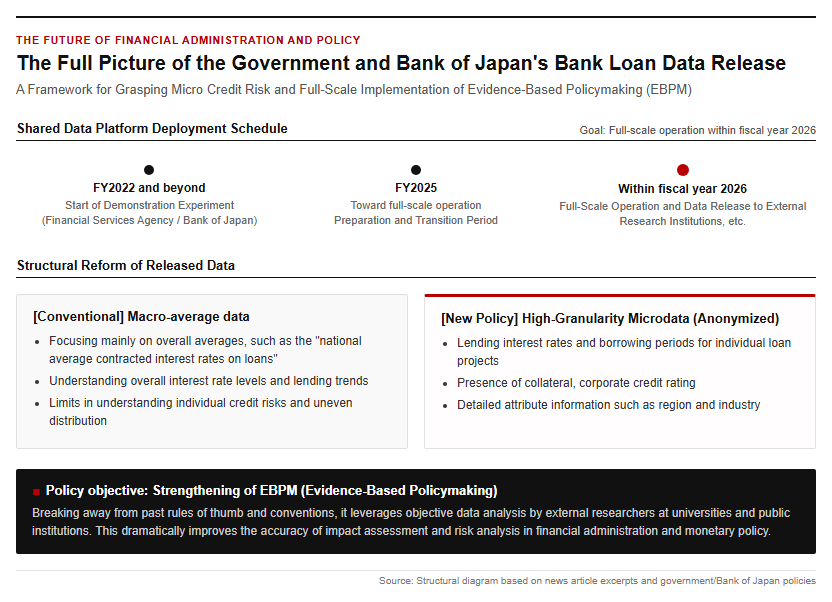
The Japanese government and the Bank of Japan have decided to make detailed loan data—obtained through management surveys of major banks and other methods—available to external researchers at universities and public institutions as early as fiscal 2026. The Financial Services Agency and the BOJ have been conducting proof-of-concept experiments for a “Joint Data Platform” since fiscal 2022, and are advancing plans to launch it into full operation between fiscal 2025 and fiscal 2026.
Up until now, the data published by the authorities has primarily consisted of macro data averaging overall figures, such as the “Average Contract Interest Rates on Loans and Discounts nationwide” for interest rates on loans made by banks across the country to businesses. However, under the new initiative, highly granular micro data—including attribute information such as the lending rates applied to individual loan transactions, borrowing periods, the presence or absence of collateral, corporate credit ratings, as well as regions and industries—will be anonymized and subjected to analysis.
In policymaking, the initiative to utilize objective data and scientific evidence instead of relying on conventional past practices or personal rules of thumb is called EBPM (Evidence-Based Policymaking). A major objective of this external opening is to introduce EBPM in earnest within the areas of financial administration and monetary policy, thereby dramatically improving the accuracy of policy impact verification and risk analysis. Please refer to the diagram below for an illustration of how loan data is utilized.
The Economic Realities Obscured by Conventional Averages and the Need for Micro Analysis
Why is the external release of lending data being emphasized so much right now? The primary reason is that as the long-standing negative interest rate policy is lifted and we transition into a “world with interest rates,” macroeconomic averages alone can no longer accurately capture the actual conditions occurring at the grassroots level of the economy.
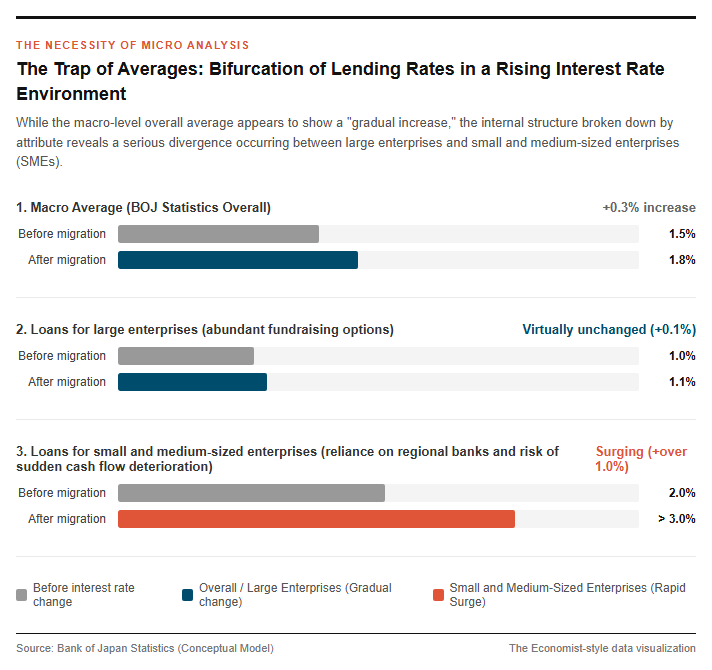
For example, if Bank of Japan statistics show that the overall average lending rate has risen by 0.3 percentage points from 1.5% to 1.8%, it may at first glance appear that the economy as a whole is gradually adapting to higher interest rates. However, breaking down the internal structure may reveal a serious polarization hidden beneath the surface: while lending rates for large corporations with abundant financing options remain virtually unchanged, edging up only from 1.0% to 1.1%, rates for small and medium-sized enterprises (SMEs) that have no choice but to rely on local regional banks are surging sharply from 2% to over 3%.
Viewed through the filter of conventional averages, the strong figures of large corporations tend to mask the sudden cash flow crunches and hardships faced by small and medium-sized enterprises (SMEs). By opening up high-granularity loan data to external researchers and conducting multifaceted analyses, it becomes possible to meticulously elucidate interest rate sensitivities and financing risks across company sizes, regions, and industries.
Specific Data Utilization Methods in Monetary Policy and Administrative Supervision
Direct Impact on the Bank of Japan’s Rate Hike Decisions and Search for the Neutral Rate
High-precision analysis of loan data has a direct impact on the monetary policy pursued by the Bank of Japan, particularly in judging the timing and magnitude of additional interest rate hikes. One of the most critical factors the BOJ emphasizes when determining monetary policy is how changes in the policy rate are permeating the grassroots of the real economy and corporate financing.
For example, when the Bank of Japan raises its policy interest rate by 0.25%, analyzing massive volumes of monthly loan contract renewal data allows us to quickly confirm the ripple effect on actual lending rates. If corporate lending rates fail to rise despite the rate hike due to fierce competition among banks for customers, it can be judged that the effects of monetary easing remain strong and that there is room for additional rate hikes.
Conversely, if interest rates for small and medium-sized enterprises were to spike suddenly and a massive number of deteriorations in debt classifications were detected, it would lead to a decision to hit the brakes on rate hikes. In searching for the landing point of the “neutral interest rate”—which neither overheats nor cools the economy—the analysis of microdata serves as a powerful tool for adjusting policy reins down to the millimeter.
Advanced AI Analysis That Balances Zombie Company Identification and Startup Support
In terms of financial regulation and industrial policy, the utilization of advanced data science and AI is expected to correctly interpret the context of companies borrowing at high interest rates. Under conventional blanket aggregation, all companies bearing high interest rates tended to be treated as cash-strapped “zombie companies.”
However, if the borrowing period is as long as 10 years and the sales growth rate significantly exceeds the IT sector average, that high interest rate can be identified as a risk premium anticipating future innovation. On the other hand, companies with a short borrowing period of just six months that repeatedly take out short-term loans to pay past interest can be accurately identified as zombie companies from the context of the data.
To analyze hundreds of millions of multidimensional big data records, traditional bureaucratic organizations and standard economic models alone lack sufficient resources. By combining AI technologies and advanced statistical expertise held by universities and private research institutions, we can extract valuable insights from previously buried data. Please refer to the figure below for the platform’s analysis structure.
Technical Framework for Confidentiality and Future Outlook
Thorough anonymization and strict information management through on-site facilities
Bank loan data contains highly confidential information, such as company names, partner bank names, individual loan interest rates, and collateral conditions. In the unlikely event that this information is leaked, it could lead to reputational damage involving credit anxiety or bankruptcy risks for specific companies, making stringent security measures essential.
Rather than being released in an open data format that anyone can freely obtain on the internet, this data release will undergo thorough anonymization processing. Specifically, after removing and processing identifying information so that individual companies and financial institutions cannot be identified, access rights will be granted only to a limited number of researchers who have passed a rigorous screening process.
Furthermore, researchers are strictly prohibited from downloading data onto their own personal computers. Access is permitted only within on-site isolated rooms physically disconnected entirely from government-managed internet networks, or via dedicated terminals equipped with advanced security. The only items permitted to be taken outside are calculated and analyzed statistical results, structurally eliminating the risk of data leaks.
Insights from Global Advanced Case Studies and Key Focus Areas for Japan’s Financial Ecosystem
Overseas financial authorities are already advancing the construction of integrated reporting platforms utilizing granular data. For example, in Austria, a single database is operated through “AuRep,” which is funded by private banks, and mechanisms are in operation where central banks and regulatory authorities collaborate to collect and share granular data, such as Italy’s “PUMA” and Canada’s “RRS”.
In light of global trends, the development and external opening of shared data platforms in Japan will have a significant impact not only on financial administration but also on the business models of financial institutions as a whole. In particular, as the importance of “transaction banking” based on transaction and accounting data grows, we have entered an era where data quality and ecosystem building determine the quality of lending.
Much attention is focused on future developments to see how the promotion of EBPM, which brings together industry and academic expertise, will enhance transparency in the lending market and contribute to setting appropriate risk premiums and ensuring a smooth supply of funds to growth industries.
Reference page
- [Financial Services Agency] Basic Survey Report on the Construction of a Joint Data Platform: https://www.fsa.go.jp/
- [Bank of Japan] Initiatives for Further Strengthening Cooperation between the Financial Services Agency and the Bank of Japan: https://www.boj.or.jp/
- [Basel Committee on Banking Supervision, Bank for International Settlements (BIS)] Report on Data Sharing: https://www.bis.org/
【#BankLending #MonetaryPolicy #BankOfJapan #EBPM #BigData #FinancialRegulation #DataAnalysis】

コメント