
On July 7, 2026, Anthropic announced that it will significantly expand the scope of its support program for open source software (OSS) developers, called “Claude for Open Source.” With this initiative, certified developers can use the company’s top-tier subscription plan, Claude Max 20x, free for six months.
- Gratitude to the developer community and the highest level of support
- Strict and specific selection criteria
- Past “Claude Code” Billing Anomalies
- New Payment Rules Introduced from June 2026
- A turnaround in the enterprise market
- Developer Retention and Countering the “Multi-Vendor Strategy”
- The Suspension of Publication of ‘Fable 5’ and Lessons from Export Controls
- Entering the commercialization phase of autonomous AI agents
Gratitude to the developer community and the highest level of support
The expansion of the “Claude for Open Source” initiative announced by Anthropic on July 7, 2026, is a powerful backup measure for open source software (OSS) developers who underpin the AI development ecosystem. The campaign offers the company’s most exclusive subscription plan, the “Claude Max 20x,” which lasts for six months. This plan offers usage limits far exceeding the regular Pro plan ($20 per month, about 3,170 yen) and the higher-end Max plan.
Since launching this campaign in February 2026, Anthropic has expressed gratitude for the contributions of OSS developers, and with this expansion, a broader range of developers will have access to this advanced intelligence. Especially as 2026 approaches, not only the performance of AI models but also the operational capability to integrate them into practice and automation is being questioned, gaining the support of developers has become a top strategic priority for companies.
Strict and specific selection criteria
Several specific numerical criteria are established to be recognized as eligible for this campaign. First, OSS administrators or library authors need to have more than 500 repositories dependent on the project, more than 100 packages, or over 200,000 monthly downloads in each language’s registries. Additionally, developers of core technologies registered as administrators or committers in prominent OSS organizations are also eligible.
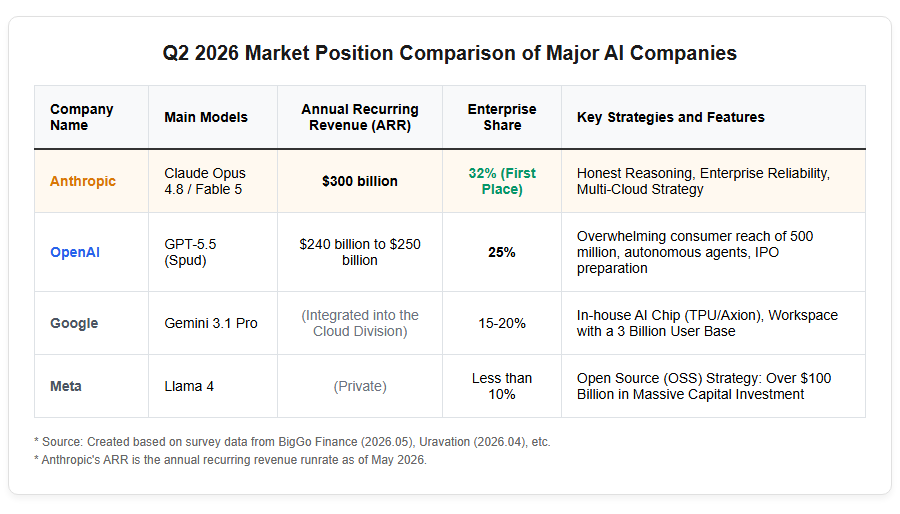
Furthermore, individual activity records are also valued, including “active developers” who created and merged over 100 pull requests for repositories they did not own in the past year, and “community builders” who accepted pull requests from more than 20 external developers in their own repositories. Even if these do not apply, if the ecosystem maintains a critical component it secretly depends on, individual consultation via a dedicated site is recommended. The chart below shows the positions of each company in the AI market.
[Background and Challenges] Strengthening the billing system to restore trust
Past “Claude Code” Billing Anomalies
The background behind this free offering is not just simple support, but is widely seen as a reflection on the billing trouble involving the programming support tool ‘Claude Code’ that occurred in March 2026. At the time, a program bug caused the prompt cache function to expire, causing users’ available slots to deplete at an abnormal rate of 10 to 20 times higher than usual. One user reported that simply typing “hello” consumed 13% of their session slot.
In response to this issue, Anthropic implemented compensation measures in April 2026, including offering up to $200 in additional credits to paid users free of charge, but criticism of the lack of transparency in the charging system remained within the user community. This six-month free campaign also serves as a strategic “apology stone” to restore the trust of developers damaged by such technical disruptions through overwhelming resource provisions, preventing outflows to rival companies like OpenAI.
New Payment Rules Introduced from June 2026
Another major move toward restoring trust is the fundamental change to the billing rules implemented on June 15, 2026. Previously, subscriptions included a mix of human interaction and ‘automated usage’ via SDKs or GitHub Actions, but the new rules separate these categories. Interactive usage remains a subscription within the plan, but automated usage has shifted to a format where each plan consumes the “monthly credit” allocated ($20 for Pro, $200 for Max 20x).
This change improves the issue of unexpected depletion of usage slots caused by the automation program running out of control, preventing human work. On the other hand, there are constraints such as credit sharing within teams or the inability to carry over to the next month, requiring users to manage their budgets carefully according to their workloads. The “Max 20x” plan offered in this campaign means you have the right to enjoy the most abundant resources under these latest billing systems.
[Significance of the Market] Strengthening the developer ecosystem to chase OpenAI
A turnaround in the enterprise market
In the AI market in Q2 2026, Anthropic has made dramatic strides. According to the latest financial data, the company’s annual recurring revenue (ARR) reached $300 billion, surpassing OpenAI, the longtime champion, which surpassed $240~$250 billion, marking a dramatic turnaround. In particular, in the enterprise market, Anthropic holds a 32% share, far ahead of OpenAI’s 25%, taking the lead.
The key to this success lies in Anthropic’s consistent focus on “safety and reliability” since its founding. In fields requiring strict precision and governance such as legal, medical, and coding, Claude’s model emphasizing “honest reasoning” since the fourth generation has gained strong support from enterprise users. This campaign for OSS developers aims to deeply penetrate the brand image of “trust” into the technical community.
Developer Retention and Countering the “Multi-Vendor Strategy”
Currently, many enterprise users have begun adopting a “multi-vendor strategy” that does not rely on specific AI, using different models according to their intended use. In this context, Anthropic’s offer of a six-month free subscription to OSS developers serves as a powerful hook to turn developers’ work environments into a “Claude-all” style. Once developers become proficient with Claude’s ecosystem and proprietary specifications like the Model Context Protocol (MCP), the high productivity of these systems makes switching to other companies’ services difficult.
Additionally, backed by a massive $40 billion investment from Google, Anthropic is also surpassing OpenAI in terms of securing computing resources. As they advance infrastructure development utilizing their own chips and SpaceX’s computing resources, a bullish stance is evident in returning this vast computing power to the world through a “free campaign” to establish the de facto standard.
[Future Outlook] Stable Supply of Next-Generation Models and Regulatory Barriers
The Suspension of Publication of ‘Fable 5’ and Lessons from Export Controls
A future concern is how the government responds to regulations. The flagship model, the Claude Fable 5, was publicly unveiled on June 9, 2026, and achieved an astonishing 95.0% score on SWE-bench Verified, a programming task measure, but was forced to halt it just 96 hours after release due to U.S. government directives. This was due to export restrictions due to concerns over jailbreaks (circumvention of restrictions), and access to some users, including foreign employees, was also restricted.
This incident once again highlighted that AI models are now treated as “strategic assets” equivalent to nuclear technology, under the strong control of the state. While Anthropic supports OSS developers and expands its ecosystem, there is always a risk that the cutting-edge technologies it develops may become unusable. Going forward, how the company can continue to provide stable service to developers while meeting government safety standards will be the key factor determining its market dominance.
Entering the commercialization phase of autonomous AI agents
In the latter half of 2026, the stage for AI competition will fully shift from simple chat UIs to a commercialization phase where AI autonomously completes tasks. Anthropic’s current initiatives such as “Managed Agents” and the ability to autonomously improve workflows without user instructions are aiming to fundamentally transform corporate business processes. Through this campaign for OSS developers, it is predicted that by the end of 2026, the cycle of “AI improving AI” will accelerate even further, as these advanced agent features are incorporated into many libraries and tools.
For developers, this six-month free period should serve as a valuable trial to lead the next generation of AI-driven development. Anthropic is focusing not only on model performance but also on “operational capability” that earns developers’ trust, and the success or failure of this will directly impact the battle for the top spot in OpenAI’s IPO (Initial Public Offering) competition.
[#Anthropic #Claude #生成AI #オープンソース #OSS #プログラミング #AIエージェント #テックニュース]
コメント