GitHub in the US has made the desktop app version of “GitHub Copilot” available to all user groups, including the free plan. Behind this is the strategic aim to secure control over developer infrastructure as autonomous development by AI agents becomes widespread.
- All plans for the GitHub Copilot app are now available.
- The role of desktop apps supporting “agent-driven development”
- Benefits of “BYOK” that lets you bring your own API
- Utilizing local models and cross-platform support
- Rising Operating Costs and Changes in Billing Models
- Future Developments: Intensifying Competition and Ecosystem Evolution
All plans for the GitHub Copilot app are now available.
On July 7, 2026, GitHub announced that the “GitHub Copilot app,” which had previously been available only to paid subscribers, would be available on all plans. This allows users of the free “Copilot Free” plan and “GitHub Education” for students and teachers to adopt the app without restrictions. Users can start their first session within a few clicks simply by signing in with their GitHub account.
This is driven by an overwhelming user base, with the number of developers on GitHub surpassing 150 million by the end of 2024. Even with the free plan, you get 2,000 code completion and 50 chat messages per month, and this app launch is a powerful initiative to deeply integrate these many free users into the GitHub ecosystem.
The role of desktop apps supporting “agent-driven development”
This app is not just a supplementary editor tool, but is designed as a home hub for agent-driven development. Its biggest feature is the ability to efficiently manage issues and pull requests across multiple repositories. Developers can gain an overview of the overall project progress together with AI, going beyond the boundaries of an IDE (Integrated Development Environment).
Furthermore, it features a function that allows you to check and control the operational status of multiple AI agents running in parallel all on a single screen. The diagram below illustrates how agents operate within the app.
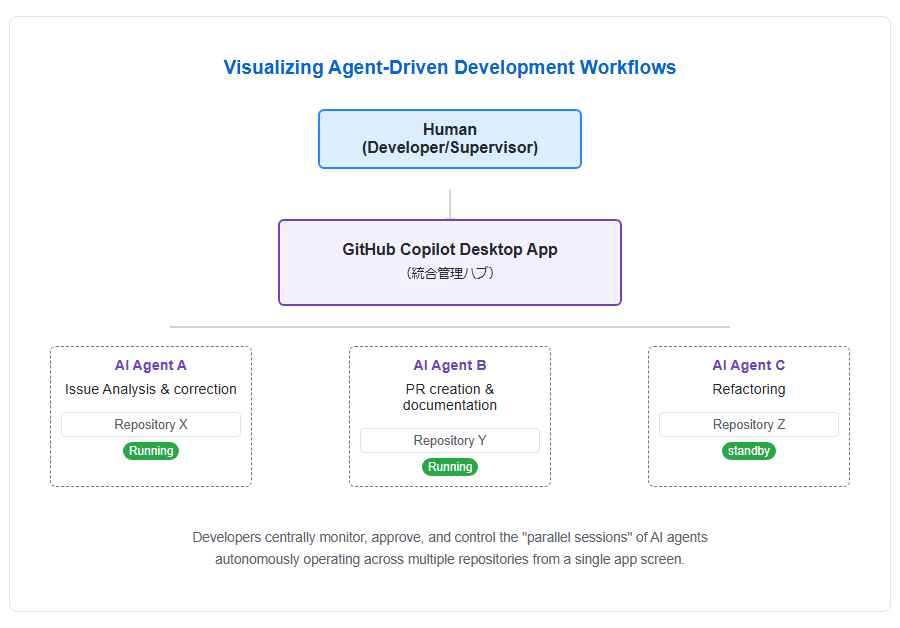
Thus, visualizing increasingly complex AI-driven autonomous workflows and providing a dedicated interface for developers to manage AI as “supervisors” symbolizes a major turning point in development methodologies.
Flexible external integration and advanced customization
Benefits of “BYOK” that lets you bring your own API
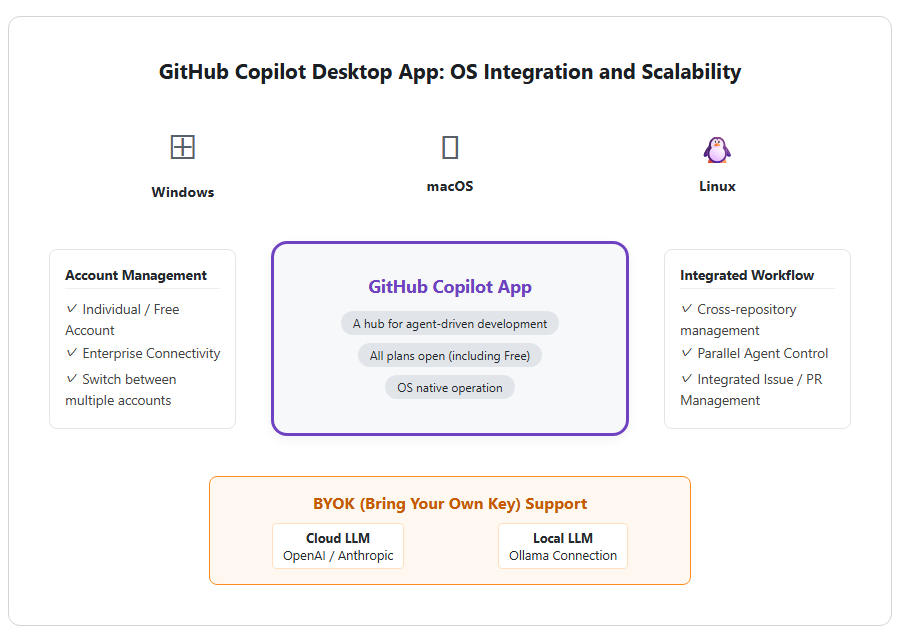
Another major attraction of this app is its support for “BYOK (Bring Your Own Key),” which allows you to bring your own API key and use it. This allows users to directly connect and use not only the standard models provided by GitHub but also the latest models they have contracted with such as OpenAI and Anthropic.
This flexibility prevents developers from being locked into specific vendors and gives them the freedom to use AI according to project requirements, costs, or the tasks specific models excel at. For example, you can use the latest Claude model for complex logic design and a cheaper model for formulaic code generation—all within a single app.
Utilizing local models and cross-platform support
Furthermore, this app supports integration with local models running on your own PC. Specifically, by connecting local LLMs managed by platforms like “Ollama,” it can be utilized for highly confidential projects where you do not want to publish code externally, or for development in offline environments.
This app supports all major operating systems including Windows, macOS, and Linux, and can be downloaded for free from the official website. Even with enterprise plans like “Copilot Business” or “Copilot Enterprise,” if administrators have enabled “Copilot CLI” in policy settings, they can benefit from this app while maintaining overall governance across the organization. The diagram below shows the integration between different operating systems.
The economics and future prospects of AI development tools
Rising Operating Costs and Changes in Billing Models
While the convenience of AI tools increases, their operational costs remain an unavoidable challenge. Since January 2026, GitHub Copilot’s weekly operating costs have nearly doubled, and Microsoft and GitHub are gradually shifting their billing methods from the traditional flat-rate system to a pay-as-you-go system based on token consumption.
In particular, the “agent-based” workflow that the app focuses on is estimated to consume 5 to 30 times more tokens than simple code completion. To address this, environments like Visual Studio 2026 have introduced meter features that allow real-time monitoring of AI credit consumption. While the launch of free plans expands the user base, it presents new management challenges for companies in how to sustainably provide these vast computing resources.
Future Developments: Intensifying Competition and Ecosystem Evolution
With the GitHub Copilot app now open to all users, the battle for share with competing tools like “Cursor” and Anthropic’s “Claude Code” is expected to intensify further. Currently, the startup community is experiencing astonishing growth, with Claude Code usage reaching 75%, and GitHub is undergoing a comprehensive infrastructure overhaul to maintain its position.
Going forward, the act of “writing code” itself will be fully entrusted to AI, and developers’ main duties will shift to “conveying intent to AI” and “auditing generated results.” The GitHub Copilot app is expected to become even more important as a command center for these “engineers who don’t write code” to control the entire project.
[#GitHub #Copilot #AIエージェント #プログラミング #ソフトウェア開発 #生成AI #DX]

コメント