Kylin OS, a domestic Chinese operating system, has established technology that enables native execution of Android applications in Linux desktop environments. This move comes against the backdrop of China’s strategy for independent and innovative information technology (Xinchuang), which aims to provide a powerful alternative to the existing Windows ecosystem.
- Open-sourcing the Android app runtime environment “KMRE”
- Accelerating the Xinchuang strategy toward the goal of full domestic production by 2025
- Container-based native behavior that does not rely on virtual machines
- Seamless functional integration with the desktop environment “UKUI”
- Broad compatibility with diverse hardware platforms
- The Inevitability and Evolution of ‘Migration and Integration’ in the 5G and AI Era
- Breaking away from a global technology stack and the future of proprietary ecosystems
Open-sourcing the Android app runtime environment “KMRE”
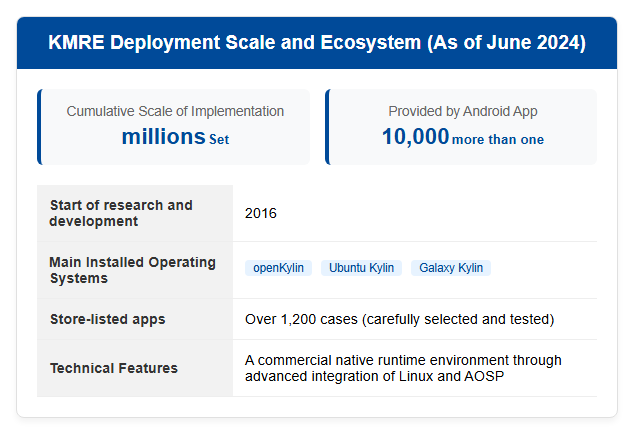
OpenKirin (openKylin), a Chinese open-source community, officially announced on June 7, 2024, that it will open-source the Kylin Mobile Runtime Environment (KMRE). KMRE is a compatible runtime environment designed to seamlessly run the Android mobile ecosystem on Linux desktops. This project began research and development in 2016 and is considered China’s first commercial transfer and consolidation ecosystem solution that integrates Linux and AOSP (Android Open Source Project) technologies. To date, millions of sets have been deployed across openKylin, Ubuntu Kylin, and Galaxy Kylin, providing over 10,000 mature Android apps for desktop users. With KMRE becoming open source, developers can access the source code and adapt to broader Linux distributions and expand functionality. Please refer to the diagram below.
Accelerating the Xinchuang strategy toward the goal of full domestic production by 2025
Behind Galactic Kirin’s rush to integrate with mobile apps is the Chinese government’s massive national strategy of information technology application innovation industries (Xinchuang). According to the “File No. 79” issued by the State-owned Assets Supervision and Administration Commission in September 2022, the goal is to domestically produce 100% of central enterprises’ OA (public service) systems by the end of 2025 and to complete comprehensive domestic substitution from hardware to software by 2027. Until now, the biggest challenge faced by domestic Linux-based OSes was the vulnerability of the ecosystem, which was a lack of office software and entertainment applications for Windows. However, by directly integrating the Android ecosystem, which has one of the world’s largest number of apps, through KMRE, China’s domestic OS is aiming to quickly overcome the challenge of ecosystem shortages. This technological breakthrough marks a crucial step toward breaking dependence on overseas software and building an IT infrastructure that can be autonomously controlled.
Research methodology and unique technical basis
Container-based native behavior that does not rely on virtual machines
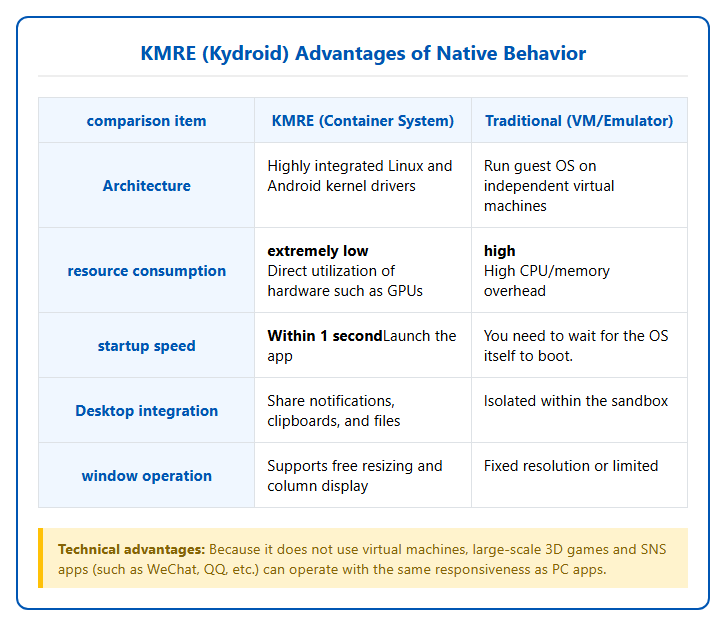
The biggest feature of KMRE is that it eliminates traditional technologies like simulators and virtual machines (VMs), creating a native execution environment based on container architecture. Simulators and virtual machines had drawbacks such as heavy system resource consumption and low integration with desktop OSes. In contrast, KMRE highly integrates the kernels, drivers, and security frameworks of both Linux and Android operating systems. This enabled Android apps to minimize emulation overhead and directly utilize hardware resources like GPUs to run faster. For example, large-scale 3D games and social media apps (such as QQ and WeChat) have been verified to launch and operate stably with performance comparable to desktop apps. Please refer to the diagram below.
Seamless functional integration with the desktop environment “UKUI”
KMRE not only runs Android apps but also achieves advanced integration with the Galaxy Kirin desktop environment (UKUI). Specifically, desktop components such as the notification center, taskbar, start menu, and system tray are shared between Android and Linux apps. Users can launch Android apps directly from desktop shortcuts, allowing windows to be displayed in full screen, divided columns, and freely resized. It also features clipboard sharing, file exchange, and audio input synchronization, allowing multiple Android apps to run simultaneously in multi-window. This creates an environment where mobile-optimized apps can be comfortably operated as part of the desktop OS using mouse and keyboard.
Broad compatibility with diverse hardware platforms
KMRE is designed to support a wide range of hardware environments, including China’s own chipsets. Regarding CPUs, it supports not only domestic Chinese brands like Phytium, Zhaoxin, Haiguang, HiSilicon, and Kunpeng, but also major x86 architectures such as Intel and AMD. In terms of GPUs, it supports domestic Chinese cards such as JEMO, Moore Threads, and Xiintong, as well as most major international brands including NVIDIA, AMD, Intel, and Mali. This is the desktop version of OpenGL| This is achieved through ES adaptation, ensuring high compatibility and performance across different hardware. Thanks to this broad range of capabilities, KMRE operates not only on a single device but also on cloud platforms, supporting the fusion of mobile and fixed devices in multiple layers.
Future Developments and Highlights
The Inevitability and Evolution of ‘Migration and Integration’ in the 5G and AI Era
A key point to watch going forward is the trend where the boundaries between desktop (fixed) and mobile (mobile) will disappear further with the spread of new technologies such as 5G, IoT, and AI. The Galaxy Kirin development team points out that the era when the OS only covered servers and desktops is over, and seamless integration of all smart devices is inevitable. The Galaxy Kirin V11, officially announced on August 26, 2025, introduced the new “Rock Architecture,” promoting decoupling between the OS itself and apps. This allows you to build your app in a single go, further lowering the development barrier. Furthermore, advanced integration, such as simulating mobile device sensors on the PC side, is expected through AI assistant upgrades and sharing computing power (computing resources) technologies.
Breaking away from a global technology stack and the future of proprietary ecosystems
The development of KMRE symbolizes China’s intention to transform from a “user” of overseas platforms like Windows and Android to a “provider” with its own technology stack. Currently, over 1,200 carefully selected Android apps are available on the Galaxy Kirin software store and are available for free. Amid ongoing U.S. export restrictions, China has built a “white list” that can be controlled domestically—from core components such as CPUs, GPUs, and NPUs to the core execution environment of the OS—aiming for full self-reliance by 2027. The speed of its adoption and technical maturity will be the focus going forward to see how much this unique migration and fusion ecosystem will threaten Windows’ dominance against the backdrop of China’s massive user base.
[#銀河麒麟 #KylinOS #Linux #Androidアプリ #KMRE #信創 #中国技術 #国産OS]

コメント