Chinese AI startup Moonshot AI stopped accepting new individual users immediately after the release of its latest large language model, Kimi K3, citing a shortage of computing resources. This situation highlights the current situation where the rise of Chinese-made AI with astonishing performance is disrupting the global supply-demand balance of computing power and significantly impacting financial markets.
- Background of the Suspension of New Applications and Service Reorganization
- Technical Innovations in the Latest Model Kimi K3
- The Kimi Shock That Shook the Global Economy
- Bottlenecks in computing power and behind the scenes of development
- Hong Kong IPO Planning and Legal Risks Faced
- AI Commoditization and the New Era of Competition
Background of the Suspension of New Applications and Service Reorganization
On July 19, 2026, Beijing-based Moonshot AI announced it would immediately stop accepting subscriptions for new consumer (consumer end) users. This decision was made at an extraordinary pace, just two days after the unveiling of the company’s latest flagship model, the Kimi K3. According to the company, the main reason is that within 48 hours of the K3 release, user requests far exceeded their expectations and reached the capacity limits of existing compute clusters.
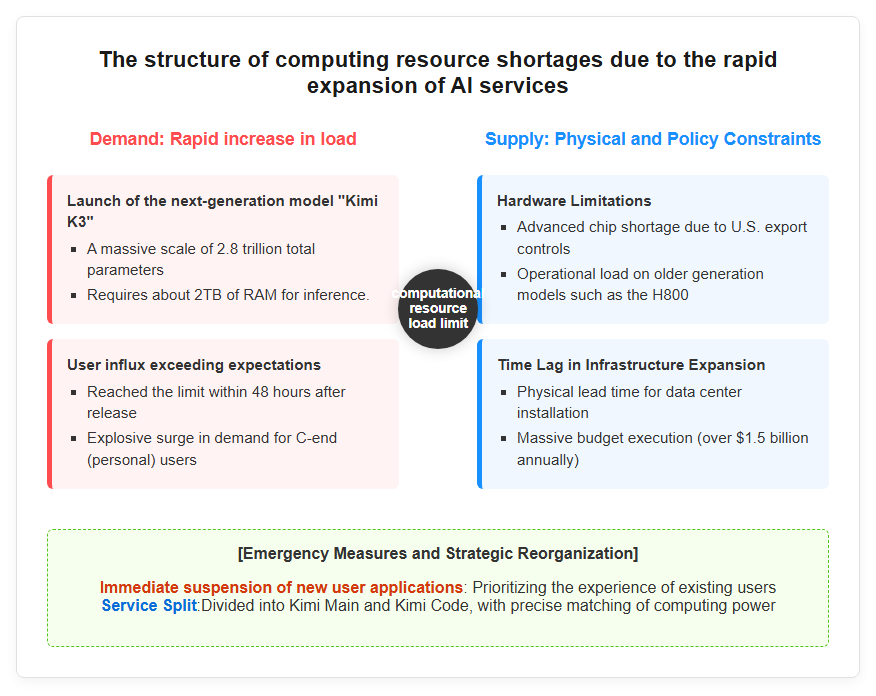
To meet this sharp increase in demand, the company prioritized allocating all existing computing resources to service maintenance for users who had already contracted it. The company is currently rapidly expanding its computing power and has indicated a plan to gradually resume acceptances as soon as preparations are complete. After resumption, changes to the product lineup are planned to optimize the allocation of computing resources. Specifically, the previously integrated services will be divided into “Kimi main interests” (including Web, APP, and Work) and “Kimi Code interests,” enabling more precise matching of computing resources. This measure has once again exposed the common computational bottleneck issues faced by China’s AI industry amid the rapid spread of large language models. The following chart illustrates the structure of computational resource shortages due to the rapid expansion of AI services.
Technical Innovations in the Latest Model Kimi K3
Unveiled without prior notice on July 17, 2026, the “Kimi K3” shocked the global AI industry with its overwhelming number of parameters and performance. K3 is an open-weight model with a total of 2.8 trillion parameters, adopting a mixed expert (MoE) architecture that activates about 50 billion parameters in a single process. This model achieves a vast context window for 1 million tokens and native multimodal support simultaneously through innovations in linear attention technology.
The K3’s biggest feature is its incredible cost performance. While delivering performance comparable to world-class closed-source AI, it keeps the cost per 1 million input tokens at about $3, less than half that of competing models in the US. In a blind front-end coding test conducted by the third-party evaluation agency Arena AI, K3 scored 1679 points to take the top spot, outperforming Anthropic’s Claude Fable 5 and OpenAI’s GPT-5.6 Sol. This result suggests that the U.S. technological dominance is beginning to waver, and industry insiders have commented: It is also described as the ‘Sputnik Moment of AI.’
Market Impact and the Battle for Computational Resources
The Kimi Shock That Shook the Global Economy
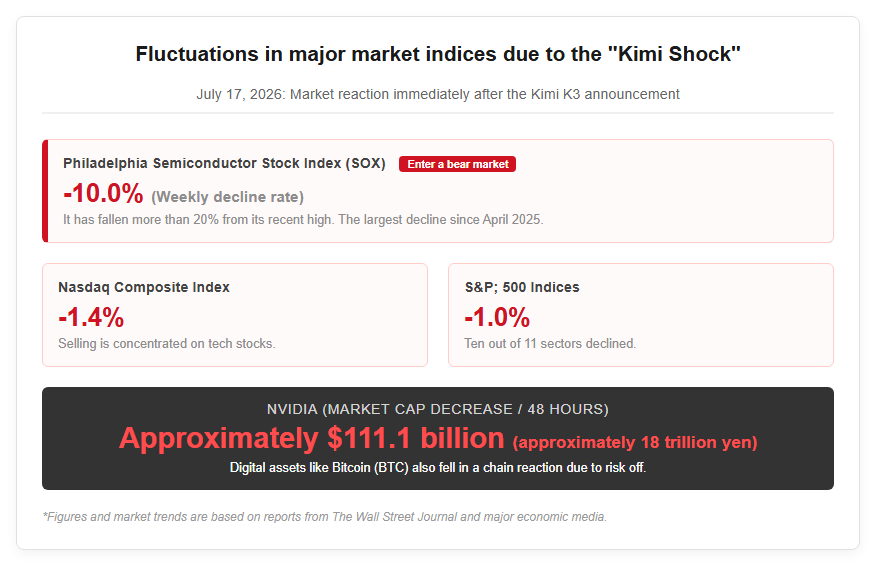
The announcement of Kimi K3 and the subsequent suspension of new admissions triggered a chain reaction of shockwaves in global financial markets. On the day of the announcement, July 17, 2026, the U.S. stock market saw heavy selling, especially technology stocks, with both the Nasdaq Composite and S&P 500 indices falling by more than 1%. The impact on semiconductor stocks was particularly significant, with the Philadelphia Semiconductor Stock Index (SOX), which includes major companies like NVIDIA and Broadcom, plunging 10% for the week and entering a bear market with a drop of more than 20% from its recent high.
As the Wall Street Journal headlined with “The Kimi Shock,” investors are increasingly wary of the collapse of existing AI business models due to China’s AI surge. This is because concerns are growing that the high valuation premiums previously offered to cutting-edge models will no longer be maintained with the advent of affordable open-weight models. Additionally, digital assets like Bitcoin have also been caught up in risk-off movements, demonstrating sensitivity to macro-level technology shocks. The chart below compares the fluctuations of major indices after the release of Kimi K3.
Bottlenecks in computing power and behind the scenes of development
The lack of computing power faced by Moonshot AI is not just a challenge for a single company, but rather a reflection of the essence of the current global AI development race. Interestingly, it has been revealed that the Kimi K3’s training was conducted on Huawei’s H800, which is two generations behind NVIDIA’s cutting-edge chip. While U.S. export restrictions limited access to advanced semiconductors, Chinese engineers pushed algorithm efficiency to the limit and pursued “hardware-software co-design” to compensate for hardware constraints through software innovation.
However, the inference load remains high, requiring about 2 terabytes of RAM to run K3 on-premises, and the demands for large-scale infrastructure continue to grow. Moonshot AI’s budget for computing resources this year is estimated to exceed $1.5 billion, and supply cannot keep up with the rapid user growth. The scarcity of these computing resources has further intensified competition within China, and internal competition within the investment ecosystem has begun, such as Alibaba’s launch of “Qwen 3.8 Max” to compete with its investment portfolio Moonshot AI.
Management Strategy and Future Outlook
Hong Kong IPO Planning and Legal Risks Faced
Alongside technological breakthroughs, Moonshot AI is rushing to establish a solid foundation in the capital markets. The company is currently aiming for an initial public offering (IPO) on the Hong Kong Stock Exchange within six months and is in discussions with Goldman Sachs and China International Resources Corporation (CICC) as lead underwriters. The company’s pre-investment valuation is expected to reach $31.5 billion (approximately 5.1 trillion yen), with annual recurring revenue (ARR) exploding from $100 million in March to $300 million in June, which supports this bullish valuation.
At the same time, management faces multiple challenges. Founder Yang Zhilin has been sued at the Hong Kong International Arbitration Centre by five investors of “Recurrent AI,” which he previously launched, citing unsettled legal liabilities. Investors claim that there were deficiencies in Yang’s procedures when launching Moonshot AI, but Yang counters that he resigned after proper procedures, highlighting legal uncertainty as a risk factor for the listing. Additionally, the company is simultaneously pursuing a complex organizational restructuring anticipating regulatory tightening by the Chinese government, such as dismantling the VIE (Variable Interest Entity) structure registered in the Cayman Islands and transitioning to a joint venture model.
AI Commoditization and the New Era of Competition
The future shown by Kimi K3 is the rapid commoditization of AI intelligence. Currently, the release frequency for cutting-edge models has been shortened from once every 60 days in 2024 to about once every 10 days. If this pace continues to accelerate, the advantages of the latest models will become obsolete within weeks, and frontier intelligence will completely transform into a “shelf life asset.” Emad Mostak and colleagues predict that within the next 18 months, advanced open-weight models operating on smartphones without internet connectivity will emerge, and the main battleground for AI will shift from model scale to inference costs and integration into specific domains.
The Chinese government also regards this technological innovation as a national priority. At the Politburo study session in April 2025, President Xi Jinping emphasized the balance between AI safety and development, calling for the establishment of risk monitoring and early warning systems. The rise of private companies like Moonshot AI is a symbol of China’s “new qualitative productive forces,” but it is also subject to strict oversight from a national security perspective. As the global AI arms race turns into a “Gray Reno (a predictable major risk),” the shock triggered by Kimi signals the dawn of a new era where technology, capital, and regulation are intricately intertwined.
[#MoonshotAI #KimiK3 #大規模言語モデル #AI開発 #中国技術 #半導体不足 #香港IPO #AI安全]

コメント