、エルニーニョ現象の発生を発表_en-1.png)
The World Meteorological Organization (WMO) has confirmed a sharp rise in sea surface temperatures in the equatorial Pacific and officially announced the occurrence of the El Niño phenomenon. This phenomenon is expected to intensify through the latter half of 2026, and combined with the effects of global warming, it is setting the stage for extreme weather disasters and economic disruptions worldwide.
- Official announcement and current status in July 2026
- Scientific Evidence and Reliability of the Occurrence
- Walker Circulation and Changes in Sea Surface Temperature
- Probability of Developing Super El Niño
- Extreme weather disasters around the world
- Severe economic losses and a blow to logistics
- Raising the Heat Level and the Risk of Heatstroke
- Increase in typhoons and alert for linear rainbands
- Direct impact on agricultural and fishery resources
- Corporate Climate Risk Management and Investment Strategies
- Peaks and Regime Shifts from Autumn to Winter
- Key Points for Strengthening Social Resilience
Official announcement and current status in July 2026
On July 3, 2026, the World Meteorological Organization (WMO) officially announced that an El Niño phenomenon has occurred, with sea surface temperatures off the coast of Peru in South America remaining above average. The occurrence of this phenomenon is said to raise temperatures across a wide range of the world, increasing the likelihood of abnormal weather such as heatwaves and heavy rainfall. According to WMO analysis, a continuous rise in sea surface temperatures has been confirmed in the equatorial Pacific region, and this phenomenon is expected to intensify further from July to September 2026. WMO Secretary-General Celeste Sauro strongly emphasized the need for early warnings to save lives and mitigate economic and social impacts. Prior to this, Japan’s Japan Meteorological Agency also announced on June 10, 2026, that the El Niño phenomenon is believed to have occurred for the first time in two years. The reason 2024 became the hottest year on record is the overlap of the previous strong El Niño and human-induced climate change, and there are strong concerns that this recurrence will further accelerate global warming.
Scientific Evidence and Reliability of the Occurrence
At the beginning of 2026, the equatorial Pacific was in a neutral state, but since spring, sea surface temperatures have risen rapidly. As of May, the sea surface temperature in the monitored area had already been recorded 1.2 degrees above the standard value, highlighting the characteristic of warm ocean surface water moving eastward. Currently, many climate models are showing consistent views, and scientific confidence in the outbreak remains very high. According to the Japan Meteorological Agency’s definition, an El Niño phenomenon occurs when the five-month moving average of the sea surface temperature difference in the monitored area remains positive by 0.5 degrees or more for six consecutive months, and this case is developing rapidly to meet this standard. Additionally, the weakening of easterly winds (trade winds) in the lower atmosphere of the central equatorial region has been confirmed, indicating that the atmosphere and ocean are interacting and intensifying the phenomenon.
Mechanism of the phenomenon and predicted intensity
Walker Circulation and Changes in Sea Surface Temperature
The El Niño phenomenon is part of the ENSO (El Niño Southern Oscillation), where sea surface temperature and atmospheric circulation in the equatorial Pacific region are closely linked. Normally, the trade winds blowing from east to west keep the seawater warm in the west and the offshore South America in the east keeping it cool, but during El Niño, this trade wind weakens. As a result, warm seawater accumulated in the west spreads out to the east off Peru, causing changes in the Walker circulation, a global atmospheric circulation. Changes in sea surface temperature shift the area where cumulonimbus clouds form eastward, and in response, the wind flow changes, causing significant changes in temperature and precipitation patterns worldwide, including Japan. Even slight changes in the ocean and atmosphere are triggering global abnormal weather events in a chain reaction.
Probability of Developing Super El Niño
This El Niño is being pointed out to potentially reach very strong intensity. A very strong condition where sea surface temperature deviates by more than 2.0 degrees on average over three months is called a Super El Niño, and the U.S. National Oceanic and Atmospheric Administration (NOAA) predicts a 63 percent chance of reaching this threshold between November 2026 and January 2027. In the past, only three cases have met this criterion in observational records: 1982–1983, 1997–1998, and 2015–2016. The spring predictability barrier, which is unique to spring, has already been resolved, and its strength is expected to become even clearer in the coming autumn. The WMO does not use the term ‘super’ as its official classification, but it has fully warned that it could become a strong phenomenon.
Global Impact and Socioeconomic Risks
Extreme weather disasters around the world
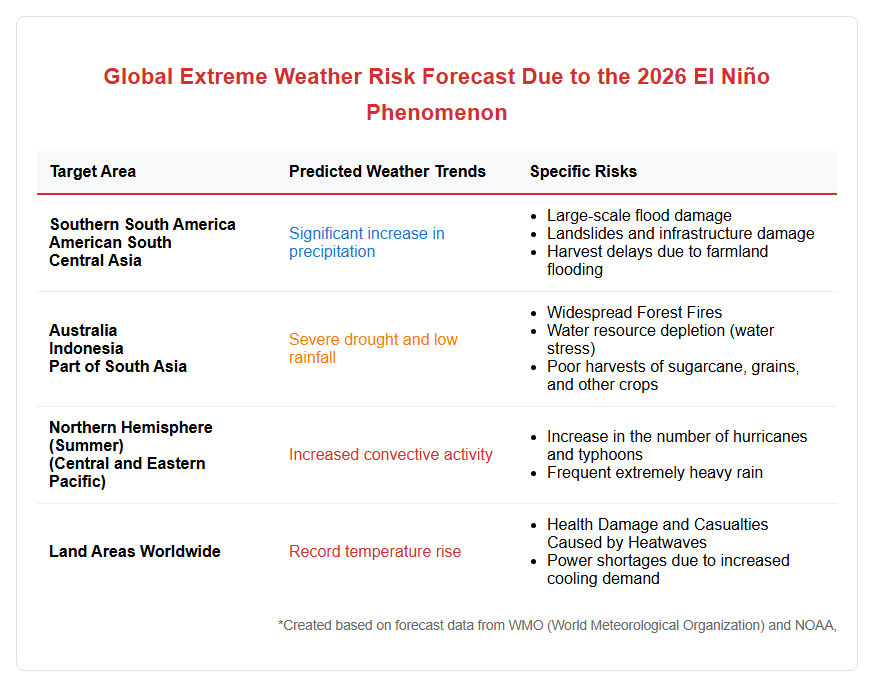
Due to the impact of El Niño, terrestrial temperatures are expected to be higher than average worldwide from May to July 2026. Specifically, rainfall increases in southern South America, the southern United States, and Central Asia, greatly raising the risk of floods and landslides. On the other hand, Australia, Indonesia, and parts of South Asia are concerned about the risks of severe droughts and forest fires. During summer in the Northern Hemisphere, hurricanes become more active in the eastern and central Pacific, while activity tends to be suppressed on the Atlantic side. These weather changes make proactive measures essential in fields such as agriculture, water resource management, and energy. There is no clear evidence that climate change itself is increasing the frequency of El Niño, but there is no doubt that ocean warming is amplifying the effects of extreme events. Please refer to the diagram below.
Severe economic losses and a blow to logistics
A super El Niño could cause astronomical losses to the global economy. According to research from Dartmouth College, the last Super El Niño event from 2015 to 2016 lost about $7.8 trillion (approximately 1,257.9 trillion yen) in global productivity. This phenomenon also risks overturning commodity prices, disrupting supply chains, and reigniting inflation. In logistics, for example, when water levels drop due to reduced rainfall in the Panama Canal, passage of large vessels is restricted, and increased transportation costs are added to supermarket product prices. Additionally, copper mines in Chile and Peru face supply disruption risks, and banks in India and Peru face the burning risk of loans to the battered agricultural and fisheries sectors. Climate phenomena have become a powerful natural threat forcing companies to significantly reconsider their equity investment strategies.
Unusual Impact on Japan’s Weather
Raising the Heat Level and the Risk of Heatstroke
Statistically, summers in Japan during El Niño events have been considered to be cold summers, but 2026 is predicted to bring exceptionally intense heat. This is due to the overall rise in temperatures caused by global warming, combined with the Indian Ocean dipole mode phenomenon that brings extreme heat near Japan. The Japan Meteorological Agency has newly added the term ‘extreme heat day,’ which refers to extremely dangerous heat above 40 degrees Celsius, in its forecasts and is calling for strict vigilance. By 2025, the number of emergency transports due to heatstroke will exceed a record high of 100,000, making it mandatory for companies to take measures to protect employee health and safety. Rising summer temperatures increase the energy costs of heating and cooling, which can also destabilize electricity supply and demand.
Increase in typhoons and alert for linear rainbands
With the outbreak of El Niño, the risk of water damage in Japan’s weather is also increasing. Due to increased convective activity due to tropical monsoons off the coast of the Philippines, the number of typhoons in 2026 is forecasted to reach 27 to 29, exceeding the average of about 25. Additionally, as the Pacific High becomes unstable, the activity of the rainy season front and autumn rain front becomes more active, and periods of increased risk such as linear rainbands tend to be prolonged. In recent years, the annual frequency of heavy rainfall has been on the rise, and river flooding and landslides have become serious physical risks that make business activities difficult to continue. Companies and local governments need to urgently establish evacuation plans and disaster information systems based on hazard maps.
Ripple Effects on Industry and Dining
Direct impact on agricultural and fishery resources
El Niño is a factor driving up the prices of major global raw materials for inflation. In the past, international sugar prices doubled due to poor sugarcane harvests caused by heatwaves in India and Thailand, and poor harvests of oil palms—the raw material for palm oil—affected prices for fried and processed foods. Off the coast of Peru, rising sea temperatures have drastically reduced the catch of anchovies, and this surge in fishmeal prices is spreading to the global livestock industry. In Japan as well, reports have emerged of poor rice quality and poor vegetable growth caused by high temperatures, accelerating the shift to replace Koshihikari rice, known as a branded rice, with new varieties that are more heat-resistant. Agricultural managers are being pressured to adjust planting seasons and thoroughly manage water.
Corporate Climate Risk Management and Investment Strategies
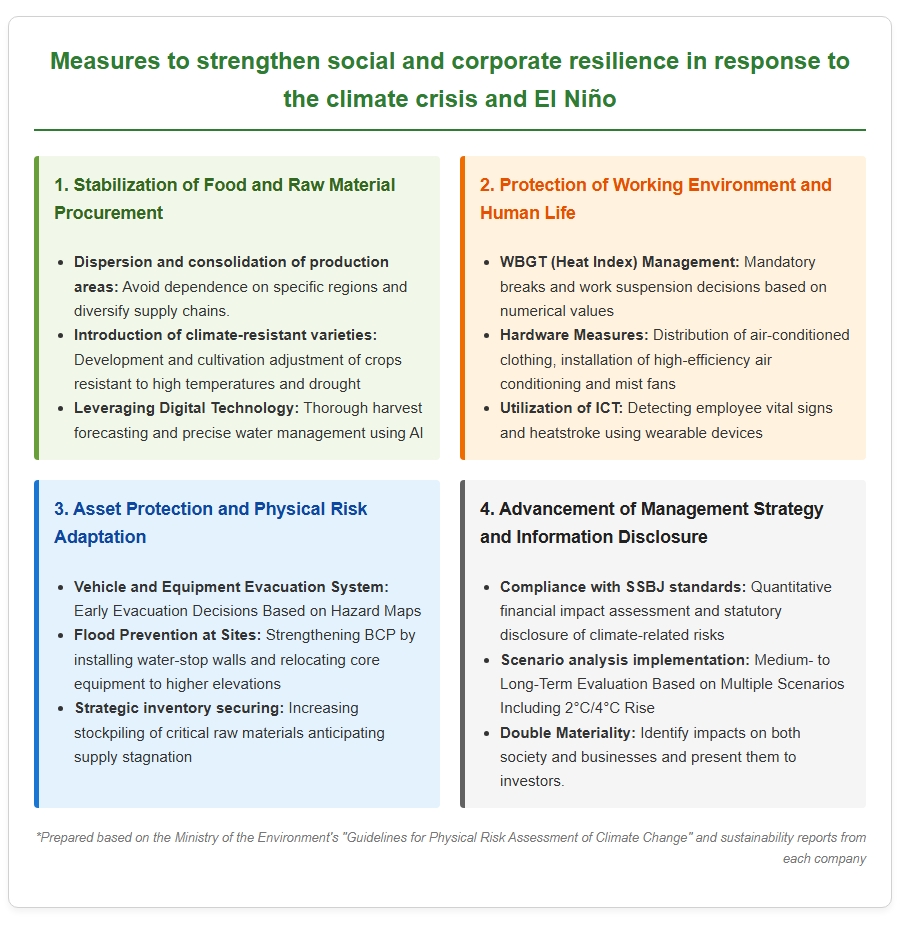
The physical risks of climate change are now recognized as a critical management issue. In particular, financial markets are concerned that the damage caused by El Niño varies greatly by sector. For example, nitrogen fertilizer manufacturers and crop protection companies may benefit from increased demand, while North American natural gas extraction companies face headwinds due to reduced demand caused by a mild winter. In the insurance sector, it is also pointed out that the Atlantic hurricane suppression effect could act as a tailwind to reduce insurance claims. Currently, companies listed on Japan’s Prime Market are increasingly required to disclose climate-related risks based on the SSBJ standard, requiring companies to quantitatively assess how vulnerable their supply chains are and present adaptation measures to investors.
Future Developments and Highlights
Peaks and Regime Shifts from Autumn to Winter
The El Niño phenomenon that occurred in 2026 is predicted to peak in intensity from late 2026 to early 2027. A major topic in the field of climate science is the climate regime shift triggered by strong shocks like super El Niño. This refers to the phenomenon where the current climate surpasses the mountain summit and falls into a completely different valley (a new climate state), and once it occurs, it is pointed out that it becomes difficult to return to the original climate over decades or decades. Rising ground temperatures lead to a decrease in soil moisture, and the feedback effect that leads to further heat risks causing abnormal conditions to become entrenched like memory devices.
Key Points for Strengthening Social Resilience
The WMO plans to continue releasing updates beyond late May, providing guidance for decision-making by each country. The next key focus will be on how powerful this phenomenon will become and how much it will impact global food security and energy prices. We need to regularly pay attention to domestic and international weather and food trends, and actively adopt adaptation measures such as introducing heat-resistant varieties and utilizing meteorological risk prediction models using digital technologies. Monitoring systems by governments and research institutions are becoming more sophisticated, but ultimately, individual disaster awareness and corporate risk management are the keys to surviving this era of “climate crisis.” Please refer to the diagram below.
[#エルニーニョ現象 #WMO #世界気象機関 #異常気象 #スーパーエルニーニョ #気候変動 #猛暑対策 #食料安全保障]


コメント