On July 10, 2026, the Digital Agency announced that it would trial domestic large language models (LLMs) on the domestic cloud “Sakura Cloud” within the government-exclusive generative AI usage environment “Gennai.” This initiative represents a strategic step to secure sovereignty over administrative data and enhance the autonomy of the domestic AI industry.
- Background of the Trial Start on the Government AI Platform ‘Gennai’
- Three domestic foundation models adopted in the demonstration experiment
- Risk Avoidance in U.S. Law and Establishment of Digital Sovereignty
- Creating Demand and Improving Performance in the Domestic AI Industry
- The Role of the Domestic Cloud ‘Sakura’s Cloud’
- Roadmap for practical use through A/B testing
Background of the Trial Start on the Government AI Platform ‘Gennai’
On July 10, 2026, the Digital Agency announced that it will begin pilot operations of a domestically produced large language model (LLM) on its generative AI platform “Gennai,” which aims to improve government operational efficiency. In Japan, the shortage of workers due to population decline and aging populations is becoming more severe, making the active use of AI essential to maintain and strengthen public services. This project is positioned as part of the large-scale demonstration project for Gennai, which will begin gradually starting in May 2026. Ultimately, the goal is to have a system that can be used by about 180,000 employees across all government ministries, marking the first time the government has actually utilized the domestically produced ‘Sakura Cloud’ on Government Cloud. The diagram below shows the overall structure of the government AI infrastructure.
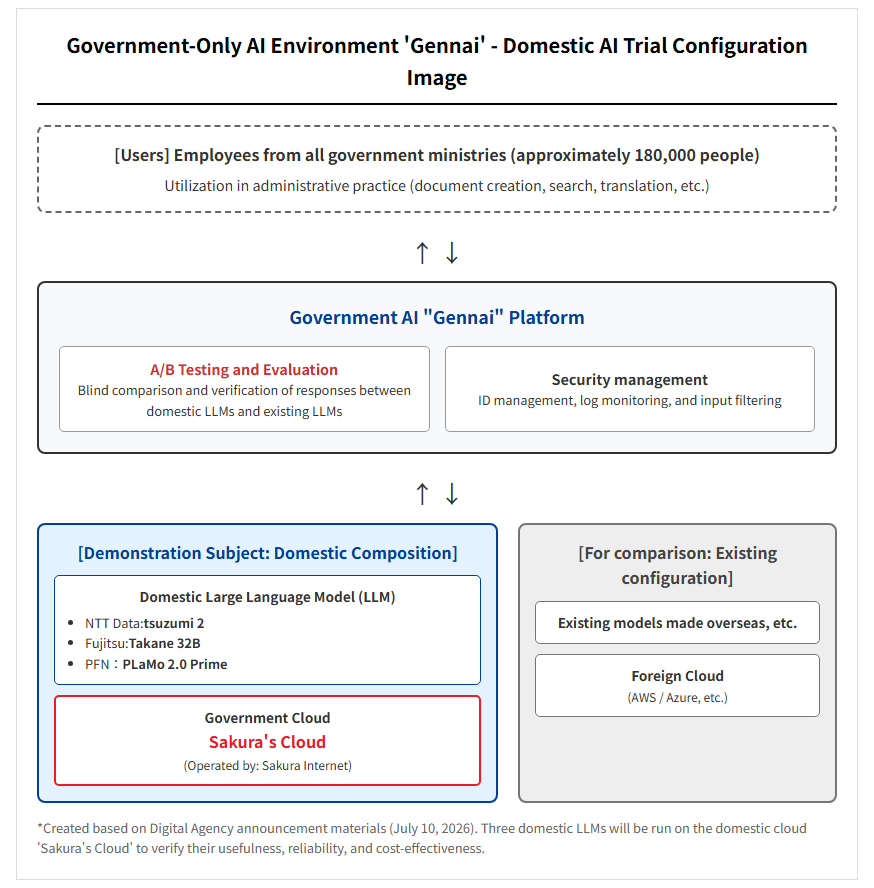
Through this trial, the government aims to break free from digital defeat and accelerate the construction of safe and secure administrative infrastructure.
Three domestic foundation models adopted in the demonstration experiment
In this demonstration experiment, the following three large language models developed by domestic companies and research institutions were selected.
-
“tsuzumi 2” provided by NTT Data Corporation
-
Fujitsu Limited’s “Takane 32B”
-
PLaMo 2.0 Prime, developed by Preferred Networks Inc.
These domestically produced foundational models are characterized by their design that conforms to Japanese’s unique vocabulary and expressions, respecting Japanese culture and values. These are operated on Sakura Internet’s “Sakura Cloud” and rigorously verified from three perspectives: usefulness, reliability, and cost-effectiveness. The Digital Agency not only introduces the latest models but also has established a mechanism to directly support the performance improvement of domestic AI through concrete feedback from administrative sites.
The Strategic Significance of Domestic Infrastructure and Data Sovereignty
Risk Avoidance in U.S. Law and Establishment of Digital Sovereignty
The main reason the government insists on combining domestic cloud and domestic LLMs is to ensure data “autonomy.” Currently, many government systems rely on foreign cloud services such as AWS and Google Cloud, which involves legal risks under the U.S. CLOUD Act. Passed in 2018, this law enables U.S. law enforcement agencies to require disclosure of data under the control of U.S. companies, even if the data is stored outside the U.S. As long as Japanese administrative data exists on foreign servers, legally, there is a possibility that the U.S. government could access it. In contrast, Sakura Internet owns its own data center in Ishikari City, Hokkaido, and since it is operated by a Japanese company, it can meet the demand for “storing data domestically” without relying entirely on foreign capital.
Creating Demand and Improving Performance in the Domestic AI Industry
Fostering domestic AI is extremely important from the perspective of economic security. The Digital Agency aims to stimulate private investment in related fields by domestic companies by creating stable demand for domestic AI through government procurement. With foreign big tech companies accounting for about 70% of the market, early government demand creation is essential for domestic businesses to survive. Furthermore, by utilizing AI that deeply understands Japanese nuances and systems in official duties, it is expected to improve the accuracy of administrative document creation and search operations. The government plans to incorporate the insights gained from this demonstration project into future procurement conditions, which could also affect the adoption standards for domestic AI in the private market.
Challenges in Implementation and Future Outlook
The Role of the Domestic Cloud ‘Sakura’s Cloud’
Sakura Internet’s “Sakura Cloud” is the only domestically produced cloud officially certified as a government cloud for fiscal year 2026. The company receives strong support as a national policy, including subsidies of up to 57.5 billion yen from the Ministry of Economy, Trade and Industry. For this provision to Gennai, the company has entered into a partnership with Microsoft, supplementing some technical requirements such as ID management and security monitoring with overseas technologies, while providing the core IaaS platform developed in-house. Please refer to the diagram below for details on the infrastructure construction.
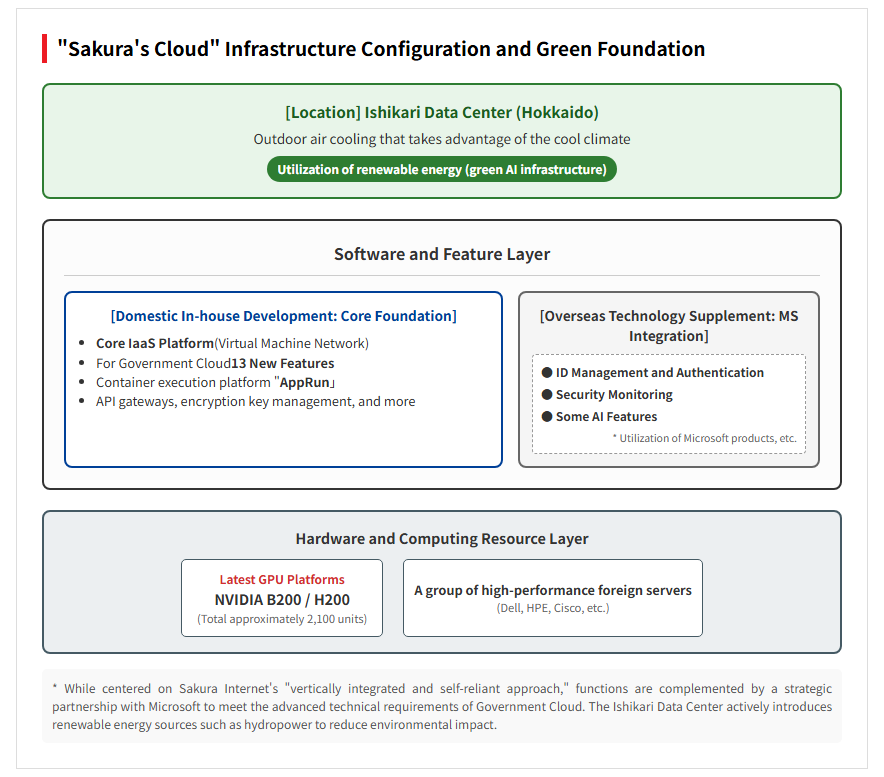
The Ishikari Data Center also has strengths as a “green AI infrastructure” utilizing renewable energy and is expected to play a role as a sustainable government foundation with reduced environmental impact. Going forward, we plan to expand computing resources, including the launch of about 1,100 of the latest B200 GPUs.
Roadmap for practical use through A/B testing
As a concrete future schedule, the Digital Agency plans to complete the construction of the experimental environment by August 2026 and conduct multiple demonstration experiments from September to November. The evaluation method uses “A/B testing,” where responses from domestic LLMs and existing models are randomly presented to users’ staff and are compared and verified in a blind state. This process highlights the specific advantages and challenges of domestic models in administrative practice. The results of this year’s evaluation will serve as an important basis for considering the approach to full-scale system procurement in the coming fiscal year. The Digital Agency aims to use this demonstration as a starting point for social implementation and to evolve domestic AI to an internationally competitive level by generating feedback loops from administrative sites.
[#デジタル庁 #生成AI #国産LLM #さくらインターネット #ガバメントクラウド #経済安全保障 #データ主権 #源内]


コメント