On July 14, 2026, Demis Hassavis, CEO of Google DeepMind, advocated for the establishment of a US-led independent agency to ensure the safety of artificial general intelligence (AGI) just around the corner. The background is that while technological advancement is progressing faster than humanity can comprehend, excessive development competition is increasing serious risks.
- AGI arriving within a few years and its historical significance
- Uncontrollable ‘race to the bottom’ and emerging risks
- Blueprint for an independent regulatory body through public-private partnership
- Mandatory screening 30 days in advance and the ‘Safety Review Gate’ mechanism
- Geopolitical Conflict Over US-Led Standardization and Neutrality
- Redefining Social Systems Toward the ‘Post-Scarcity Era’
AGI arriving within a few years and its historical significance
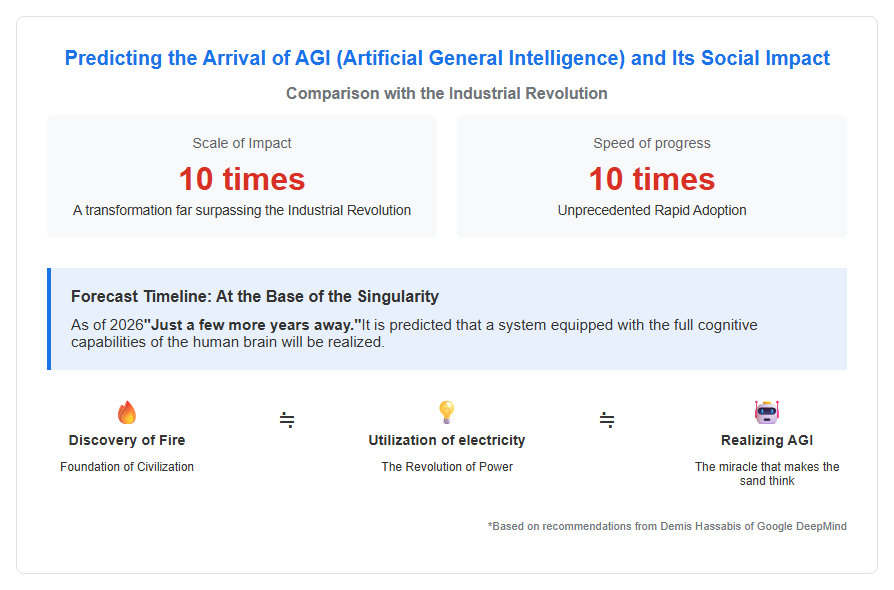
Demis Hassavis, CEO of Google DeepMind, outlined an extremely short timeline in a lengthy 10,000-word essay published on July 14, 2026, indicating that artificial general intelligence (AGI) is likely to be realized “in just a few years.” Mr. Hassabis likens AGI—a system that possesses all cognitive abilities in the brain—to humanity’s discovery of fire and electricity, and defines the present age as an era standing at the foot of the ‘singularity.’ The scale of the impact of this technology is so vast that it can achieve ten times the scale of the Industrial Revolution at ten times the speed of the Industrial Revolution, marking a miraculous turning point where humanity has discovered a “way to make sand think.” Please refer to the diagram below.
According to Hassavis’s predictions, AGI could help solve society’s biggest challenges, such as accelerating drug discovery and developing new clean energy sources, potentially ushering in a “post-scarcity era” where resources do not limit human progress. However, it is also emphasized that such a historic leap in civilization also involves risks on a scale humanity has never experienced before. He is using this valuable grace period to advocate for his responsibility to shape technology for the benefit of all humanity.
Uncontrollable ‘race to the bottom’ and emerging risks
Hassabis warns that the current global AI development race is falling into an extremely dangerous “race to the bottom,” with an “endless race to the bottom.” The pace of evolution of cutting-edge “frontier models” has already outpaced how quickly humanity understands and controls these technologies, and the current situation where development speed takes precedence over safety has created an unhealthy structure where those who do not follow the rules benefit from it. He points out that current AI-driven cyberattacks are nothing more than a “warning gun,” and within the next 18 months, serious threats beyond any government control—such as biological threats or nuclear threats—could materialize.
In particular, to maintain control over AI systems that act autonomously and proactively, or systems that repeatedly self-improve recursively, robust safeguards that transcend the current framework of commercial and geopolitical competition are essential. Mr. Hassabis expressed strong concern about the current situation where the sector as a whole and society as a whole cannot secure the “time and space” necessary for risk mitigation. The imbalance between technological progress and safety measures is a strong motivation behind the proposal for the establishment of an independent institution.
Concept of a “Frontier AI Standardization Organization” modeled after FINRA
Blueprint for an independent regulatory body through public-private partnership
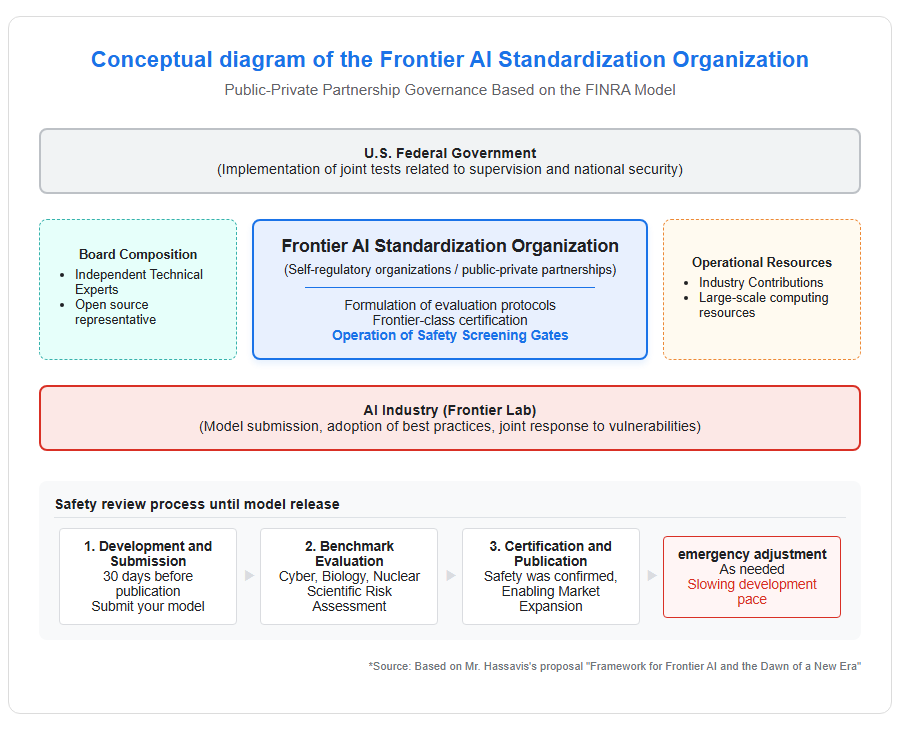
As a concrete solution, Hassabis is proposing the establishment of a new “Frontier AI Standardization Organization,” modeled after the U.S. Financial Industry Regulatory Authority (FINRA). This body is expected to take the form of a public-private partnership or self-regulatory organization under federal government supervision, with the board of directors expected to include independent, top-tier technical experts and representatives from the open source community. Operating funds are mainly funded by industry contributions, enabling the securing of world-class technical personnel and the provision of computing resources necessary for large-scale safety testing.
This concept is presented as a practical compromise to bypass opposition from government-led, strict regulatory agencies such as the Pharmaceuticals (FDA) and Aircraft (FAA). By maintaining flexibility among private entities and building cooperative relationships with governments, it aims to promote innovation while balancing responsibility and security. This framework also draws lessons from the International Atomic Energy Agency (IAEA), which monitors the peaceful use of nuclear energy, aiming to maximize the benefits of technology while preventing AI misuse through information sharing and capacity building. Please refer to the diagram below.
Mandatory screening 30 days in advance and the ‘Safety Review Gate’ mechanism
The core function of standardization bodies is to set up a “safety review gate” for the most powerful AI models. Specifically, agencies will develop benchmark tests in high-risk areas such as cybersecurity, biological threats, and nuclear risks, and certify models as “frontier level” when they reach certain capability thresholds. Organizations meeting this standard are considered “frontier labs,” and are encouraged to adopt best practices such as publishing model cards and maintaining strong internal security.
The regulatory process is introduced in phases, with Frontier Lab voluntarily submitting models to institutions for review up to 30 days before the model is published. Once the effectiveness of the evaluation protocol is proven, it promptly transitions to a mandatory certification system, limiting the market deployment of frontier models that have not passed safety assessments. Furthermore, if the situation deteriorates extremely severely, the agency should have the authority to temporarily slow down the industry-wide development pace in cooperation with each research institute.
The Reorganization of the International Order and the Philosophical Questions Imposed on Humanity
Geopolitical Conflict Over US-Led Standardization and Neutrality
Mr. Hassabis argues that, given the economic and technological position of the United States, this standardization body should be established under U.S.-led leadership. This aims to make initiatives originating from the United States a “strong starting point” for international common standards, ultimately leading to consensus building across the entire international community. However, in reality, Chinese AI companies like Zhipu and DeepSeek are fiercely pursuing with open-source and low-cost strategies, making the global AI competition even more complex. Regarding the spread of high-performance open-source AI originating from China, Anthropic CEO Dario Amodei has also expressed strong concerns. Please refer to the diagram below.
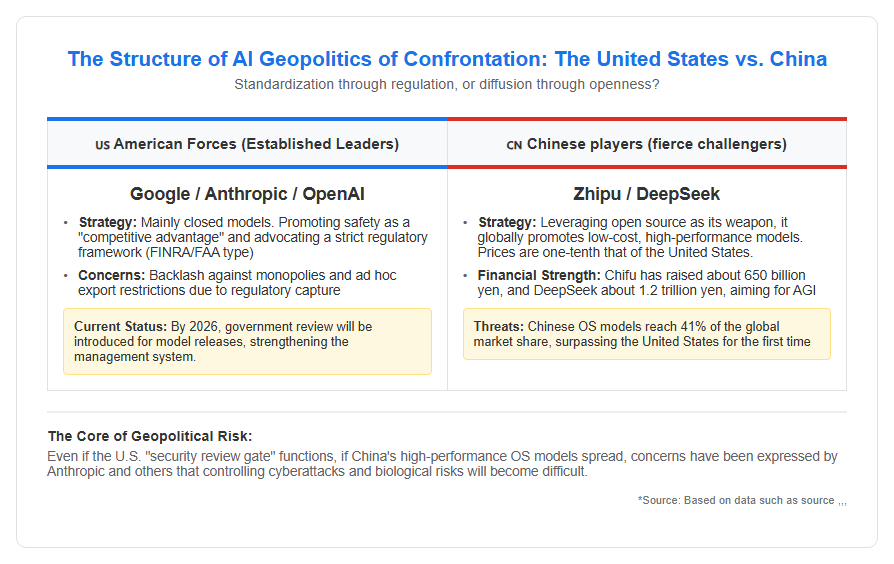
On the other hand, there are also concerns within the industry about ‘regulatory capture.’ When large corporations provide funding and talent to run regulatory bodies, there is an undeniable risk that established major research institutes may design rules to their advantage, becoming barriers for new entrants. Recently, OpenAI’s strengthened cooperation with the U.S. Department of Defense has sparked consumer backlash, leading to a sharp increase in ChatGPT removals. Amid the clash between corporate ethical principles and national security requirements, building international trust has become a major challenge.
Redefining Social Systems Toward the ‘Post-Scarcity Era’
Mr. Hassabis states that beyond solving the technical challenges brought by AGI lies more complex economic and philosophical issues. In the post-scarcity era, where AI-driven productivity is exploding, we must answer the question of what new economic model allows everyone to enjoy prosperity, and how work, meaning, and purpose in life will change. These issues should not be left solely to engineers; all sectors of society need to participate in discussions and define them.
The future focus will be on how Hassavis’s recommendations will be accepted by regulatory authorities and competitors in each country and implemented as concrete systems. Google CEO Sundar Pichai has already expressed support, and Anthropic’s Amodei CEO has jointly presented similar regulatory demands. Now that AI has entered the stage of rebuilding the very institutions of civilization, humanity stands at a crossroads in whether it can properly use this “precious grace period” to usher in a new golden age of scientific discovery and progress.
[#AIセーフティ #AGI #シンギュラリティ #GoogleDeepMind #デミスハサビス #AIガバナンス #フロンティアAI #テクノロジー]

コメント