Leading Chinese AI chipmakers, including Huawei Technologies, have raised their quoted prices for key AI processors by 20% to 50%. The price hikes are driven by a severe global shortage of High Bandwidth Memory (HBM) and skyrocketing procurement costs, posing a significant challenge to China’s push for self-sufficiency as it seeks to replace Nvidia.
- Key Takeaways: Major Chipmakers Announce Widespread Price Hikes of 20% to 50%
- Latest AI Chips Hit by Price Hikes and Their Industry Impact
- HBM Shortages and the Burden of Gray-Market Reliance
- Manufacturing Under U.S. Restrictions and SMIC’s 7nm Expansion
- Tech Giants Accelerate Adoption of In-House AI Chips Amid Market Share Shifts
- Outlook and Key Developments: Challenges on the Path to Supply Chain Independence
Key Takeaways: Major Chipmakers Announce Widespread Price Hikes of 20% to 50%
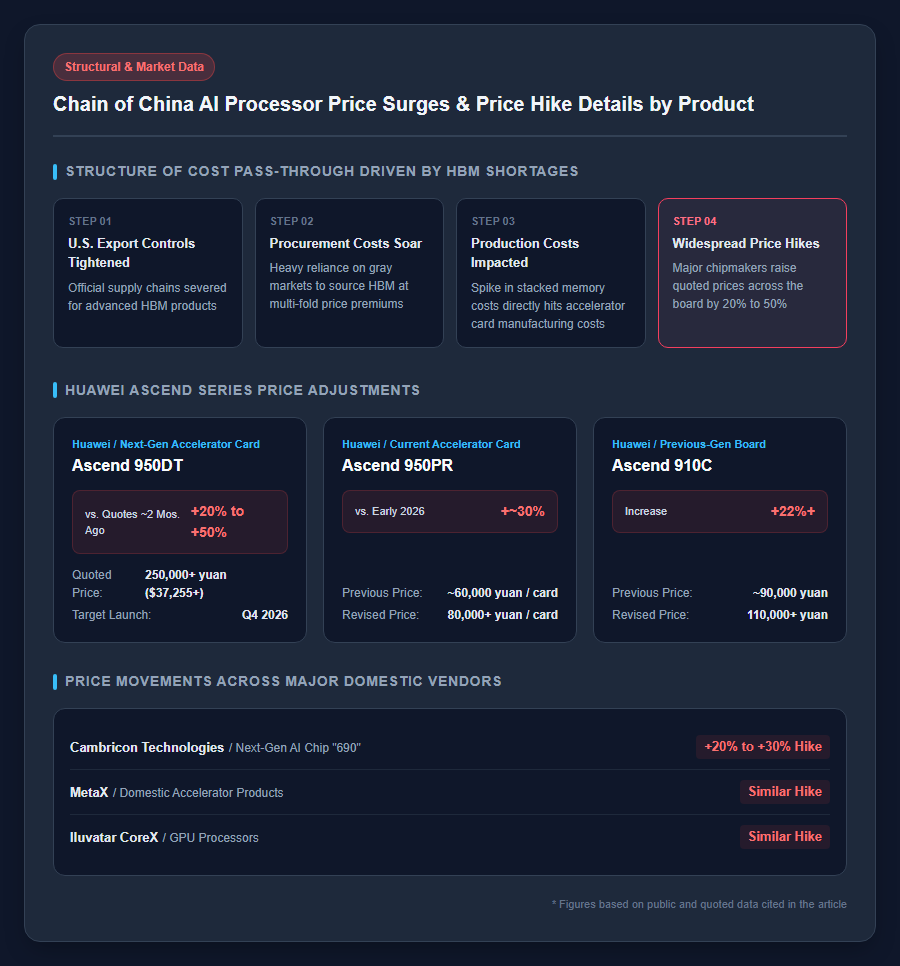
In September 2026, major Chinese AI semiconductor manufacturers disclosed widespread price increases across both current and next-generation AI processors. Key domestic fabless designers, including telecommunications giant Huawei Technologies, Cambricon Technologies, MetaX, and Iluvatar CoreX, have all stepped up their prices. At the heart of this trend is an acute global shortage of High Bandwidth Memory (HBM)—a crucial component for AI accelerators—and the resulting surge in procurement expenses. Although Beijing has strongly encouraged domestic firms to swap Nvidia hardware for locally made chips in response to U.S. export controls, Chinese vendors now face a dilemma: soaring component expenses are driving up the manufacturing cost of domestic AI chips themselves. This price escalation is not limited to a single vendor but is rippling across the entire industry, raising the cost of building China’s AI computing infrastructure. As shown in the market structure diagram below, supply chain bottlenecks are being passed on directly to end-product pricing.
Latest AI Chips Hit by Price Hikes and Their Industry Impact
In a notable example, Huawei raised the quoted price of its latest integrated accelerator card, the Ascend 950DT—scheduled for launch in the fourth quarter of 2026—by 20% to 50% compared to quotes given just two months earlier, pushing the price above 250,000 yuan (approximately \$37,255). Similarly, Huawei’s previous-generation Ascend 910C board saw its price climb from roughly 90,000 yuan to over 110,000 yuan, while the Ascend 950PR, which sold for around 60,000 yuan per card in early 2026, has jumped nearly 30% to over 80,000 yuan. Cambricon also raised the quoted price for its upcoming 690 AI chip by 20% to 30%, with MetaX and Iluvatar CoreX making comparable adjustments. With price increases spanning current models to unreleased next-generation hardware, cloud providers and large language model developers deploying AI servers face an inevitable surge in capital expenditure.
Background and Structural Drivers of the Price Surge
HBM Shortages and the Burden of Gray-Market Reliance
The single biggest factor driving these price increases is the global demand squeeze and skyrocketing procurement costs for High Bandwidth Memory (HBM), which enables ultra-fast data transfer in AI processors. The advanced HBM market is overwhelmingly dominated by a trio of global chipmakers: South Korea’s SK Hynix and Samsung Electronics, and U.S.-based Micron Technology. However, after the U.S. government significantly tightened export restrictions on advanced HBM products to China in December 2024, Chinese semiconductor companies found it exceedingly difficult to obtain supplies through official channels. As a result, domestic vendors have increasingly relied on unofficial gray-market supply chains, forcing them to purchase HBM at massive premiums—several times higher than standard global market rates. Because stacked memory accounts for a substantial portion of an accelerator card’s bill of materials, these soaring procurement costs translate directly into higher final product prices.
Manufacturing Under U.S. Restrictions and SMIC’s 7nm Expansion
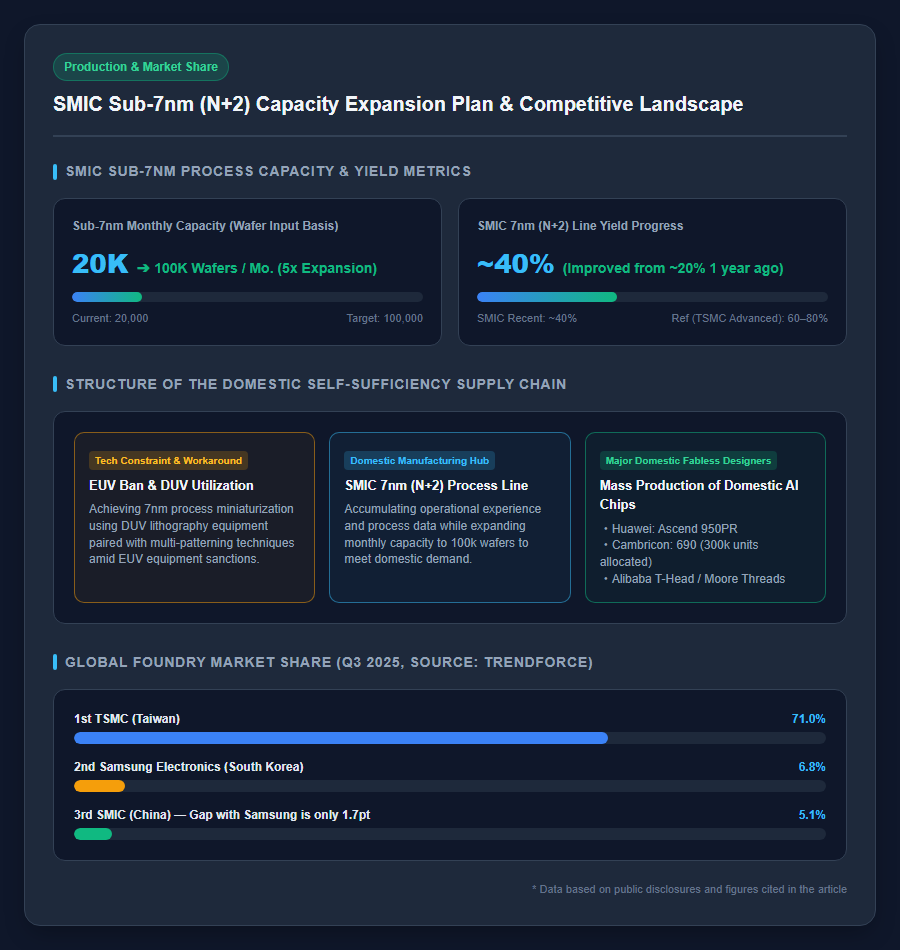
U.S. sanctions on semiconductor manufacturing equipment have also severely impacted production efficiency for advanced nodes. Blocked from obtaining Extreme Ultraviolet (EUV) lithography equipment, SMIC, China’s largest foundry, relies on Deep Ultraviolet (DUV) machinery paired with multi-patterning techniques to achieve 7-nanometer (N+2 process) miniaturization. While Huawei’s Ascend 950PR and Cambricon’s high-performance chips are produced on SMIC’s 7nm lines, yield rates remain at around 40% recently—a key reason manufacturing costs remain elevated compared to leading-edge foundries like TSMC. At the same time, SMIC is pushing ahead with plans to dramatically expand its sub-7nm monthly production capacity from 20,000 wafers to 100,000 wafers, aiming to accumulate operational experience and accelerate the establishment of a domestic AI chip mass-production system. As illustrated below, the expansion of domestic foundries forms the core of China’s self-sufficiency network.
Shifts in the Domestic Ecosystem and Future Outlook
Tech Giants Accelerate Adoption of In-House AI Chips Amid Market Share Shifts
Even under tight sanctions, the market share of domestic AI chips within China is expanding rapidly. In 2025, total shipments of AI accelerator cards from domestic Chinese vendors reached 1.65 million units, pushing their collective market share past 41% for the first time. Huawei Ascend led domestic manufacturers with 812,000 units shipped (capturing a 20% total market share), followed by Alibaba’s T-Head (265,000 units), Baidu’s Kunlunxin, and Cambricon. Anticipating stricter U.S. controls and potential supply disruptions for chips like Nvidia’s H200, tech giants such as Tencent, Alibaba, and ByteDance have increased capital expenditures to deploy domestic chips at scale. In particular, DeepSeek’s deployment of Huawei’s Ascend 950PR in the inference stage of its latest AI model, V4, demonstrated that domestic AI chips have begun offering practical competitiveness capable of handling large-scale production environments.
Outlook and Key Developments: Challenges on the Path to Supply Chain Independence
Looking ahead, the critical focal point is whether China’s AI semiconductor industry can sustain rapid growth while achieving technological independence under mounting price pressures. China’s AI chip market, valued at approximately 142.5 billion yuan in 2024, is projected to expand to 1.34 trillion yuan by 2029. However, domestic players face significant hurdles, including performance gaps in standalone chips, the need to mature software ecosystems (such as Huawei’s CANN framework), and recovering massive research and development expenditures. With U.S. lawmakers advocating for even tighter controls, Chinese firms caught between external sanctions and rising costs are forced to explore workaround strategies, such as clustering multiple chips via advanced networking or adopting hybrid architectures combining domestic and U.S. chips. Ultimately, improving manufacturing yields and advancing domestic HBM production will prove decisive in shaping the future competitive landscape.
Reference Pages
- [U.S. Federal Register: Revision to License Review Policy for Advanced Computing Commodities] https://www.federalregister.gov/documents/2026/01/15/2026-00789/revision-to-license-review-policy-for-advanced-computing-commodities
- [U.S. House Select Committee on the CCP: Investigation Report on AI Chip Dependence and Restrictions] https://chinaselectcommittee.house.gov/media/press-releases/select-committee-investigation-reveals-china-s-history-of-ai-chip-smuggling-and-model-distillation
【#Semiconductors #AIProcessors #Huawei #HBM #ChinaTech #USChinaTensions #AIInfrastructure #SMIC】

コメント