UN Secretary-General António Guterres called for the drafting of a legally binding treaty by the end of 2026 to regulate AI-powered autonomous lethal weapon systems (LAWS). In response to the risks posed by the rapid automation of weapons to international humanitarian law and human dignity, building global governance has become an urgent necessity.
- Building Global Governance with a Deadline of 2026
- Divisions in the International Community Over Autonomous Lethal Weapon Systems (LAWS)
- Shift in the main players in the stock market and capital inflows into “unmanned assets”
- 10 Weaponization of U.S.C. §3252 and Purge Pressure on Corporations
- Practical Deployment of AI Targeting Systems in the Gaza War
- Future Outlook and Strategic Challenges Facing Japanese Companies
Building Global Governance with a Deadline of 2026
From July 6 to 7, 2026, the first meeting of the “Global Dialogue on AI Governance” was held in Geneva, Switzerland. At this meeting, Secretary-General António Guterres declared that the development of AI-powered “killer robots” is morally unacceptable and called on countries to complete legally binding international measures to ban and regulate them by the end of 2026. The Secretary-General emphasizes that even if machines can provide information, the final decisions that affect life and death must always be made by humans. Current AI technology is evolving at a pace that exceeds the government’s ability to adapt, raising concerns that malicious users or system malfunctions could cause catastrophic harm. The United Nations has so far held discussions within the framework of the Convention on the Prohibition and Restriction of Certain Conventional Weapons (CCW), but this statement by the Secretary-General elevates the discussion to a more politically significant UN General Assembly and demonstrates its determination to establish an effective treaty.
Divisions in the International Community Over Autonomous Lethal Weapon Systems (LAWS)
Autonomous Lethal Weapons (LAWS) refer to weapon systems that, once activated, select targets and carry out attacks without human intervention. Humanitarian organizations such as the International Committee of the Red Cross (ICRC) point out the risk that unpredictable AI weapons could make it impossible to distinguish civilians from combatants and call for strict restrictions. However, the international community is not aligned. Major military powers such as the United States, Russia, China, and India have shown a stance of supporting the application of existing international law and domestic guidelines over legally binding treaties. Global defense spending reached a record high of about $2.3 trillion in 2023, and major countries are accelerating the race to develop AI weapons to secure technological superiority over adversaries. There are also reports that about 3,000 drones called “Veter” are already operating in Russia, highlighting the current state where technological progress is outpacing international rule-making.
Transformation of the Defense Business and Supply Chain Risks
Shift in the main players in the stock market and capital inflows into “unmanned assets”
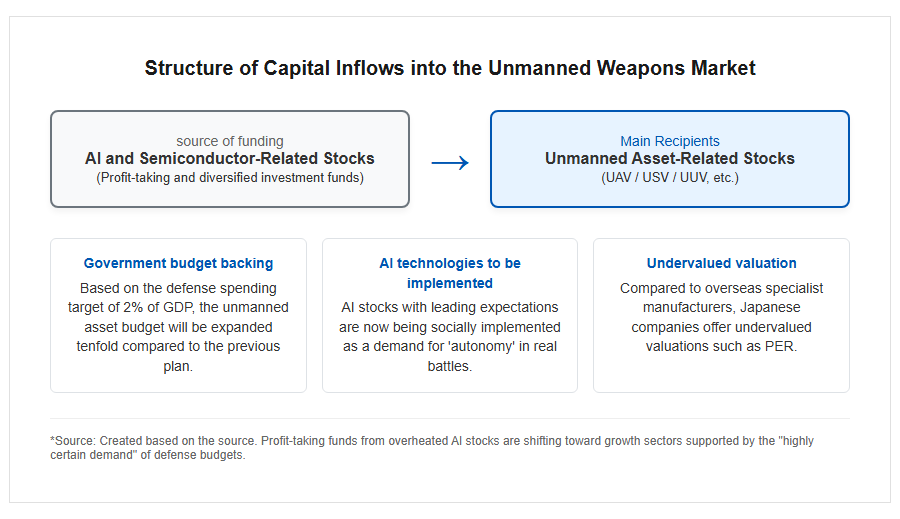
As the main players on the battlefield shift to AI and drones, the hierarchy of defense stocks in the stock market is undergoing a seismic shift. Until now, Japanese defense stocks have mainly been comprehensive heavy industries such as Mitsubishi Heavy Industries, but in 2026, stocks like OKI (Oki Electric Industry), which possesses underwater drone-related technology, are attracting attention. OKI’s stock price is expected to rise about 65% compared to the end of 2025, significantly outperforming Mitsubishi Heavy Industries’ performance during the same period. Investors have high expectations for growth areas related to “unmanned assets,” which can be deployed in large quantities at lower cost than traditional large equipment like fighter jets and missiles. In particular, Japanese unmanned aer-related stocks are judged to have undervalued valuations compared to overseas companies focused mainly on defense, serving as a channel for capital shifting from AI stocks. The chart below shows the structure of capital inflows into the unmanned weapons market.
10 Weaponization of U.S.C. §3252 and Purge Pressure on Corporations
The ethical conflict over the military use of AI has transformed into a powerful supply chain risk that shakes the management of private companies. In February 2026, the U.S. Department of Defense (DoD) designated Anthropic, an AI company for its use of AI models for “any legitimate purpose,” under Title 10, Section 3252 of the U.S. Code. Originally, this law was intended to eliminate hostile foreign companies like Huawei, but this time it is being enacted for the first time against major domestic companies. With this designation, all contractors working with the U.S. military must remove the target company’s technology from their systems, dealing a devastating blow to the company’s business model. Meanwhile, OpenAI agreed to deploy models on the Department of Defense’s classified network and chose to synchronize with the national security system. AI development companies are forced to make the “ultimate choice” between adhering to their own ethical standards or following the nation’s operational doctrine.
On-site AI Operations and Future Highlights
Practical Deployment of AI Targeting Systems in the Gaza War
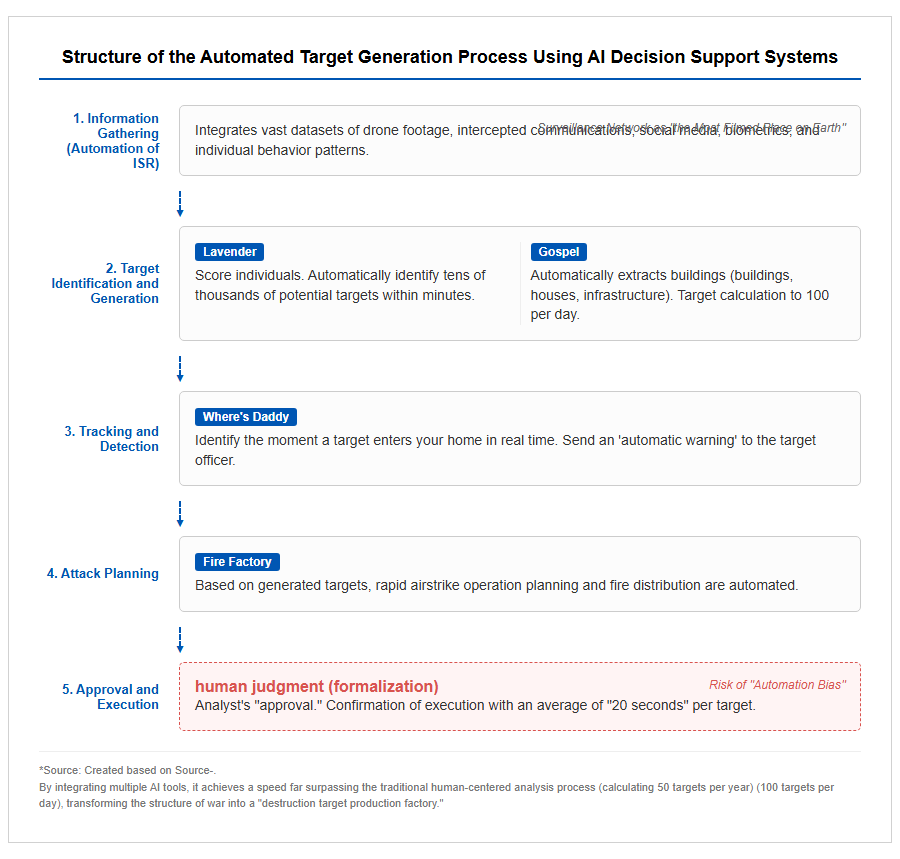
AI-powered decision support already plays a central role on the real battlefield. Since 2023, in the fighting in the Gaza Strip, the Israeli military has deployed AI systems such as “Gospel” and “Lavender” on a large scale. Gospel automatically generates target building maps, while Lavender scores and identifies specific individuals by scoring and identifying them as Hamas fighters based on communication data and activity history. As a result, what used to be possible for humans to count only about 50 targets per year has now increased to 100 per day. However, the time required to identify targets has been reduced to an average of about 20 seconds, and the problem of “automation bias,” where humans simply validate AI’s decisions, is becoming more serious. While AI speeds up kill chains to under one minute, criticism is mounting that efficiency is prioritized over precision, increasing civilian casualties. The diagram below visualizes the AI-driven target generation process.
Future Outlook and Strategic Challenges Facing Japanese Companies
Ahead of the regulatory deadline at the end of 2026, the international community is entering an extremely uncertain paradigm. The Japanese government will establish “Guidelines for Responsible AI Application” in 2025, banning the development of autonomous lethal weapon systems (LAWS) and maintaining a strict stance of requiring “proper human involvement.” However, as the U.S. aggressively demands “unrestricted AI use,” Japan’s defense industry risks being caught between domestic norms and U.S. procurement requirements. Furthermore, geopolitical risks such as China’s ban on rare earth exports are compounding, forcing Japanese companies to engage in a “two-front strategy” in both hardware and software. Going forward, it will be essential to avoid excessive reliance on specific platforms, secure agility to switch between multiple AI models, and build a sovereign “sovereign AI” model. To ensure that technological evolution does not leave ethics behind, the outcome of international treaty negotiations in 2026 will determine the future of the global economy and security.
[#AIガバナンス #キラーロボット #防衛産業 #経済安全保障 #サプライチェーン #国連 #無人兵器]


コメント