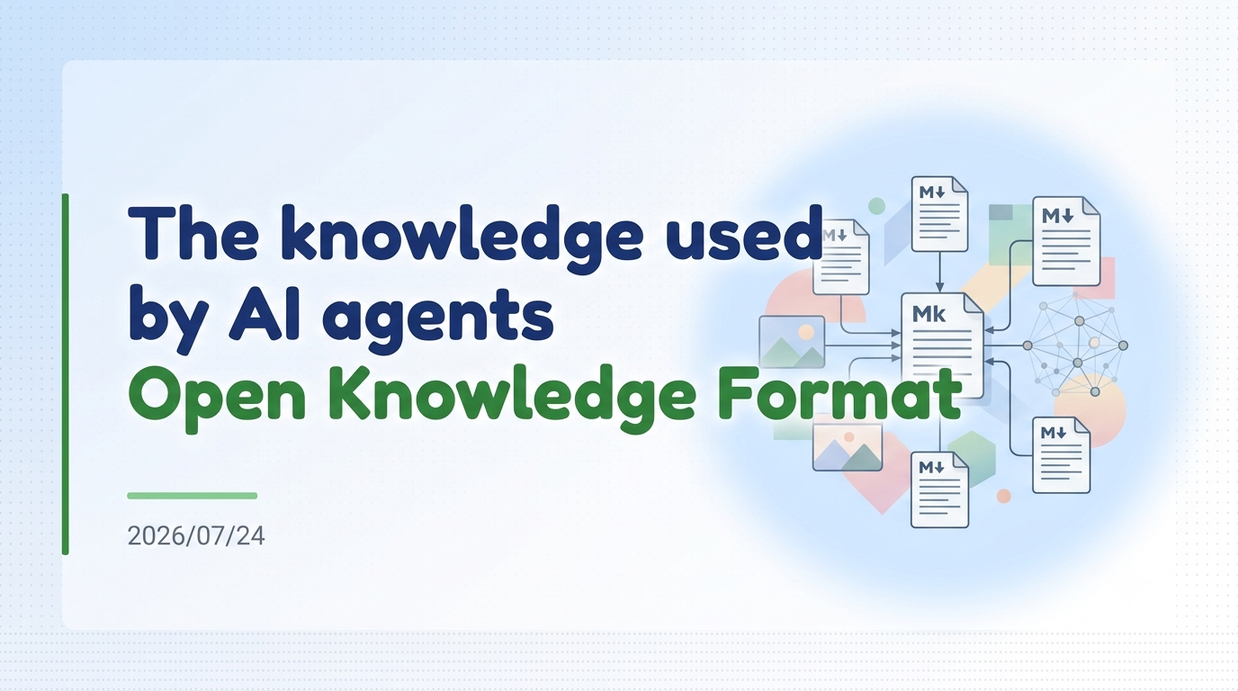
On June 12, 2026, Google Cloud released Open Knowledge Format (OKF) v0.1, a knowledge representation format for AI agents. The background lies in solving the contextual assembly problem that AI agents face when assembling vast knowledge scattered within the company.
- A new standard that integrates fragmented contexts
- Ensuring interoperability with minimal constraints
- The significance of being a form, not a platform.
- The realization of the LLM Wiki proposed by Karpathy
- Components connecting structured data and natural language
- Addressing the challenges faced by traditional RAGs
- Preventing knowledge bloat and confusion of roles
- Version control and governance with Git
- Compliance with Data Sovereignty and Compliance
- Automatic expansion and visualization by agents
- The New Field of Agent Search Optimization (ASO)
A new standard that integrates fragmented contexts
In modern organizations, much of the information used by AI-based models comes from internal knowledge. These include table schemas, definitions of business metrics, failure response manuals, and integration paths between systems, but many of these exist in catalogs with their own APIs, shared drives, code comments, and even fragmented memories of veteran engineers. When AI agents attempt to perform specific tasks, contextual assembly issues arise by gathering information from these incompatible locations, and developers have had to solve this problem from scratch for each project. OKF is a standard format proposed to break this situation, making it easy to handle for both vendor-independent humans and agents.
Ensuring interoperability with minimal constraints
The biggest feature of OKF v0.1 is its surprisingly simple specification. Specifically, knowledge is represented as a directory of Markdown files that includes the YAML front matter. Each file is called a concept and represents a single unit of knowledge, such as tables, metrics, or policies. The only required field required of writers is the type, and its value is not managed in a central registry but can be freely defined by the producer. Fields such as title, description, resources, tags, and timestamps are recommended but optional, and readers must not reject unknown fields, adopting a tolerant consumption model.
The significance of being a form, not a platform.
Sam McVeety, Technical Lead at Google Cloud, and others emphasize that OKF is essentially a formality, not a separate service. Anyone can create and use it without being restricted by specific clouds, databases, or AI model providers, and without SDKs or accounts. The value of knowledge form does not depend on who owns it, but on how many systems can use it as a common language. Therefore, OKF is released as an open standard, pursuing high portability that allows existing infrastructure to be utilized as-is, such as hosting in Git repositories or mounting to file systems.
Mechanism and Design Philosophy
The realization of the LLM Wiki proposed by Karpathy
OKF’s design is based on the LLM Wiki pattern proposed in April 2026 by renowned AI researcher Andrej Karpathy. In this pattern, the LLM is treated not as a mere search engine but as a knowledge compiler. Whenever new data or materials arrive, agents interpret them and integrate and update them into existing wikis, allowing knowledge to grow compoundably over time. The reason humans cannot maintain Wikis often lies in administrative tasks such as updating descriptions and cross-references, but LLMs can maintain the integrity of many files at once without getting bored, making file-based knowledge management practical.
Components connecting structured data and natural language
OKF knowledge bundles are organized by a directory tree structure. The main components are three types: a index.md that shows the structure of the knowledge base, a chronological log.md that records update history, and a concept file that describes individual knowledge. The figure below shows a typical bundle structure.
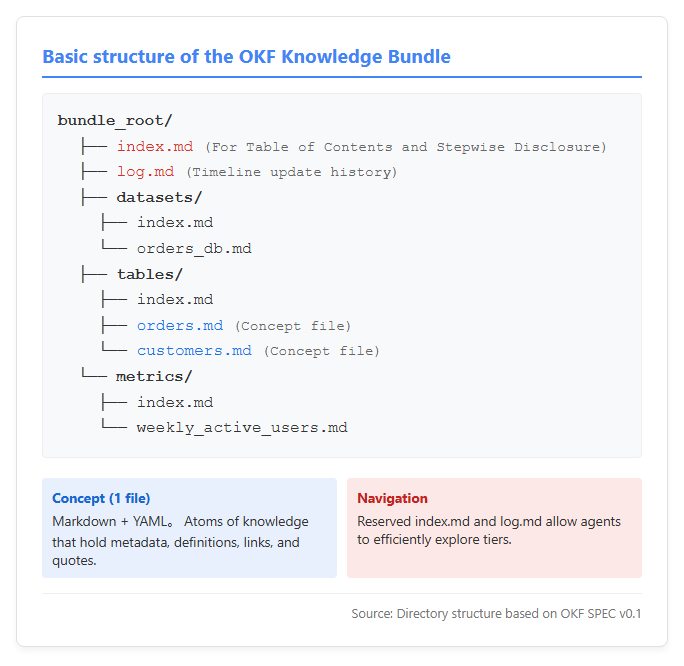
Within concept files, standard Markdown links are used to link with other files, building a rich knowledge graph that goes beyond the directory structure. Traditional technologies have tried to squeeze fluid thinking into strict schemas, but OKF, based on the philosophy of semantic unbaking, enables natural language explanations and playbooks to be preserved as machine-readable knowledge.
Addressing the challenges faced by traditional RAGs
OKF also serves as a countermeasure against the systemic limitations of traditional stateless search extension generation (RAG). Typical RAG queries vector searches for fragmented document chunks for each query, but this method tends to cause contextual fragmentation and search noise, and does not learn from past interactions. In contrast, OKF helps suppress hallucination by providing pre-curated facts organized and summarized by agents. By compiling knowledge that is willing to organize in advance, agents no longer need to rediscover facts from the source each time, enabling them to derive more accurate and consistent answers.
Benefits of Implementation and Operational Strategies
Preventing knowledge bloat and confusion of roles
In repositories equipped with agents, numerous Markdown files tend to grow chaotically, causing agents to struggle with which ones to load first. This is caused by confusion of roles, and by introducing OKF, knowledge can be organized hierarchically. Specifically, AGENTS.md define behavioral rules, separate layers in the form of Skills that demonstrate actionable procedures, and OKF bundles that retain domain knowledge of the organization. By separating contracts, procedures, and facts in this way, agents no longer need to read encyclopedically large instructions, allowing them to trace only the necessary facts from the index.md and refer step by step when needed.
Version control and governance with Git
Because OKF is a text-based format, advanced version control using Git is possible. All changes in knowledge are recorded as commits and subject to human peer review via pull requests and automated verification through CI (Continuous Integration). For example, if the indicator formula changes, the impact can be checked row-by-row using Git diff, and human gates can ensure semantic validity. Moreover, by combining not only manual maintenance but also living contract operations that automatically regenerate OKFs weekly from the catalog API, it is possible to prevent document obsolescence and discrepancies from reality.
Compliance with Data Sovereignty and Compliance
As a pure file format rather than a platform, OKF serves as a powerful tool for ensuring data sovereignty and complying with regulations such as GDPR (European General Data Protection Regulation). Because knowledge bases are stored entirely within the organization’s own infrastructure or Git repositories, without going through external vendors or cloud providers’ services, the risk of confidential information leaking outside their jurisdiction is minimized. Traceability that allows us to track when and with which version of knowledge agents responded is an essential requirement in the highly regulated financial and healthcare industries, and OKF achieves this transparency through a simple file structure.
Future Outlook and Ecosystem Expansion
Automatic expansion and visualization by agents
Google Cloud has published a reference implementation to support the adoption of OKF. One such feature, the Extension Agent, scans BigQuery datasets, automatically creates drafts of OKF documents from table and view metadata, and uses LLMs to supplement explanations of schemas and merge paths. Additionally, by using static HTML visualizers, you can convert your created bundles into interactive graph displays that run in your browser. This enables humans to intuitively grasp the complex relationships between knowledge. These tools are just one example and do not depend on any specific framework, so various alternative implementations are expected to emerge in the future.
The New Field of Agent Search Optimization (ASO)
The emergence of OKF holds the potential to create a new business practice of agent search optimization (ASO) as an alternative to traditional SEO (Search Engine Optimization). In the future, it is predicted that instead of humans searching the web directly, personal AI agents crawl knowledge bundles worldwide to execute the necessary information. If business expertise remains locked away in PDFs or unstructured websites, there is a risk that agents will not discover or overlook it. It is becoming increasingly realistic for companies to bundle their expertise into OKF and publish it, and for agents to purchase and execute verified knowledge.
Reference Page
-
【GitHub – GoogleCloudPlatform/knowledge-catalog】https://github.com/GoogleCloudPlatform/knowledge-catalog
-
【Open Knowledge Format SPEC.md (v0.1 Draft)】https://github.com/GoogleCloudPlatform/knowledge-catalog/blob/main/okf/SPEC.md
-
【How the Open Knowledge Format can improve data sharing – Google Cloud Blog】 https://cloud.google.com/blog/products/data-analytics/how-the-open-knowledge-format-can-improve-data-sharing/
-
【LLM-Wiki Gist by Andrej Karpathy】https://gist.github.com/karpathy/442a6bf555914893e9891c11519de94f
[#OpenKnowledgeFormat #AIエージェント #Markdown #GoogleCloud #ナレッジ管理 #生成AI #技術標準 #ASO]

コメント