An industry-academia collaboration team, including Shibaura Institute of Technology, officially launched “e-Machi Karte,” a cloud-based bridge and road inspection platform for municipal governments, on September 1, 2026. This release addresses the urgent challenges of deteriorating public infrastructure built during Japan’s high-economic-growth period and a severe shortage of civil engineers in local municipalities.
- Official Rollout of “e-Machi Karte” Through Industry-Academia-Government Collaboration
- From Student Research to Social Implementation via Open Innovation
- Over 75% of Road Bridges Crossing 50-Year Lifespan Mark by 2040
- Severe Engineer Shortages and a 32% Repair Completion Rate in Municipalities
- Streamlining Operations and Going Paperless via On-Site Mobile Data Entry
- Promoting Municipal DX and Future Outlook Through Data-Driven Validation
Official Rollout of “e-Machi Karte” Through Industry-Academia-Government Collaboration
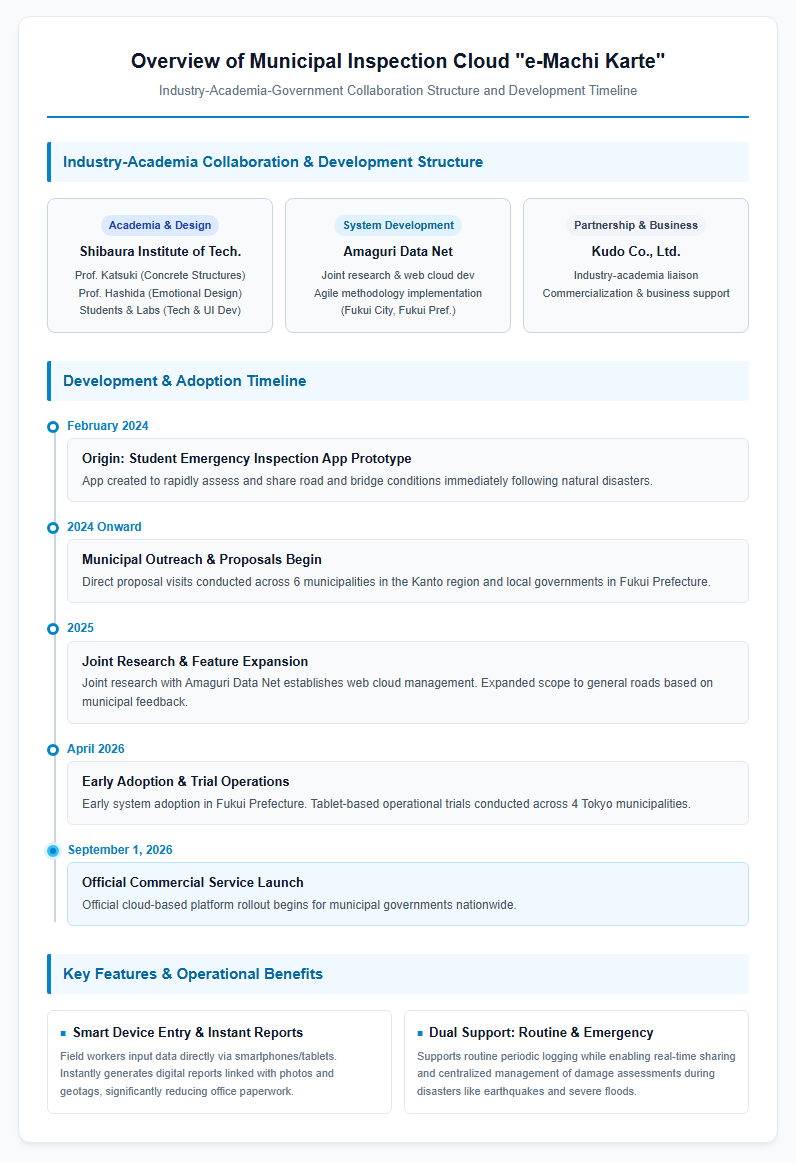
On September 1, 2026, an industry-academia collaboration team—comprising Professor Futoshi Katsuki (Concrete Structures Laboratory) and Professor Noriko Hashida (Emotional Design Laboratory) from Shibaura Institute of Technology (SIT), alongside Amaguri Data Net Co., Ltd. and Kudo Co., Ltd.—officially launched “e-Machi Karte,” a cloud-based inspection support system for municipal bridges and roads. Compatible with smartphones and tablets, the system enables field personnel to easily create, store, and share inspection results for both routine five-year surveys and post-disaster emergency assessments. The service logo and its official mascot, “Machi-Mia-kun,” were designed by Tomoya Onuki, a first-year master’s student at SIT’s Graduate School of Engineering and Science. By fusing academic research with private-sector software development and commercialization expertise, this open innovation initiative aims to dramatically reduce the operational burden on municipal staff. The platform features an intuitive interface that allows local government personnel and field technicians to operate it effortlessly without requiring specialized IT skills.
From Student Research to Social Implementation via Open Innovation
The project originated in February 2024, when students in Professor Katsuki’s Concrete Structures Laboratory developed an emergency bridge inspection application prototype. Designed to rapidly assess and share the status of roads and bridges following major natural disasters such as earthquakes, the application required a sustainable operational and maintenance framework for full-scale deployment. To achieve this, the research team sought corporate partnerships, forming a joint development structure with Fukui-based Amaguri Data Net through the brokerage of Kudo Co., Ltd. Beginning in 2025, joint research converted the prototype into an enterprise-grade cloud system capable of centralized web management. Incorporating feedback from local governments across Japan, the team expanded the system’s scope from bridges to roads in general. Operating under an agile development methodology, the team conducted outreach to six municipalities in the Kanto region and several in Fukui Prefecture starting in 2024. This led to an early adoption in Fukui Prefecture in April 2026 and tablet-based trial operations across four Tokyo municipalities, culminating in the official commercial release. Please refer to the diagram below.
Aging Infrastructure Crisis and Structural Challenges in Local Municipalities
Over 75% of Road Bridges Crossing 50-Year Lifespan Mark by 2040
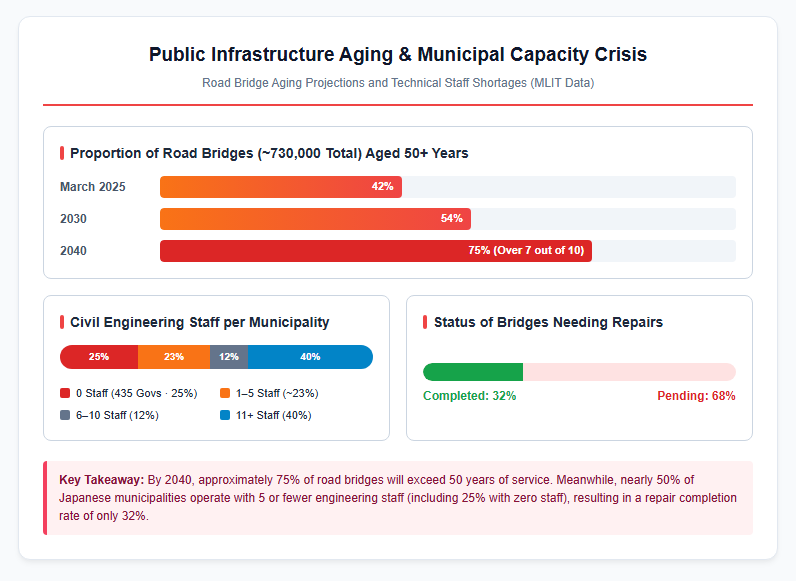
Japan has approximately 730,000 road bridges measuring two meters or longer, a vast majority of which were constructed during the post-war economic boom of the 1960s and 1970s. According to data from the Ministry of Land, Infrastructure, Transport and Tourism (MLIT), the proportion of bridges aged 50 years or older reached approximately 42% as of March 2025. This ratio is projected to rise rapidly to roughly 54% in 2030 and surpass 75% (over seven out of ten bridges) by 2040. Similar aging trends affect other vital public assets, including tunnels and sewerage systems, making a transition from reactive repairs to proactive preventative maintenance imperative. However, managing and maintaining such a massive stock of aging infrastructure under strict budgetary and manpower constraints presents a critical national challenge, creating an urgent demand for digital technologies that streamline inspection and diagnostic workflows.
Severe Engineer Shortages and a 32% Repair Completion Rate in Municipalities
While public infrastructure deteriorates rapidly, local government maintenance capacity faces a structural crisis. MLIT surveys reveal that among municipal bridges diagnosed as requiring repair or remediation, only 32% have actually completed necessary repairs. The primary bottleneck is an acute shortage of civil engineering personnel in local administration. Nationwide, 435 municipalities (approximately 25% of all local governments in Japan) employ zero technical engineering staff, while nearly 50% of municipalities operate with five or fewer engineers. In smaller municipalities, a single official often manages multiple domains, including roads, bridges, rivers, and waterworks simultaneously. Compounded by the mandatory five-year visual inspection cycle enacted under the Road Act in 2014, the administrative burden of preparing field notes and office reporting has overwhelmed local staff. These resource constraints have led to significant delays in essential maintenance, exposing a growing digital divide between major metropolitan areas and regional municipalities. Please refer to the diagram below.
The Future of Infrastructure Management Enabled by Cloud Technology
Streamlining Operations and Going Paperless via On-Site Mobile Data Entry
The primary benefit of deploying “e-Machi Karte” lies in substantial labor savings and paperless workflow integration. In conventional inspection routines, field workers record damage observations and take photographs using paper field notebooks, requiring hours of manual data entry and report formatting back at the office. With “e-Machi Karte,” field technicians input data directly via smartphones or tablets on site, instantly generating standardized digital inspection reports linked with geotagged photos and location data. This drastically cuts post-inspection administrative hours. Furthermore, by centralizing inspection data on a secure cloud platform, municipalities can seamlessly transition from routine survey logging to emergency disaster response during earthquakes or severe flooding. Real-time information sharing between field crews and emergency headquarters enables swift decisions regarding traffic restrictions and emergency repairs, substantially boosting local disaster resilience.
Promoting Municipal DX and Future Outlook Through Data-Driven Validation
Following its launch on September 1, 2026, “e-Machi Karte” will undergo continuous agile feature additions tailored to evolving municipal needs. The development team plans to conduct ongoing user surveys and quantitative time-motion studies across client municipalities. By quantifying the extent to which digital inspection workflows accelerate municipal Digital Transformation (DX) and reduce lifecycle maintenance costs, the team aims to refine the system and drive broader national adoption. Furthermore, as MLIT promotes Regional Infrastructure Group Management (“Gun-Mane”)—a strategy where multiple municipalities collaboratively manage regional assets across domains—lightweight, accessible cloud tools like “e-Machi Karte” serve as vital digital infrastructure for broad-area administrative cooperation and public-private partnerships. As a model of academic expertise and commercial technology working in tandem, this solution holds significant promise for sustainable infrastructure management.
References
- 【Shibaura Institute of Technology Official Announcement: Press Release】https://www.shibaura-it.ac.jp/headline/detail/20260826_7070_1.html
- 【Ministry of Land, Infrastructure, Transport and Tourism: Infrastructure Maintenance Initiatives】https://www.mlit.go.jp/sogoseisaku/kanminrenkei/content/001584616.pdf
【#BridgeInspection #LocalGovDX #ShibauraInstituteOfTechnology #AgingInfrastructure #DisasterPreventionTech #IndustryAcademiaCollaboration #eMachiKarte #PreventiveMaintenance】


コメント