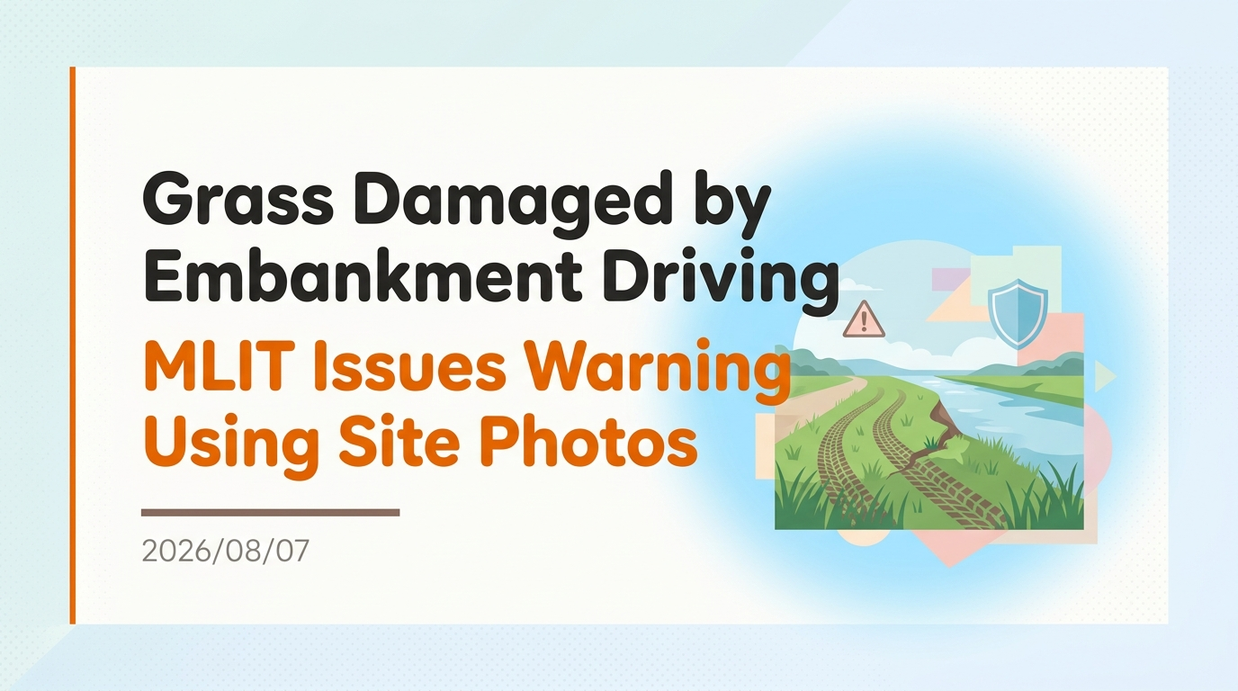
The Oita River and National Highway Office of Japan’s Ministry of Land, Infrastructure, Transport and Tourism (MLIT) has released photos of damage to river levee slopes caused by vehicles and issued a stern warning. This act goes beyond a mere breach of etiquette, as it significantly degrades regional disaster prevention functions and constitutes a dangerous activity that threatens the lives of Japanese citizens.
- Actual conditions at the site as disclosed by the Oita River Office
- Outcry on Japanese SNS calling the act “Terrorism”
- The critical role of grass in preventing soil erosion
- Mechanisms of levee breach and the risk of catastrophic damage
- Requirements for “Damage to Property” under the Japanese Penal Code
- Restrictions and penalties based on the Japanese River Law
- Advanced surveillance using CNN models trialed at the Yodogawa River
- Improving nighttime detection and warning systems in Japan
- Aging Japanese infrastructure and the 12.9 trillion yen investment
- The “Infrastructure Renaissance” and the need for mutual aid in Japan
Actual conditions at the site as disclosed by the Oita River Office
On August 3, 2026, the Oita River and National Highway Office of the Japanese Ministry of Land, Infrastructure, Transport and Tourism (MLIT) released several photos on its official social media account showing tire tracks from a vehicle that had apparently driven on a river levee slope. The office titled the post “Regarding Driving on Levee Slopes” and issued a warning to drivers using the exceptionally strong word “NO!” in Japanese. Please refer to the following image.
The published images show that the levee slope, which should normally be covered with lush green grass, has been deeply gouged by thick tire tracks, leaving the soil exposed. This news was reported by major Japanese media outlets on August 6, 2026, and has drawn wide social attention. It is an unusual situation for a Japanese river management office to issue such a direct and severe warning against a specific nuisance. The background reveals a concern that “off-road driving” by some thoughtless drivers is becoming common, and local Japanese maintenance offices are struggling to respond.
Outcry on Japanese SNS calling the act “Terrorism”
When this post was shared on Japanese social media, many users posted comments strictly condemning the drivers. Some opinions even described it as “a terrorist act against the region” and suggested “consulting the Japanese police as it is like a time bomb,” reflecting a growing recognition that destroying a levee is a serious issue that shakes the safety of the entire local Japanese community.
In particular, enthusiasts of high-performance off-road vehicles in Japan expressed indignation, calling the drivers a “disgrace to 4WD owners” and stating that such acts are “absolutely unforgivable”. The reaction on SNS is characterized by a sense of crisis directly linked to survival, as the levee is the last line of defense protecting lives during disasters in Japan. Since the publication on August 6, 2026, comments have continued to increase, with many calling for stricter penalties through Japanese legal amendments. Public awareness of the need for proper use of public infrastructure in Japan has reached an unprecedented level, showing strong support for the MLIT’s stance.
The Importance of Levee Grass for Protecting Japanese Lives
The critical role of grass in preventing soil erosion
The reason why levee grass is so highly valued in Japan is that it is not merely for landscaping, but functions as a precision disaster prevention device to maintain the levee structure during floods. According to Japanese government explanations, the grass covering the levee surface plays a vital role in preventing “erosion,” where the levee’s soil is washed away by the intense flow of water when river levels rise.
Past experimental data from the Hokuriku Regional Development Bureau in Japan provides numerical proof of the grass’s powerful protective function. In an experiment where water was allowed to overflow the top of a levee at a height of 20 centimeters, no abnormalities were found in the levee with healthy, dense grass even after 6 hours. In contrast, in a levee where the grass had been removed and the soil was exposed, the soil was washed away significantly within just 15 minutes, and the destruction of the levee began. In other words, gouging the grass with tires can drastically reduce the time a Japanese levee can withstand overflow from hours to mere minutes. Please refer to the following diagram.
Mechanisms of levee breach and the risk of catastrophic damage
When grass or a levee is damaged by vehicle traffic, that spot becomes lower than its surroundings and loses its strength, which can be a fatal flaw during a flood. River levee breaches in Japan occur through multiple mechanisms such as “overflow (erosion from the landward side),” “erosion (wearing away from the river side),” and “seepage (internal collapse),” and the loss of surface grass increases all these risks.
For example, when an “overflow” occurs, tire tracks become a path for the water, concentrating the erosion in those spots. Once the soil begins to wash out, the levee’s thickness is lost, leading to a sudden breach (breakage). A levee breach in Japan would result in a massive rush of muddy water into residential areas, not only causing loss of life but also catastrophic damage to homes and infrastructure. The Oita River Office’s plea that “what the levee protects is the lives and livelihoods of everyone in the region” is no exaggeration. Lessons from past Japanese disasters, such as the 2015 Kinugawa River breach and the 2012 Yabegawa River breach, show that slight defects in a levee can lead to ruinous damage.
Legal Basis: Property Damage and the Japanese River Law
Requirements for “Damage to Property” under the Japanese Penal Code
Driving on a levee and damaging the grass is more than a violation of manners; it is highly likely to constitute the crime of “Damage to Property” under Japanese criminal law. According to Article 261 of the Japanese Penal Code, a person who damages the property of another can be punished with imprisonment for up to 3 years or a fine of up to 300,000 yen. “Property” here includes public levees and the plants growing on them.
The definition of “damage” in this Japanese law is important. It includes not only physical destruction but also the act of making an object lose its original “utility”. In the case of levee grass in Japan, its original utility is “preventing soil erosion during floods”. Once the grass is stripped away by vehicle traffic and its disaster prevention function is degraded, it can be judged that the original utility of the levee has been impaired, regardless of the physical scale of the destruction. In Japan, there have been cases where the crime was established for killing a tree with herbicides, and damage to a levee—a facility of extremely high public interest—carries the risk of criminal prosecution.
Restrictions and penalties based on the Japanese River Law
The management of levees in Japan is directly regulated by the “River Law”. According to Article 29, Paragraph 1 of the River Law and Article 16-4, Item 1 of its Enforcement Ordinance, activities within river areas are strictly restricted. In particular, entering designated areas with vehicles is prohibited by Japanese river managers, and violations are subject to legal punishment.
Reports from the Yodogawa River Office in Japan indicate that inappropriate vehicle entry into riverbeds and levees is a major management challenge, along with illegal occupation and illegal dumping of waste. For serious violations like illegal dumping, Japanese authorities use surveillance cameras for evidence and cooperate with the police to make arrests. Regarding the current case, the MLIT’s disclosure of the site photos is likely intended as a “final warning” with a view toward future legal action or consultation with the Japanese police. The River Law is intended to protect the public interest in Japan, and acts that sacrifice levee safety for personal hobbies or convenience can be viewed as a challenge to the Japanese legal order.
Advanced Monitoring: Using AI to Automatically Detect Misconduct
Advanced surveillance using CNN models trialed at the Yodogawa River
In recent years, to overcome the limits of manual 24-hour monitoring of Japan’s vast riverbeds, efforts to introduce the latest Artificial Intelligence (AI) technology have begun. For example, the Yodogawa River Office of the Kinki Regional Development Bureau in Japan is working on advanced systems that use AI to analyze CCTV camera footage and automatically detect misconduct or illegal acts.
This Japanese system utilizes “CNN (Convolutional Neural Network) models,” a method of deep learning. By training the AI on a vast number of “correct images,” it can distinguish between vehicles, people, and trash in the footage. Between April 2017 and August 2020, there was a cumulative total of 20,824 cases of misconduct or illegal acts within the Yodogawa jurisdiction in Japan, including “vehicle entry into designated areas”. When the AI detects a specific behavioral pattern (e.g., a vehicle entering a prohibited area or a person leaving trash behind), a notification is immediately sent to the Japanese river office terminal or a staff member’s mobile device. Please refer to the following diagram.
Improving nighttime detection and warning systems in Japan
A long-standing challenge for AI surveillance in Japan has been nighttime detection accuracy. Misconduct on Japanese levees and riverbeds often occurs late at night or early in the morning to avoid being seen. In conventional Japanese camera footage, dark areas would lose detail, making it impossible for the AI to correctly recognize targets. However, the latest Japanese trials are combining image sharpening models like “Gamma correction,” making it possible to detect people and vehicles with high precision even at night.
For detected acts, the Japanese government is considering “warning notification systems” using electronic billboards, rotating lights, and sirens installed on-site. This is expected to have a psychological deterrent effect, encouraging violators to stop their activities immediately. The disclosure of photos by the Oita River Office on SNS is also a demonstration that the digital evidence collection capabilities of Japanese authorities have improved, carrying a strong message that violators will not be allowed to escape. In the future, it is expected that automatic AI monitoring will become standard for major Japanese rivers, establishing a system to instantly identify illegal acts.
Future Outlook: Infrastructure Maintenance Efficiency and Citizen Awareness
Aging Japanese infrastructure and the 12.9 trillion yen investment
From a broader perspective, the problem of damaged levee grass is part of a serious challenge facing Japanese social infrastructure: “aging” and rising “maintenance costs”. According to estimates by the Japanese Ministry of Finance and the MLIT, an average annual investment of approximately 12.9 trillion yen is needed to properly renew and maintain infrastructure like roads, bridges, and levees that were built intensively during Japan’s high-growth period in the 1960s and 70s.
To continue protecting the safety of the Japanese public within limited budgets, it is essential to shift from “reactive maintenance” (fixing after breakage) to “preventive maintenance” (preventing damage to extend life). Acts that shorten the life of a Japanese levee due to human factors are not only dangerous but also result in economic losses by forcing the wasteful spending of large amounts of public funds (taxpayer money). As Japan’s infrastructure continues to age, the perspective of “Asset Management”—how to make existing assets last longer—has become a top priority for Japanese river management.
The “Infrastructure Renaissance” and the need for mutual aid in Japan
The civil engineering industry in Japan is currently undergoing a transformation known as the “Infrastructure Renaissance,” aiming for next-generation infrastructure management using data and AI. Efficiency improvements through technology, such as 3D surveying by drones and levee behavior monitoring using IoT sensors, are making steady progress in Japan. However, no matter how much technology evolves, the most fundamental power to protect Japanese infrastructure lies in the “awareness of the users”.
According to Japanese Ministry of Finance research reports, one of the greatest obstacles to infrastructure maintenance in Japan is “consensus building”. Cultivating a public consciousness where Japanese citizens view the costs of maintaining public facilities as their own concern and refrain from reckless use is the strongest disaster prevention measure. The fact that many sympathetic voices were raised in response to the Oita River Office’s SNS post can be seen as a positive sign of rediscovering the value of infrastructure in Japan. Moving forward, alongside strict enforcement by the Japanese government, it will be important to promote “mutual aid” systems where local residents monitor levees and report issues using ICT. We have entered an era where the public and private sectors in Japan must work together to maintain the structures that protect our lives.
Reference Pages
-
[MLIT Yodogawa River Office] About initiatives toward advanced river monitoring using AI (Intermediate Report) https://www.kkr.mlit.go.jp/yodogawa/shiryo/ai_monitoring.html
-
[Ministry of Finance, Policy Research Institute] Considerations regarding aging infrastructure measures and renewal investment financing https://www.mof.go.jp/pri/publication/financial_review/fr_list6/r147/r147_04.pdf
-
[MLIT Hokuriku Regional Development Bureau] The form that protects our lives – The role of grass https://www.hrr.mlit.go.jp/sinano/mamoru/katachi/shiba.html
-
[MLIT Oita River and National Highway Office] Official X (formerly Twitter) account https://x.com/mlit_oita
[#Japan #MLIT #DisasterPrevention #Levee #PropertyDamage #RiverLaw #AgingInfrastructure #AI #DX]


コメント