
Following road flooding and vehicle submersion accidents caused by the August 2026 torrential rains in Chiba, Japan’s Ministry of Land, Infrastructure, Transport and Tourism (MLIT) has begun formulating new guidelines that establish preemptive road closures and physical barrier installations. With intensifying short-duration heavy rains exposing the limits of relying solely on conventional drainage infrastructure, a transition toward defense-in-depth combining physical infrastructure and operational controls has become an urgent priority.
- Key Highlights of the Incident
- Equipment Failure Analysis: The Murata-cho Underpass Accident
- Principles of Fail-Safe Design and Defense-in-Depth
- Inland Flooding Surge Outside Designated Hazard Maps
- Limits of Urban Infrastructure and “Inundation-Tolerant Damage Mitigation”
- Flood Sensor Bollards and Sewerage DX Applications
- Future Outlook and Key Watchpoints
Key Highlights of the Incident
During the torrential rains in Chiba Prefecture in August 2026, record-breaking short-duration downpours triggered severe road flooding and residential inundation across the region. In a particularly tragic incident at the Murata-cho underpass on National Route 16, a vehicle entered the flooded road and became submerged, resulting in one fatality. In response, MLIT conducted emergency inspections across 108 similar underpasses on directly managed national highways nationwide. The inspections verified whether emergency generators and drainage equipment automatically activated as intended during power outages, uncovering equipment anomalies at three locations under regional development bureaus (Chubu, Kinki, and Okinawa). Repairs were immediately completed at two sites in Kinki and Okinawa. For the remaining site in Chubu, pending repair completion, authorities designated it for preemptive traffic restrictions and established manual power-switching protocols for blackouts. Treating these developments with utmost gravity, MLIT decided to move away from reactive post-flooding responses and enact new guidelines that systematically introduce weather-data-based preemptive road closures and physical entry-prevention barriers such as automated crossing gates.
Equipment Failure Analysis: The Murata-cho Underpass Accident
According to an interim report released by the Kanto Regional Development Bureau, the failure of the emergency generator to start during a blackout at the Murata-cho underpass stemmed from legacy hardware installed in 1984 and peculiar control logic. Under the original design concept, activating the emergency generator required dual signals: a power outage detection signal and a high-water-level signal from water gauges. Furthermore, although pressure-type and float-type water gauges were present on site, switching between them required manual selection, lacking an automated failover mechanism during anomalies. Following the power outage, irregular phenomena occurred, including a 226-minute gap during which accurate data was not transmitted to the Chiba National Highway Office’s water level monitor prior to manual activation. While modern infrastructure standardly triggers emergency generators based on blackout detection alone, the complex requirement logic dating back to the Showa era triggered a systemic failure during the dual emergency of heavy rainfall and power loss. Please refer to the structural diagram below.

Principles of Fail-Safe Design and Defense-in-Depth
At the core of MLIT’s flood countermeasures are the concepts of fail-safe design and defense-in-depth. Conventional road management assumed that pumps and drainage hardware would function properly; however, as natural disasters grow increasingly severe, safety paradigms must shift toward anticipating equipment failures and power blackouts. Under a defense-in-depth strategy, authorities first leverage weather forecasts and precipitation modeling to institute preemptive road closures before actual inundation occurs. Second, moving beyond warning signage and variable message boards, physical barriers such as remotely or automatically operable crossing gates are deployed to physically block accidental vehicle entry. Third, fail-safe operational procedures ensure an immediate transition to conservative safety measures (early traffic closures) whenever single-point failures occur, such as blackout or sensor faults. By conducting routine manual startup drills for drainage equipment and strengthening inter-agency coordination during normal times, the policy aims to build a multi-layered safety net independent of any single piece of equipment.
Structural Changes in Urban Flooding and Inland Inundation
Inland Flooding Surge Outside Designated Hazard Maps
During the August 2026 Chiba torrential rainstorm, 24-hour rainfall in Chiba City exceeded 360 millimeters, setting an all-time record, while torrential downpours exceeding 100 millimeters per hour were recorded near Yachiyo and Funabashi Cities. A particularly notable feature of this disaster was the geographic distribution of flood damage. According to survey data published by a private meteorological firm, 55.7% of reported inundation and road flooding incidents occurred outside municipal hazard map zones, in areas not designated as low-lying or flood-prone. Unlike riverine flooding caused by breached levees, inland flooding occurs when precipitation over asphalt- and concrete-covered urban terrain exceeds the intake capacity of drainage pipes and storm sewers, overflowing onto streets. Because conventional urban stormwater systems were designed for a 10-year storm standard of roughly 50 millimeters per hour, existing drainage infrastructure has proven vastly inadequate against climate-change-driven cloudbursts exceeding 100 millimeters per hour.
Limits of Urban Infrastructure and “Inundation-Tolerant Damage Mitigation”
Major metropolitan areas like Tokyo and Osaka feature high-density concentrations of roads, subways, underground shopping centers, water utilities, and power/telecom networks. Consequently, while expanding sewer pipe diameters or constructing massive underground retention basins would theoretically increase drainage capacity, physical and financial constraints—such as astronomical construction costs, land acquisition, and underground spatial conflicts—render absolute rainfall protection via hardware alone unfeasible. Against this backdrop, urban disaster management is shifting fundamentally from complete flood prevention to “damage mitigation assuming inundation will occur.” Specific measures include stormwater runoff controls that temporarily store and infiltrate rainwater in parks, sports fields, and residential lots, as well as installing flood barriers and waterproof doors for underground retail complexes and basement electrical substations, alongside relocating power facilities to higher floors. Furthermore, combining rapid traffic controls in flooded sections with evacuation guidance establishes a comprehensive, integrated disaster response system bridging physical infrastructure and operational protocols.
Latest Trends in Disaster Prevention DX and Municipal Infrastructure Investment
Flood Sensor Bollards and Sewerage DX Applications
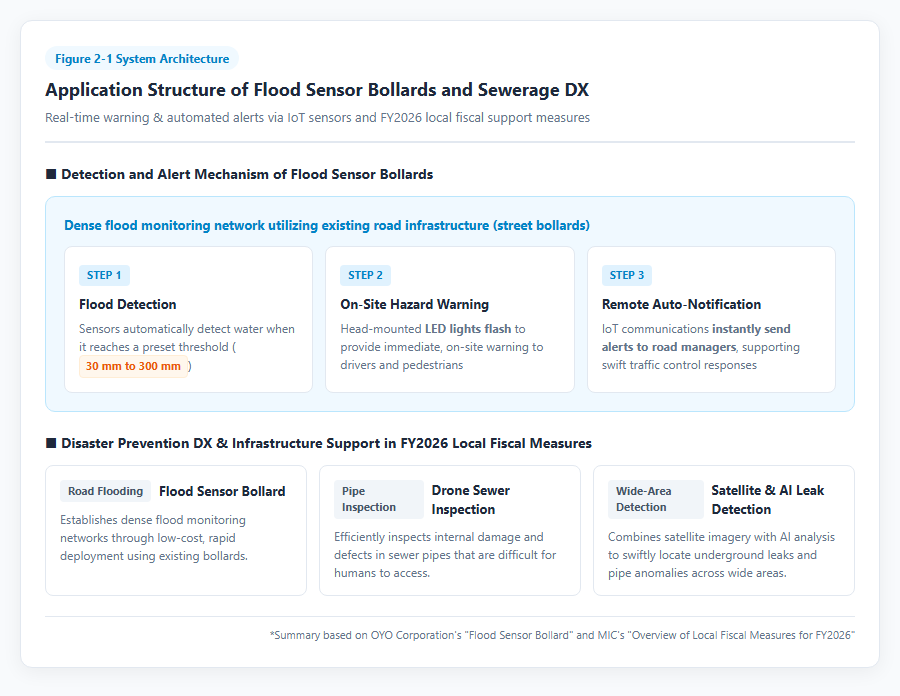
In urban flood management, alongside draining and storing water, digital transformation (DX) solutions that leverage IoT and AI to track flood risks in real time are gaining pivotal importance. A primary example is the “flood sensor bollard,” which integrates water-level sensors and communication modules directly into street bollards. When water reaches a preset threshold (ranging from 30 millimeters to 300 millimeters), the device automatically transmits alerts to road managers while flashing head-mounted LED lights to warn drivers and pedestrians on site. Utilizing existing street infrastructure enables the rapid, cost-effective deployment of dense flood monitoring networks. Furthermore, local fiscal policy measures for FY2026 advanced by the Ministry of Internal Affairs and Communications (MIC) and MLIT incorporate financial support for municipalities adopting sewerage DX technologies, such as drone-based sewer pipe inspections and satellite/AI-driven leakage detection. Please refer to the monitoring overview image below.
Future Outlook and Key Watchpoints
A specialized joint panel of MLIT and the Cabinet Office is scheduled to finalize comprehensive guidelines covering inland flood countermeasures and underpass entry prevention by the winter of 2026. Local governments and road managers are urged to prioritize the following actions without awaiting formal publication. First, execute emergency inspections across managed underpasses and historically flood-prone lowlands, including manual startup verifications and practical drills for backup power supplies. Second, utilize expanded local fiscal measures starting in FY2026—such as sewer enterprise bonds and emergency natural disaster prevention bonds—to accelerate the rehabilitation of aging sewer networks and DX-based inspection surveys. Third, prioritize installing automated physical gates and IoT sensors at high-risk locations while establishing rapid-response protocols with police and fire departments. As climate risks escalate, infrastructure investments and technological innovations aimed at enhancing urban resilience will remain a critical focus.
References
- [Ministry of Land, Infrastructure, Transport and Tourism] Immediate Measures to Prevent Underpass Inundation Accidents

- [Kanto Regional Development Bureau, MLIT] Investigation into Drainage Equipment Failure at Murata-cho Underpass [Interim Report]

- [Ministry of Internal Affairs and Communications] Overview of Local Fiscal Measures for FY2026

- [OYO Corporation] Flood Sensor Bollard

[#RoadFlooding #MLIT #Underpass #UrbanFlooding #InlandFlooding #DisasterDX #InfrastructureInvestment]


コメント