
On September 28, 2026, Minister of Land, Infrastructure, Transport and Tourism Tatsunori Ibayashi and four major construction industry associations held an exchange of views, and agreed to strengthen cooperation through a public-private partnership toward raising wages for skilled workers, leveling out construction work, and improving productivity. The background to this is a situation where ensuring the sustainability of the construction industry and securing its workforce has become an urgent priority due to prolonged labor shortages, persistently high material prices, and the application of caps on overtime work starting in April 2024.
- Holding of Public-Private Joint Exchange of Opinions and Summary of Events
- The Serious Industry Background That Led to the Exchange of Opinions and the Lineup of Participants
- Initiatives to Improve Skilled Workers’ Treatment and Secure Labor Costs
- Improving the Ordering Process for Work Schedule Leveling and Prevention of Overwork
- Productivity Improvement and DX Promotion Based on the Revised Construction Business Act
- Challenges for the Future, Future Developments, and Key Points to Watch
Holding of Public-Private Joint Exchange of Opinions and Summary of Events
On September 28, 2026, a meeting for an exchange of views was held between Minister of Land, Infrastructure, Transport and Tourism Tatsunori Ibayashi and representatives of four major construction industry associations at the Ministry of Land, Infrastructure, Transport and Tourism in Kasumigaseki, Tokyo. This meeting served as an important occasion for direct dialogue between industry leaders and Ibayashi, who assumed the post of Minister of Land, Infrastructure, Transport and Tourism in the Second Takaichi Reshuffled Cabinet launched on September 17, 2026. Attending the meeting from the Ministry were Minister Ibayashi, along with Administrative Vice-Minister Hideyuki Shiomi and Chief Engineer Masayoshi Hirose, while the construction associations were represented by Kenji Hasuwa, Vice Chairman of the Japan Federation of Construction Contractors; Masanori Imai, Chairman of the National Association of General Contractors; Shigeru Kawasaki, Chairman of the National Federation of Small and Medium Construction Contractors; and Shogo Iwata, Chairman of the National Federation of Construction Industry Specialty Contractors, among others. At the meeting, gratitude was expressed for the construction industry’s support in recovery and reconstruction efforts following heavy rain disasters and the 2026 Kumamoto Earthquake, and the significant social role that the construction industry must play in promoting growth investment and national resilience to support Japan’s future economy was reaffirmed. The main focal points were the steady achievement of wage increase targets for skilled workers at construction sites, work style reforms aimed at reducing working hours, and the promotion of productivity improvements through the utilization of ICT. A strong policy was set forth for the government and the construction industry to work together to accelerate various measures and aim for the establishment of a sustainable construction industry.
The Serious Industry Background That Led to the Exchange of Opinions and the Lineup of Participants
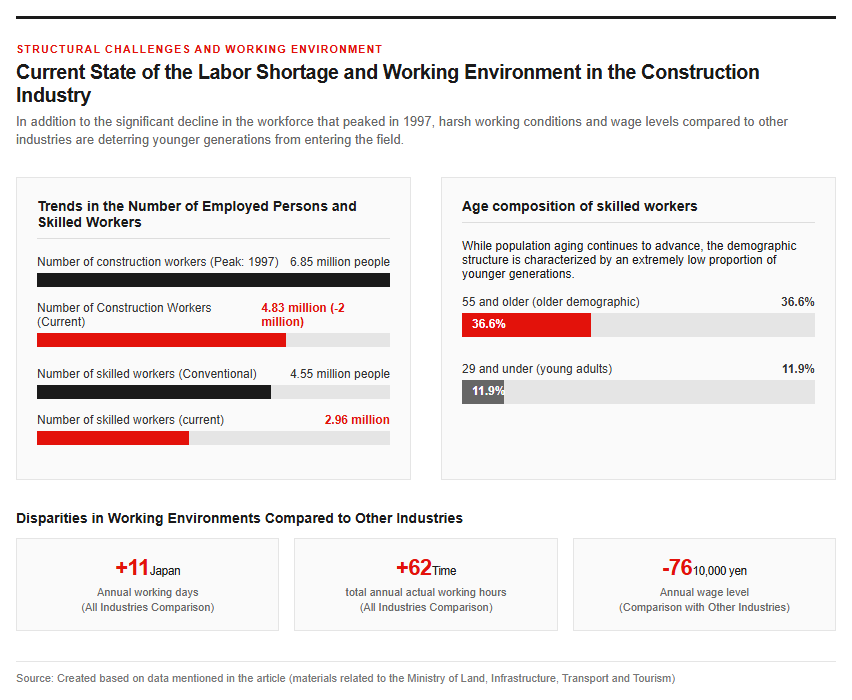
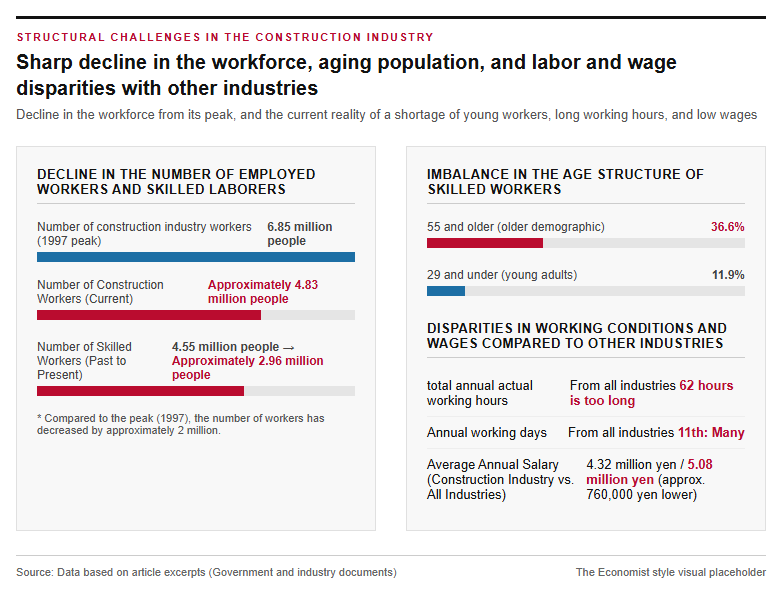
Behind the holding of this meeting lie structural challenges and rapid environmental changes facing the construction industry. The number of workers in the construction industry has dropped from a peak of 6.85 million in 1997 to approximately 4.83 million today, resulting in a loss of about 2 million workers. Furthermore, limiting it to skilled workers, the number has decreased from 4.55 million to about 2.96 million. The aging of the workforce is also severe, with those aged 55 and over accounting for 36.6 percent of the total, while young workers aged 29 and under remain at just 11.9 percent. In addition, the challenging working environment—such as an annual number of workdays 11 days higher and total annual actual working hours 62 hours longer than the all-industry average—along with wage levels that are approximately 760,000 yen lower compared to other industries, have been factors hindering younger generations from entering the workforce. Please refer to the figure below.
To address this situation, the government enacted the third set of three laws concerning construction workers in June 2024 (including the revised Construction Business Act and the Act on Promotion of Quality Assurance in Public Works), legislating measures to improve working conditions and combat soaring material costs. At the council meeting in September 2026, discussions covered the progress of the “roughly 6 percent” wage hike target agreed upon by the public and private sectors in March of that year, responses toward the fiscal 2027 rough estimate budget requests, and the industry’s construction capacity.
Concrete Discussions Toward Realizing Wage Hikes and Order Leveling
Initiatives to Improve Skilled Workers’ Treatment and Secure Labor Costs
To enhance the sustainability of the construction industry, the top priorities are improving the appropriate treatment and raising the wages of skilled workers who support the jobsites. Although the standard unit labor cost for public works design has been raised for 14 consecutive years, the average annual income in the construction industry remains around 4.32 million yen, still falling below the all-industry average of 5.08 million yen. At the meeting, Minister Ibayashi stated that, in light of soaring material prices and a sharp rise in labor costs, efforts will be made to secure the necessary public works budget. Under the revised Construction Business Act, based on the “Standards Concerning Labor Costs” formulated and recommended by the Central Council for Construction Business, estimates and contract conclusions involving extremely low labor costs are prohibited. This strengthens a mechanism to ensure that labor costs are properly secured in transactions between primary contractors and subcontractors, and that they reach skilled workers at the end of the chain. Discussions also covered support for transitioning to a monthly salary system based on proficiency and skills, as well as enhancing retirement benefit systems, by utilizing the promotion of the Construction Career Up System (CCUS) and capability evaluation systems. Representatives from the specialized contracting industry pointed out the importance of in-house training to nurture skilled artisans, and called for further government support toward making wage levels visible and forming career paths.
Improving the Ordering Process for Work Schedule Leveling and Prevention of Overwork
To promote work style reforms at construction sites, there have been strong demands to prevent unrealistic construction periods (construction period dumping) and to level out the issuance of construction orders throughout the year. The National Federation of Small and Medium Construction Contractors and the National Association of General Contractors reported that public works projects by local governments and other entities often see a concentration of orders from the second quarter onward, frequently forcing contractors into short-term construction schedules leading up to the end of the fiscal year. This concentration of work during specific periods makes it difficult for sites to secure two-day weekends and reduce overtime hours, while also reducing the operational efficiency of equipment, materials, and labor. Industry representatives explained that sites have sufficient construction capacity if orders are distributed appropriately, and called for the leveling out of order timings. In response, Minister Ibayashi acknowledged that stable construction work throughout the year contributes to the business stabilization of partner companies, improved treatment of skilled workers, and the securing of eight days off every four weeks. He emphasized his intention to firmly implement measures to level out order timings, including working with local governments as an executive government agency. Please refer to the figure below.
Furthermore, it was agreed to thoroughly enforce company-wide the establishment of a fair trading environment based on laws and regulations, such as mandating responses to consultations on contract price changes when material prices surge and prohibiting contracts with unreasonably short construction periods.
Advancement of Structural Reforms, Future Developments, and Key Points of Focus
Productivity Improvement and DX Promotion Based on the Revised Construction Business Act
As a measure to optimize long working hours and overcome labor shortages, initiatives to improve on-site productivity utilizing ICT and AI technologies are accelerating. Under the provisions of the revised Construction Business Act enacted in December 2024, the obligation to assign exclusive on-site engineers was rationally streamlined, enabling on-site management using remote cameras and communication equipment. This allows instructions to be given to the site via camera footage even from remote locations, aiming to reduce the burden on site supervisors and engineers. The government has set a goal to reduce labor requirements at construction sites by 30% and increase productivity by 1.5 times by 2040, and is strengthening support for the use of BIM/CIM, AI-based estimation, and the introduction of construction robots. Furthermore, measures directly linked to improving the on-site environment were introduced, such as the Ministry of Land, Infrastructure, Transport and Tourism’s AI implementation policy for the infrastructure sector and support packages for extreme heat countermeasures. In addition, operational efficiency is being promoted through the simplification of administrative procedures and paperwork, such as streamlining the obligation to submit construction organization ledgers for public works, where document submission becomes unnecessary if the client can directly verify the construction organization via the Construction Career Up System (CCUS) or other means.
Challenges for the Future, Future Developments, and Key Points to Watch
As the first point of attention moving forward, the stable securing of the public works budget for the formulation of the fiscal 2027 budget and the promotion of incorporating it into the initial budget to break away from dependence on supplementary budgets can be cited. The Japan Federation of Construction Contractors and the National Association of General Contractors are requesting a sufficient budget that reflects soaring material and labor costs to prevent any reduction in project volume caused by rising prices. Minister Ibayashi judged from current budget execution trends that sufficient construction capacity exists, and after dispelling concerns that the expansion of public investment would crowd out private investment, indicated a readiness to make proactive budget requests. The second focus is the integration and enforcement of labor cost standards and rules prohibiting below-cost contracts on-site, based on the revised Construction Business Act. From the autumn to the winter of 2025, preparations for the inclusion of labor cost items in public works bidding breakdowns and client confirmation methods are scheduled to be completed, which will test the practical effectiveness of the system. Toward the realization of a sustainable construction industry, the ultimate key moving forward will be whether the public and private sectors can closely cooperate to balance wage increases with productivity improvements, updating the industry into an attractive one where young people and women can hold hope for the future.
Reference page
- [Ministry of Land, Infrastructure, Transport and Tourism Official Announcement] [suspicious link removed]
【#MLIT #ConstructionIndustry #TatsunoriIbayashi #WageIncrease #WorkStyleReform #ProductivityImprovement #SecuringWorkforce】


コメント