- The Debut of a New Processor Enabling Local Execution of Massive LLMs
- Three Distinct Models Tailored to Different Workloads
- Key Improvements and Architecture Changes Over the Max 300 Series
- 192GB Unified Memory and GPU Allocation Revolution
- Massive Memory Bandwidth and High-Efficiency Data Control Flow
- Comparison with Competitors and Future Outlook
The Debut of a New Processor Enabling Local Execution of Massive LLMs
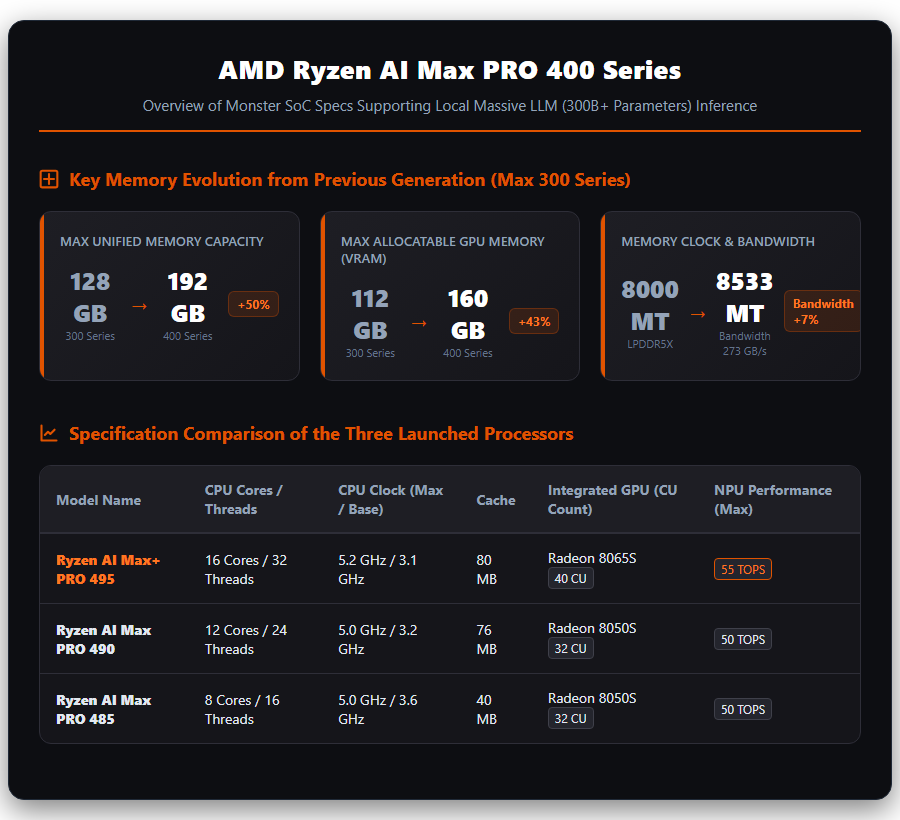
In May 2026, Advanced Micro Devices (AMD) officially unveiled the Ryzen AI Max PRO 400 series, a line of business-oriented processors supporting up to 192GB of high-speed unified memory. Codenamed Gorgon Halo, this new system-on-chip (SoC) family serves as a refined update to the previous Ryzen AI Max 300 series. It is designed to be the world’s first x86 client processor family capable of running large language models (LLMs) with over 300 billion parameters directly on a local device without internet connectivity or external cloud dependencies. This represents a monumental shift for organizations handling highly sensitive corporate data, allowing them to perform advanced AI inference locally, eliminating data privacy risks and minimizing monthly cloud computing costs. Systems powered by these processors are scheduled to begin shipping from major PC manufacturers in the third quarter of 2026, making desktop and mobile workstation-grade local AI workflows more accessible than ever. Please refer to the diagram below for a summary of the system architecture.
Three Distinct Models Tailored to Different Workloads
The Ryzen AI Max PRO 400 series features three distinct models designed to meet varying performance requirements and budget constraints. The flagship Ryzen AI Max+ PRO 495 integrates 16 Zen 5 CPU cores and 32 threads, a powerful Radeon 8065S built-in GPU with 40 compute units (CUs), and a dedicated XDNA 2 NPU capable of delivering up to 55 TOPS of AI processing power. Positioned in the middle of the lineup, the Ryzen AI Max PRO 490 offers 12 cores and 24 threads, while the entry-level Ryzen AI Max PRO 485 features 8 cores and 16 threads. Both the 490 and 485 models utilize the Radeon 8050S GPU with 32 CUs and deliver up to 50 TOPS of NPU performance. All three models feature a highly flexible configurable thermal design power (cTDP) ranging from 45W to 120W, with a base TDP of 55W. This versatility allows hardware partners to deploy these chips in everything from ultra-compact desktops to high-end laptops. Additionally, as part of AMD’s PRO portfolio, they include enterprise-grade security and manageability features for seamless corporate integration.
Key Improvements and Architecture Changes Over the Max 300 Series
While the Ryzen AI Max PRO 400 series preserves the foundational design of the Ryzen AI Max 300 series (known codenamed Strix Halo), it introduces several critical memory and clock speed enhancements. The most significant upgrade is the maximum supported memory capacity, which has been increased by 50% from 128GB to 192GB. Memory speed has also been boosted from LPDDR5X-8000 to LPDDR5X-8533, resulting in a 6.6% frequency increase. On the computational side, the top-tier Ryzen AI Max+ PRO 495 benefits from a 100MHz increase in maximum boost clock speeds for both its CPU (up to 5.2Ghz) and GPU (up to 3.0Ghz) compared to its predecessor. Unlike the dual consumer-and-enterprise focus of the 300 series, AMD has chosen to launch only the business-oriented PRO models for this generation. This strategy delivers full enterprise security and manageability suites to corporate users out of the box, although it may carry a slight price premium.
Technical Innovations and Market Position
192GB Unified Memory and GPU Allocation Revolution
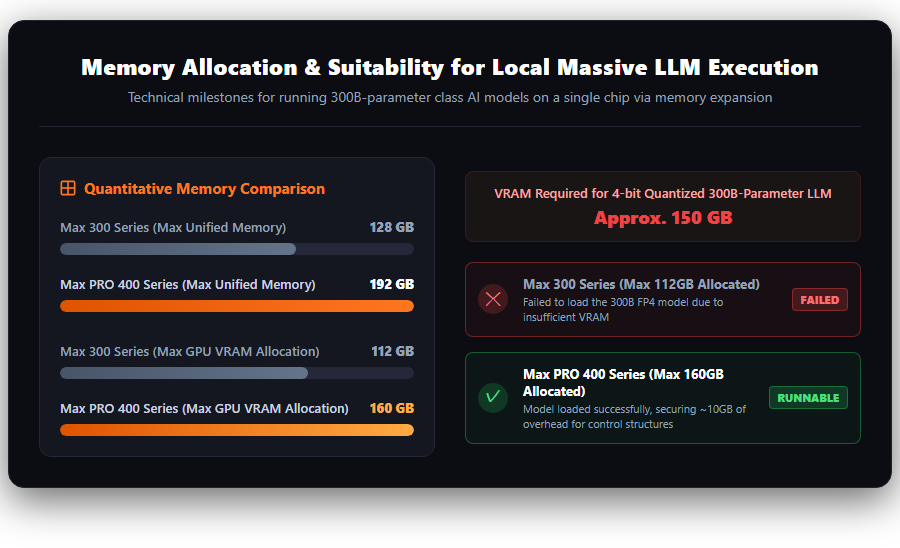
The defining technical innovation of this SoC family is its support for up to 192GB of high-speed unified memory, which can be shared seamlessly between the CPU, GPU, and NPU. Even more impressive is the firmware’s ability to allocate up to 160GB of this memory pool directly as dedicated video memory (VRAM) for the integrated GPU. This capability is crucial because running a 300-billion-parameter LLM quantized to 4-bit precision (FP4) requires approximately 150GB of memory. On conventional PC systems with discrete graphics cards, a model exceeding the card’s VRAM size triggers slow transfers over the PCI Express bus, causing a severe drop in performance. By unifying the system and GPU memory pools on a single chip, AMD eliminates the need for data duplication and transfer overhead. This makes it possible to load and execute massive, state-of-the-art AI models on a single local system. Please refer to the memory allocation comparison below.
Massive Memory Bandwidth and High-Efficiency Data Control Flow
Connecting the LPDDR5X-8533 memory over a wide 256-bit bus allows the Ryzen AI Max PRO 400 series to achieve an exceptional theoretical memory bandwidth of approximately 273GB/s. This represents a 7% increase in bandwidth compared to the previous 300 series. High memory bandwidth is a vital factor in local AI execution, especially for multi-agent parallel AI workflows where several autonomous models operate simultaneously. In these scenarios, the CPU acts as the primary control plane, coordinating search queries, executing code, and updating the key-value (KV) caches of active models. The unified, high-bandwidth architecture enables rapid data movement and cache manipulation directly within the shared memory pool. By avoiding the bottlenecks associated with traditional split-memory architectures, the system significantly reduces inference latency, enabling smooth and highly responsive real-time AI interactions on the device.
Comparison with Competitors and Future Outlook
The Ryzen AI Max PRO 400 series competes directly with specialized unified memory platforms like Apple’s Mac Studio and NVIDIA’s DGX Spark. Introduced in May 2026, the DGX Spark combines a 20-core Arm CPU and a Blackwell GPU with 128GB of unified memory, retailing at a Founders Edition price of \$4,699 (approximately 733,000 JPY at a conversion rate of 156 JPY/USD). AMD’s solution offers a clear advantage in memory capacity, providing up to 192GB compared to the DGX Spark’s 128GB. Furthermore, because AMD’s SoC utilizes the x86-64 architecture, it enjoys unmatched software compatibility with existing enterprise software, virtualization layers, and corporate management tools on Windows and Linux. Hardware partners such as ASUS, HP, and Lenovo are scheduled to launch laptops and small-form-factor desktops powered by these chips starting in Q3 2026. A key focus moving forward will be how effectively AMD’s ROCm software stack and open-source frameworks like llama.cpp and Ollama are optimized to maximize token generation speeds for these massive local models.
Reference Pages
- 【AMD Official Website】https://www.amd.com/
【#AMD #Ryzen #Semiconductor #Processor #LocalAI #LLM #UnifiedMemory #Tech】


コメント