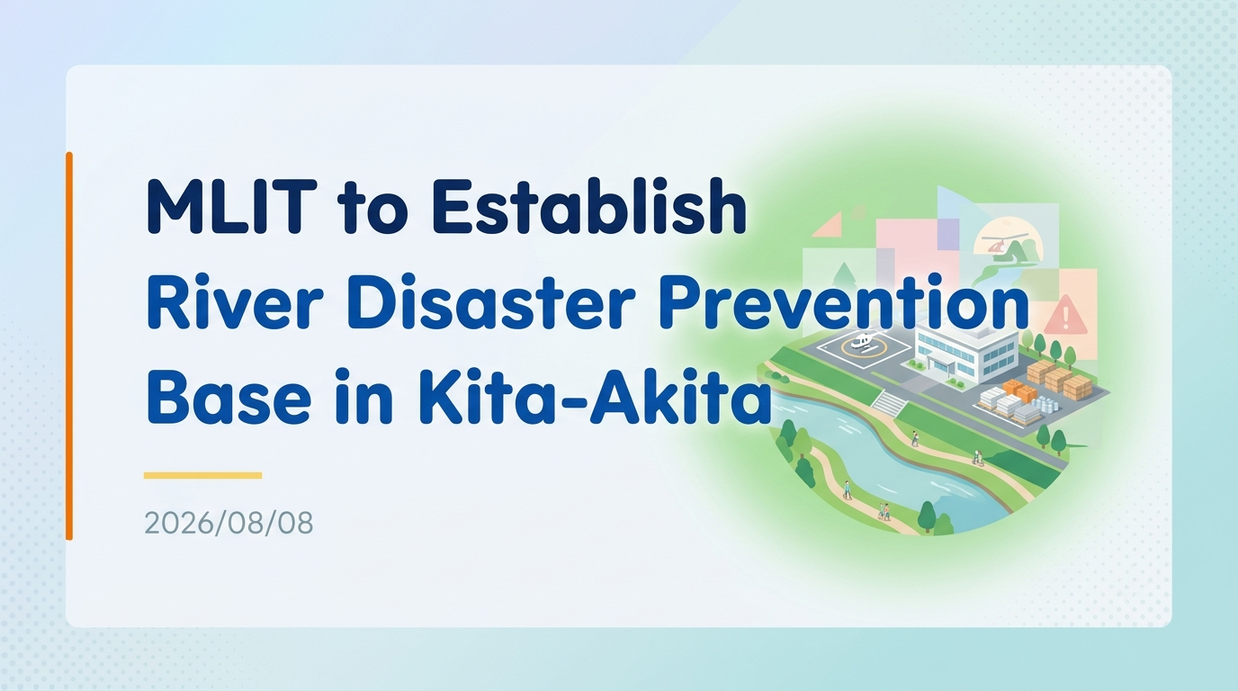
On August 7, 2026, the Japanese Ministry of Land, Infrastructure, Transport and Tourism (MLIT) officially decided on a plan to develop the Takanosu District River Disaster Prevention Station along the Yoneshiro River in Kitaakita City, Akita Prefecture. This project aims to strengthen Japan’s regional resilience against increasingly severe weather disasters while simultaneously serving as a “MIZBE Station“—a facility designed to create local community vibrancy during non-emergency times.
- Decision on the Takanosu District River Disaster Prevention Station Plan
- Overview of Facility Composition and Site Area
- Timeline Targeting Completion in 2032
- Role of River Disaster Prevention Stations in Rapid Emergency Response
- Expectations for Regional Revitalization as a MIZBE Station
- Important Disaster Prevention Base in the Basin-wide Flood Control Project
- Construction of the Flood Prevention Center through Municipal Cooperation
- Potential for Multi-purpose Use as a Community Hub
Decision on the Takanosu District River Disaster Prevention Station Plan
On August 7, 2026, the Japanese Ministry of Land, Infrastructure, Transport and Tourism registered two new locations for the development of River Disaster Prevention Stations and MIZBE Stations, bringing the total number of such registered projects across Japan to 156. One of the newly selected sites is the Takanosu District along the Yoneshiro River in Kitaakita City, located in northern Japan. With this official registration, the project to establish a strategic base for rapid emergency recovery activities during flood events has formally commenced.
The background of this development is the increasing frequency and intensity of water-related disasters in Japan due to climate change, which has led to a national shift toward the concept of “Basin-wide Flood Control” (Ryūiki Chisu). Under this approach, it is considered essential for Japanese society to prepare for large-scale flooding by fostering cooperation between the government, residents, and private enterprises. The Takanosu project is designed to provide the physical infrastructure necessary to enhance this collaborative disaster prevention capability. Following this decision, the Japanese government will now proceed with detailed design work to equip the region with proactive disaster mitigation functions.
The following table provides an overview of the planned development project.
Overview of Facility Composition and Site Area
The newly planned Takanosu District River Disaster Prevention Station will be situated in the Sakae district of Kitaakita City, specifically on the southern side of an existing commercial facility area. The site covers an extensive area of approximately 38,710 square meters, making it a large-scale hub for the region. This base will centralize various facilities indispensable during a disaster. Specifically, the Japanese national government (MLIT) will be responsible for preparing the land, constructing a heliport, establishing parking areas for large emergency vehicles, and creating storage spaces for emergency materials such as concrete blocks and soil.
Furthermore, the site will house a “Flood Prevention Center” (Suibō Center), the construction of which will be undertaken by Kitaakita City. This center will serve as the command post where local flood-fighting teams can safely standby, gather real-time information, and issue activity orders during a flood event. By utilizing this vast 3.8-hectare site, the facility will enable the smooth transport of large-scale materials and efficient rescue operations via helicopter. It is highly expected to become the cornerstone of the disaster prevention network in the middle reaches of the Yoneshiro River in Japan.
Timeline Targeting Completion in 2032
The Japanese government aims to complete this project by 2032 (Reiwa 14), following a long-term development process spanning several years. Preparations have already been underway; for example, in the Japanese fiscal year 2023, approximately 680 million yen was allocated for land acquisition for this water disaster prevention base.
Moving forward, the project will progress through detailed design phases, followed by the strengthening of embankments, land filling, and the phased construction of the various facilities. The specific timing for the construction of the Flood Prevention Center by Kitaakita City and the development of incidental facilities for daily community use will be coordinated with the city’s broader urban development plans. Between now and the targeted 2032 completion, the government plans to strengthen disaster prevention functions incrementally, such as by starting the stockpiling of materials as soon as areas are ready. As this is a decade-long project, periodic reviews will be conducted to ensure alignment with changing social conditions and local Japanese regional needs.
Hybrid Function of Disaster Protection and Community Vitalization
Role of River Disaster Prevention Stations in Rapid Emergency Response
The primary purpose of a River Disaster Prevention Station in Japan is to ensure that emergency responses during floods can be executed with maximum speed. In a large-scale Japanese river system like the Yoneshiro River, a threat of embankment failure requires extensive flood-fighting activities across a wide area. By pre-stockpiling materials such as concrete blocks and earth within this station, emergency crews can immediately deploy resources to damaged areas, potentially preventing a minor breach from becoming a catastrophic flood.
The provision of a dedicated standby location for flood-fighting teams is also critical for the safety of the personnel working at the front lines. By sharing real-time river information from a base equipped with redundant power supplies and communication systems, evacuation guidance and flood warnings can be issued more accurately to the Japanese public. Additionally, in the event of an earthquake, these stations serve as hubs for inspecting river infrastructure, contributing to the prevention of secondary disasters in Japan.
For a comparison of how these facilities function during normal times versus during a disaster, please refer to the following image.
Expectations for Regional Revitalization as a MIZBE Station
The Takanosu District has also been registered as a “MIZBE Station”. In the Japanese context, this system allows municipalities to utilize the space of a disaster prevention station during normal times to foster regional revitalization and create local “vibrancy”. By utilizing the waterfront space, the facility is expected to serve as a place of relaxation and interaction for local Japanese citizens.
Specific ideas for utilization include opening the vast parking and open spaces for recreational use, such as local markets or sports events, and using the Flood Prevention Center as a base for environmental education. By leveraging the rich natural environment and history of the Yoneshiro River, the city could host activities such as canoe classes or river cleanup events, providing opportunities for residents to feel closer to the water while naturally increasing their disaster awareness. This project represents a modern Japanese approach to public facilities, merging the “public” purpose of disaster prevention with the community goal of creating a lively social hub.
Important Disaster Prevention Base in the Basin-wide Flood Control Project
This project is a vital component of the “Yoneshiro River Basin-wide Flood Control Project” currently being promoted in Akita Prefecture. Basin-wide Flood Control is a strategy where flood management is not left solely to river administrators; instead, all stakeholders in the river basin—including Japanese local governments, private companies, and residents—work together to mitigate damage. The River Disaster Prevention Station acts as a vital link between “hardware” measures (infrastructure construction) and “software” measures (evacuation planning and information sharing).
For instance, the Yoneshiro River Council for Mitigating Damage from Large-scale Flooding has set goals such as “preventing evacuation delays,” “being prepared,” and “enabling rapid recovery”. The Takanosu base provides the physical “preparation” site and supports the “rapid recovery” phase after a disaster occurs. Even if a massive flood strikes, having this base will allow for the swift deployment of drainage pump vehicles and reconstruction support, thereby minimizing the long-term impact on the local Japanese economy.
The following diagram illustrates the overall structure of the Yoneshiro River Basin-wide Flood Control Project.
Future Outlook and Impact on Local Society
Construction of the Flood Prevention Center through Municipal Cooperation
A major point of focus moving forward will be the construction of the “Flood Prevention Center” led by Kitaakita City and the establishment of its operational framework. How the city designs the building on the foundation provided by the national government will determine the overall effectiveness of the base. The goal is to move beyond a simple warehouse or waiting area, focusing instead on how to create a space where residents can feel safe and how to equip the facility with tools that make the latest disaster information visible and easy to understand.
Furthermore, as the number of Japanese infrastructure operators decreases due to an aging population, there is a push for “advanced management” through the remote control and automation of floodgates and sluices. The Flood Prevention Center is expected to function as the command center for these high-tech systems, enabling reliable disaster response even with fewer personnel. Close cooperation between the city and the national government will be essential to realize a “trinity” of hardware, software, and operational expertise by the 2032 target completion.
Potential for Multi-purpose Use as a Community Hub
Once completed, the daily use of this base is expected to have a positive impact on the local Japanese community. The key to success as a MIZBE Station lies in whether the facility can generate a “chain of vibrancy” by leveraging its location adjacent to existing commercial facilities. Plans are being considered for multi-purpose use that transcends the typical boundaries of a disaster prevention base, such as using the plazas for regional festivals or developing walking paths to promote the health of Japanese citizens.
Furthermore, the station is expected to be a venue for environmental education programs for elementary and junior high school students, such as conducting surveys of aquatic life in the Yoneshiro River. By having children interact with the river and become familiar with the disaster prevention station from a young age, the project aims to enhance the disaster literacy of the next generation of citizens. While it serves as a fortress protecting safety, the challenge for the local Japanese community will be to nurture this space into a landmark and a source of regional pride.
Reference Pages
-
[Initiation of New Regional Disaster Prevention Base Development] https://www.mlit.go.jp/report/press/mizukokudo05_hh_000281.html
-
[Yoneshiro River Kitaakita District Water Disaster Prevention Base Development Project (PDF)] https://www.mlit.go.jp/report/press/content/002015728.pdf
-
[Yoneshiro River System River Development Plan (PDF)] https://www.thr.mlit.go.jp/noshiro/kasen/seibikeikaku/plan.pdf
【#KitaakitaCity #YoneshiroRiver #MLIT #DisasterPrevention #BasinWideFloodControl #MIZBEStation #RiverDisasterPreventionStation #TakanosuDistrict】


コメント