The Supreme Court of Japan has dismissed the final appeals filed by former executives of Taisei Corporation and Kajima Corporation, finalizing their guilty verdicts in a massive bid-rigging scandal surrounding the Linear Chuo Shinkansen project. The decision brings legal closure to a landmark case stemming from illegal collusion among major general contractors on a multi-trillion-yen national infrastructure endeavor, exposing deep-seated procurement flaws in Japan’s construction sector.
- Supreme Court Rejects Appeals, Finalizing Guilty Verdicts for Former Executives
- Divided Judicial Outcomes Among the “Big Four” Contractors
- Pre-Bid Adjustments and Collusive Tactics Since 2014
- Procurement Flaws in Large-Scale Infrastructure Projects
- Administrative Sanctions and Corporate Compliance Restructuring
- Key Debates and Focus Areas for Construction Procurement Reform
Supreme Court Rejects Appeals, Finalizing Guilty Verdicts for Former Executives
On September 14, 2026, the First Petty Bench of the Supreme Court of Japan dismissed the final appeals filed by Takashi Okawa, former managing executive officer of Taisei Corporation, and Ichiro Osawa, former senior department manager at Kajima Corporation, who were charged with violating the Antimonopoly Act in connection with construction contracts for the Linear Chuo Shinkansen. This decision finalizes the lower court rulings sentencing both individuals to 1 year and 6 months in prison, suspended for 3 years, while imposing fines of 250 million yen each on Taisei Corporation and Kajima Corporation as corporate entities.
The scandal involves unreasonable restraint of trade on a mega-national project ordered by Central Japan Railway Company (JR Tokai), with total construction costs reaching approximately 9 trillion yen. The contractors colluded to predetermine winning bidders for key contracts, including the construction of new subterranean stations at Shinagawa and Nagoya. In March 2021, the Tokyo District Court ruled that the companies engaged in illegal pre-bid adjustments to avoid price competition and secure high profit margins, severely damaging public trust in the construction industry. The Tokyo High Court upheld this verdict in March 2023, prompting the defendants’ appeal to the Supreme Court. Please refer to the following figure.
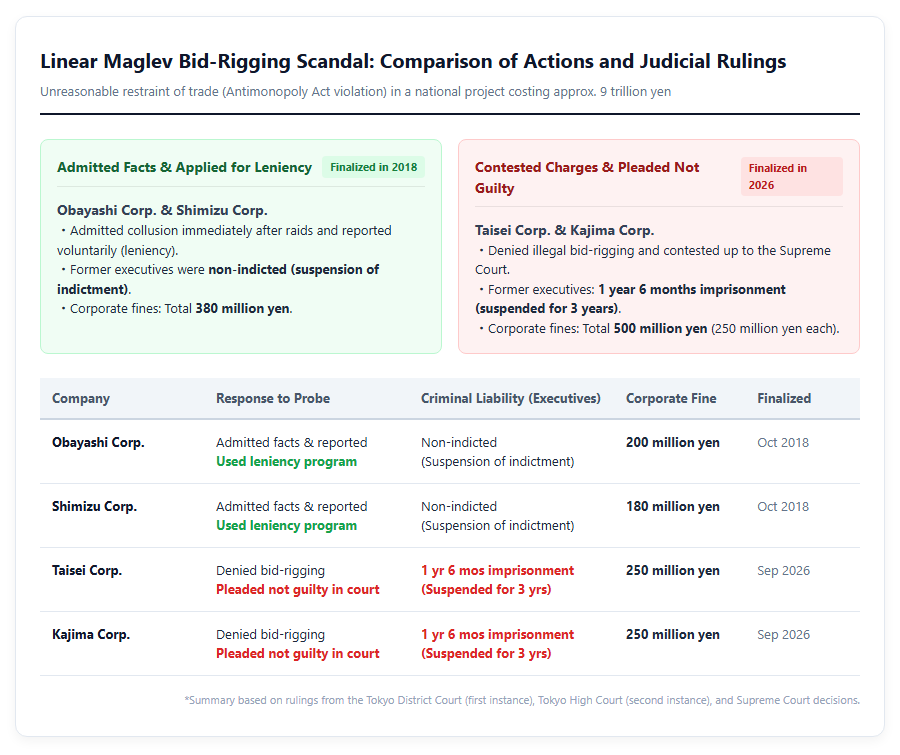
With total fines against the two corporate entities amounting to 500 million yen, the criminal proceedings have reached their ultimate legal conclusion approximately nine years after the initial raids.
Divided Judicial Outcomes Among the “Big Four” Contractors
All four of Japan’s top general contractors—collectively known as the “Super General Contractors” (Taisei Corporation, Kajima Corporation, Obayashi Corporation, and Shimizu Corporation)—were targeted in the sweeping probe. However, their contrasting approaches during the investigation led to starkly divided judicial outcomes and social consequences.
Immediately following compulsory raids in December 2017, Obayashi Corporation and Shimizu Corporation fully admitted the facts to investigating authorities and applied for leniency under the Fair Trade Commission’s (FTC) leniency program. As a result, former executives from both companies escaped indictment, and corporate fines of 200 million yen for Obayashi and 180 million yen for Shimizu were finalized early on in October 2018.
Conversely, Taisei Corporation and Kajima Corporation maintained that their pre-bid interactions constituted legitimate information exchange and technical discussions rather than illegal bid-rigging, opting to contest the charges in court. Nevertheless, relying on testimony from Obayashi and Shimizu officials alongside documentary evidence, the courts formally recognized a four-company conspiracy. The stark contrast in strategy produced a clear divide in sentencing timelines and personal criminal liability between the two firms that utilized the leniency mechanism and the two that fought their cases to the highest court.
Background and Structural Mechanics of the Linear Maglev Collusion
Pre-Bid Adjustments and Collusive Tactics Since 2014
The illicit bid-rigging scheme began secretly around 2011, following the official announcement of the Linear Chuo Shinkansen route, and intensified around 2014 as JR Tokai finalized its concrete procurement plans. Utilizing confidential information regarding project design and cost estimates obtained from JR Tokai officials, former Taisei executives held more than 38 secret meetings with counterparts from competing firms at restaurants across Tokyo.
The collusive negotiations covered primary construction sections, including the open-cut excavation work for Shinagawa and Nagoya stations, as well as the Southern Alps Tunnel project—a notoriously difficult engineering task featuring a maximum overburden of approximately 1,400 meters. Taking into account each firm’s technical expertise, historical project track record, and preferred construction methods, the four companies divided the project packages among themselves and exchanged detailed estimate breakdowns and unit price information to guarantee high profit margins for designated winners.
Investigations revealed that these pre-bid adjustments effectively crippled free price competition, resulting in artificially inflated cost estimates submitted to JR Tokai. In December 2017, the Tokyo District Public Prosecutors Office’s Special Investigation Department and the FTC conducted simultaneous raids on the contractors’ headquarters, leading to formal antitrust indictments against the four corporate entities and key executives in March 2018.
Procurement Flaws in Large-Scale Infrastructure Projects
Beyond individual corporate wrongdoing, experts point to deep-rooted procurement customs and systemic structural flaws within Japan’s construction sector as primary catalysts for the scandal. For extraordinary infrastructure projects requiring highly advanced engineering—such as the Southern Alps Tunnel or deep subterranean station caverns—it is nearly impossible for the project owner to formulate detailed designs and execution plans independently without early technical support from major general contractors.
However, Japanese public works and infrastructure procurement traditionally operate under a “self-sufficiency principle” (jimae-shugi), where consulting fees (“soft fees”) for pre-bid planning, surveying, and design stages are rarely compensated by project owners. Consequently, general contractors invest immense uncompensated labor and technical development costs during pre-bid engineering evaluations and budget preparation, seeking to recoup these upfront expenditures through inflated execution profits after winning the contract. Please refer to the following figure.
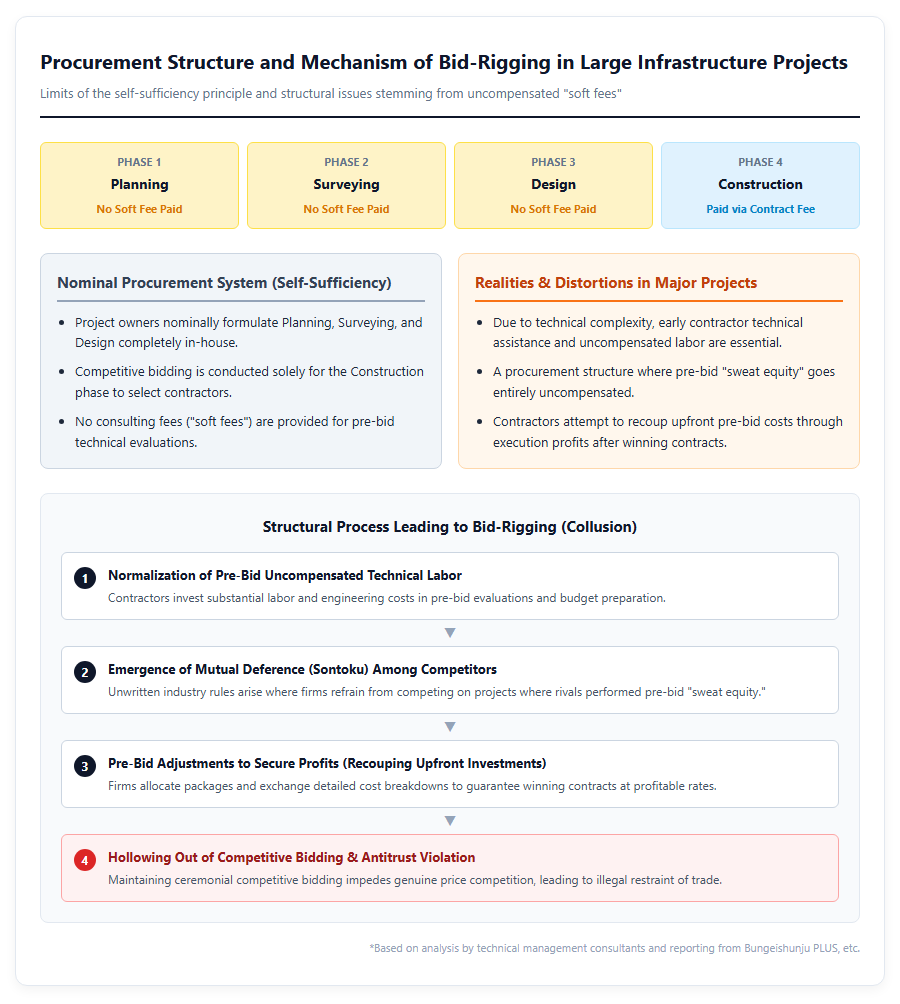
This lack of explicit compensation for pre-bid “sweat equity” fostered an environment of unwritten industry courtesy (sontoku) and bid allocation. By insisting on the appearance of formal competitive bidding while remaining fundamentally dependent on specific contractors’ proprietary technology, project owners unwittingly rendered the competitive bidding system hollow and incentivized unlawful collusion.
Impact of the Verdict and Future Industry Outlook
Administrative Sanctions and Corporate Compliance Restructuring
The finalization of these guilty verdicts carries severe administrative and economic repercussions for the involved companies. Following their earlier convictions, Obayashi Corporation and Shimizu Corporation were hit with 120-day business suspension orders by the Ministry of Land, Infrastructure, Transport and Tourism (MLIT) from February to June 2019, barring them from bidding on private civil engineering projects and forcing them to suspend activities within Keidanren (Japan Business Federation). Similar stringent administrative sanctions and government debarment measures are anticipated for Taisei and Kajima following the Supreme Court’s ruling.
The scandal also forced major contractors to overhaul their management structures and compliance frameworks. Obayashi replaced its president in March 2018, establishing an independent third-party committee of outside experts to draft anti-recurrence measures, enforce strict rules governing competitor contact, and strengthen internal monitoring.
Financially, even as Taisei Corporation’s annual revenue reaches approximately 2 trillion yen in 2026, the reputational damage threatens its stock performance and investor relations, underscoring the urgent need for transparent corporate governance and accountability to shareholders.
Key Debates and Focus Areas for Construction Procurement Reform
While the Supreme Court’s decision brings legal closure to criminal prosecutions, industry attention now shifts toward reforming opaque bidding practices and establishing sustainable public procurement systems across the construction sector.
The first critical focus area is the formalization of “soft fees” and the modernization of procurement methods. Moving away from rigid self-sufficiency toward a model that fairly compensates contractors for pre-bid technical proposals and surveying is essential to eliminating the financial pressure that drives bid-rigging. Furthermore, for highly complex engineering projects, project owners are urged to move beyond ceremonial competitive bidding in favor of transparent, negotiated single-source contracting (tokumei zuikei) or comprehensive technical evaluation systems permitted under relevant laws.
The second focus area centers on heightened antitrust oversight by the Fair Trade Commission and broader adoption of corporate leniency mechanisms. The success of the leniency program in exposing this cartel has demonstrated its efficacy, raising expectations for earlier detection and deterrence of anticompetitive behavior industry-wide. As the Linear Chuo Shinkansen project advances toward its target opening from 2027 onward, stakeholders will closely monitor whether Japan’s construction market can maintain a fair, transparent, and competitive environment.
Reference Pages
- [Overhaul of Management Structure and Rebuilding of the Compliance System | Obayashi 130-Year History] https://www.obayashi.co.jp/chronicle/130th/history/chapter3_2.html
- [Notice Regarding Supreme Court Decision Concerning Alleged Antimonopoly Act Violations | Taisei Corporation] https://japanir.jp/wp-content/uploads/2026/09/1801-20260915-01.pdf
【#LinearMaglev #SupremeCourtVerdict #MajorContractors #AntimonopolyAct #Compliance #TaiseiCorporation #KajimaCorporation】
コメント