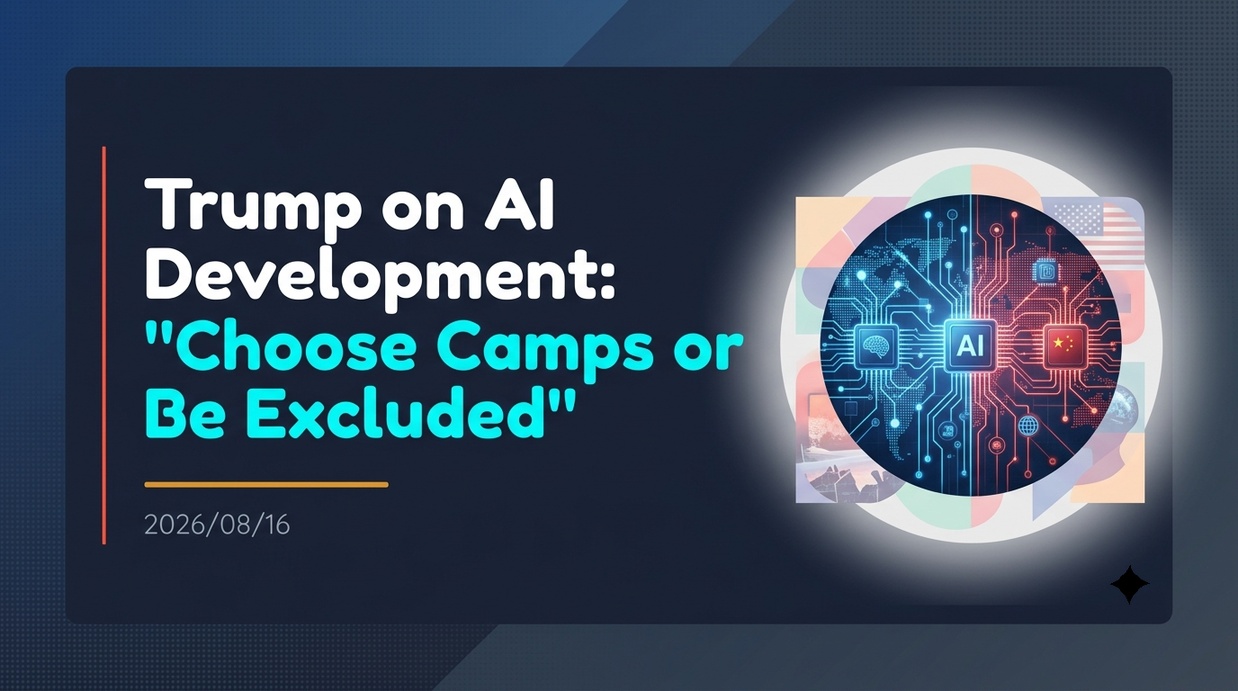
The Trump administration is strongly pressuring its allies to choose sides in a global AI development race. By formalizing a policy that prohibits simultaneous participation in U.S.-led and China-led frameworks, the administration has decisively triggered a fragmentation of the global AI supply chain.
- The AI Hegemony “Loyalty Test” and the Technological Encirclement
- Demanding a Choice from Over 30 Countries and Excluding Chinese-led Frameworks
- The Exclusive Nature of the Multilateral “Pax Silica” Framework
- U.S. National AI Strategy and its Impact on Infrastructure and Markets
- Accelerating AI Development and Energy through the “AI Action Plan”
- The Administration’s Investment Strategy and Proposals for Government Shareholding
- Implications for Japanese Companies and the Outlook for Late 2026
- Supply Chain Decoupling and the “Patchwork” Block Economy
- Management of Computing Resources and New Rules for Economic Security
The AI Hegemony “Loyalty Test” and the Technological Encirclement
Demanding a Choice from Over 30 Countries and Excluding Chinese-led Frameworks
On August 14, 2026, the Trump administration began preparing letters to be sent to more than 30 allies and partner countries, including Japan, demanding they break ties with the Chinese AI camp. The draft letter from the U.S. State Department uses strong language, stating that “participating in everything is the same as participating in nothing,” and requires a binary choice between the U.S.-led “Pax Silica” and China’s “Global AI Cooperation Organization”. This notice targets the 35 countries and regions that signed the “AI Opportunity Statement” in June 2026. The U.S. government views signing this statement not as a mere registration but as a deep commitment, explicitly stating that duplicate participation in Chinese-led frameworks—against U.S. expectations—will not be tolerated. Washington is particularly wary of countries like Kazakhstan, which is currently confirmed to be participating in both frameworks, and is prepared to exclude such nations from supply chains if they do not comply.
The Exclusive Nature of the Multilateral “Pax Silica” Framework
“Pax Silica” is a multilateral cooperation framework aimed at securing semiconductors and critical minerals essential for AI technology. It includes over twenty countries and regions, such as Japan, South Korea, Australia, and the European Union (EU). In contrast, Chinese President Xi Jinping announced the establishment of the “Global AI Cooperation Organization” in Shanghai in July 2026, with 29 countries including Russia, Brazil, and Pakistan signing the agreement. China aims to counter U.S. influence by promoting open-weight AI models. Please refer to the following diagram:
U.S. National AI Strategy and its Impact on Infrastructure and Markets
Accelerating AI Development and Energy through the “AI Action Plan”
The Trump administration’s aggressive stance is rooted in “Winning the Race: AMERICA’S AI ACTION PLAN,” released by the White House on July 23, 2025. This plan consists of three pillars: “Accelerating Innovation,” “Building Domestic AI Infrastructure,” and “International Diplomacy and Security,” with the goal of achieving AI hegemony by positioning it as the “oil of the 21st century”. On the infrastructure side, the administration is promoting the rationalization of permit systems for the construction of data centers and power plants under the slogan “Build, Baby, Build!”. Please refer to the following diagram:
The Administration’s Investment Strategy and Proposals for Government Shareholding
While expressing strong support for the AI industry, Donald Trump has also personally invested in AI-related stocks, drawing significant market attention. In 2026, he acquired hundreds of millions of dollars in shares of major U.S. AI companies, including Nvidia, Microsoft, Amazon, and Dell. His Dell holdings alone reportedly gained at least several million dollars after rising 150% following his purchase in early February, leading to concerns about potential conflicts of interest with national AI promotion policies. Amidst this, on June 5, 2026, President Trump revealed a plan for the U.S. government to hold stakes in major AI development companies as a means to distribute wealth to American citizens. While he argues this will allow citizens to benefit directly from AI’s success, analysts view it as a tactic for the November 2026 mid-term elections or an effort to sustain the AI stock market. This stance of government market intervention acts as a powerful magnet to attract investment capital into the U.S., even as concerns about an AI bubble burst persist.
Implications for Japanese Companies and the Outlook for Late 2026
Supply Chain Decoupling and the “Patchwork” Block Economy
The U.S. demand for camp selection is forcing Japanese companies with deep ties to the Chinese market to radically restructure their production systems. The Japanese semiconductor industry holds a significant global share—about 30% in manufacturing equipment and 48% in materials—and maintains a dominant 90% share in specific advanced materials like EUV photoresists, making it an indispensable part of the global supply chain. However, as U.S.-China tensions intensify, these assets are increasingly treated as “economic security weapons”. AI-based predictive analysis suggests a 50% probability of “uncontrolled escalation” and a 45% probability of a permanent “patchwork block economy,” meaning there is a 95% total probability of a harsh future ahead. Indeed, Japanese companies like Tokyo Electron have seen their sales ratio to China decline from approximately 42% in the fiscal year ending March 2025, though China remains their largest single market. Japanese firms must quickly prepare “Plan B” contingencies and accelerate the diversification of production bases to ASEAN countries, India, and Mexico in the face of an unprecedented trade war with potential tariff rates as high as 145% vs 125%.
Management of Computing Resources and New Rules for Economic Security
The focus of AI competition is shifting from chip export controls to the management of “compute resource utilization”—essentially monitoring who is using compute power and from where. In January 2026, the U.S. House of Representatives passed the “Remote Access Security Act,” which aims to regulate the use of AI through the cloud. This is designed to close the “cloud loophole” where Chinese tech giants like Alibaba and ByteDance use overseas data centers in Southeast Asia to train advanced AI models. Please refer to the following diagram:
Reference Pages
-
【America’s AI Action Plan】https://www.whitehouse.gov/wp-content/uploads/2025/07/Americas-AI-Action-Plan.pdf
-
【Department of Commerce Revises License Review Policy for Semiconductors Exported to China】https://media.bis.gov/press-release/department-commerce-revises-license-review-policy-semiconductors-exported-china
-
【Remote Access Security Act (H.R.2683)】https://www.congress.gov/bill/119th-congress/house-bill/2683/all-actions
-
【AI Basic Plan (Cabinet Office of Japan)】https://www8.cao.go.jp/cstp/ai/ai_plan/ai_plan.html
【#AI #TrumpAdministration #EconomicSecurity #Semiconductors #PaxSilica #USChinaTensions #BusinessStrategy】

コメント