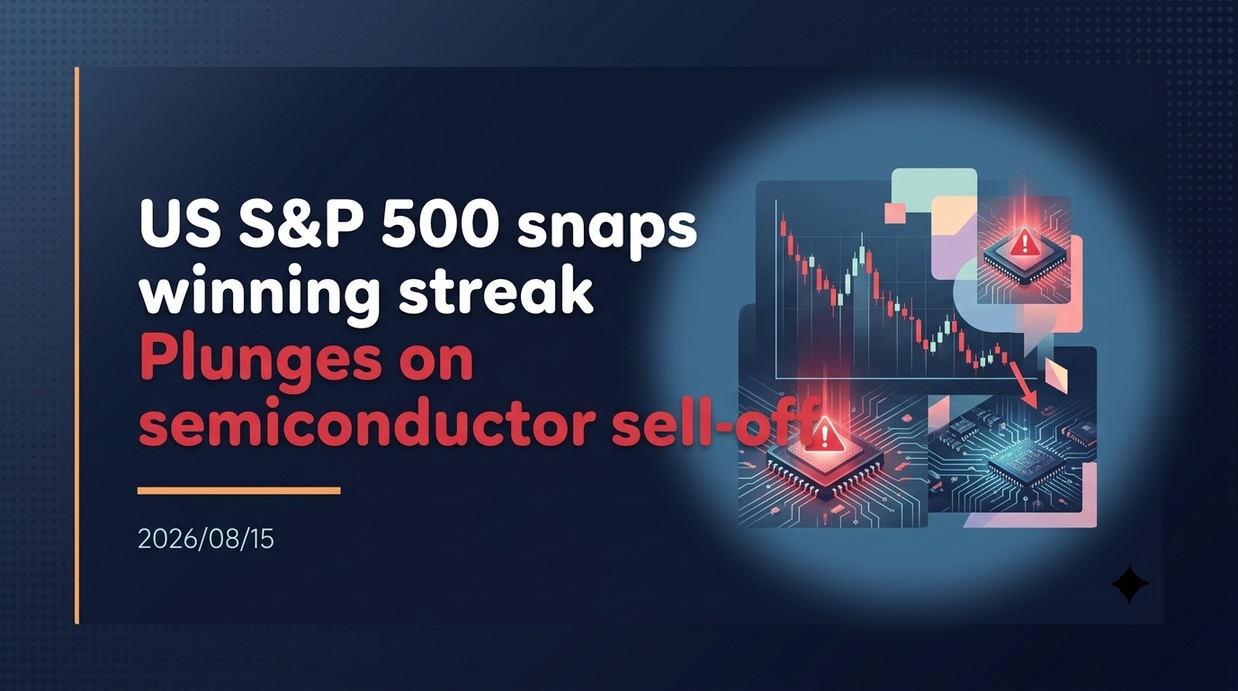
The S&P 500 Index has retreated as a significant downturn in the semiconductor sector weighed heavily on the market. Applied Materials (AMAT), the world’s largest semiconductor manufacturing equipment maker, issued a financial outlook that fell short of the market’s high expectations, while stricter U.S. export controls on China have raised concerns about future revenue stability.
- S&P 500 Dragged Down by the Semiconductor Slump
- Applied Materials’ Missed Expectations Trigger a Chain Reaction
- AI Demand vs. Legacy Markets: A Sharp Contrast in Japan
- Stricter U.S. Export Controls and the Resulting Financial Blow
- Cost Barriers and Labor Shortages Hindering Domestic Rebirth
- Future Outlook: Policy Transparency and AI Investment Sustainability
S&P 500 Dragged Down by the Semiconductor Slump
In the U.S. stock market, the sharp decline in semiconductor-related stocks, which had previously driven the artificial intelligence (AI) boom, has become a significant weight on major indices. As of July 17, 2026, the S&P 500 Index fell 1.55% weekly to close at 7,457.69, marking its first weekly decline in three weeks. The Philadelphia Semiconductor Index (SOX) was hit even harder, plummeting 9.97% during the same week and dropping more than 20% from its recent all-time high, crossing the threshold for a bear market. This volatility stems from a sense of overheating and overvaluation; for example, the Price-to-Earnings (PER) ratio of the U.S. chipmaker AMD reached 47.6, far exceeding its post-2023 average of 34.1. Investors are increasingly wary of an earnings shock, where stock prices tumble significantly following corporate financial disclosures. The following figure illustrates the recent performance of major market indices.
Applied Materials’ Missed Expectations Trigger a Chain Reaction
Applied Materials (AMAT) surprised the market with a financial outlook for the October 2025 quarter that failed to meet the market’s high growth expectations. The company projected revenue of approximately \$6.7 billion (±\$0.5 billion), which was lower than the market consensus of roughly \$7.33 billion. Following this announcement, AMAT’s stock plunged nearly 14% in after-hours trading, dragging down its industry peers: the measurement specialist KLA fell by about 7%, the front-end equipment leader Lam Research dropped by nearly 7%, and the Dutch lithography giant ASML saw a decline of approximately 3%. Investors are deeply concerned that the China risk—characterized by a pause in demand for mature-node chips as Chinese customers digest existing capacity—could ripple across the entire manufacturing equipment sector.
A Polarized Market and the Wall of Regulation
AI Demand vs. Legacy Markets: A Sharp Contrast in Japan
The global semiconductor market is currently defined by a stark “AI or everything else” dichotomy. In Japan, companies positioned within the AI supply chain are seeing unprecedented growth; for instance, the Japanese test equipment manufacturer Advantest nearly doubled its operating profit forecast for the Japanese fiscal year ending March 2025, from an initial 90 billion yen to 165 billion yen, due to high demand for High Bandwidth Memory (HBM) testing. In contrast, Japanese chipmakers focused on non-AI sectors such as automotive, industrial machinery, and consumer electronics are facing severe challenges. Rohm, a Japanese specialist in analog and power semiconductors, now expects an operating loss of 15 billion yen for the current fiscal year—marking its first time in the red in 12 years. Similarly, the Japanese company Renesas Electronics has been forced to reduce factory utilization rates due to weakening demand in its core automotive and industrial segments. This polarized market structure is visualized in the comparison below.
Stricter U.S. Export Controls and the Resulting Financial Blow
The decline in AMAT’s stock was further exacerbated by new export regulations issued by the U.S. Bureau of Industry and Security (BIS). Under the BIS Related Entities Rule announced on September 29, 2025, the ability to export products or provide services to specific customers in China without a license has been further restricted. AMAT estimates these regulations will reduce its revenue by approximately \$110 million in the fourth quarter of 2025 and by a substantial \$600 million in fiscal year 2026. Additionally, the company recently settled with the BIS regarding illegal exports to China’s SMIC, agreeing to pay a \$252 million penalty—the second-highest fine in the history of the bureau. With bipartisan support for these curbs in the U.S., geopolitical risk has become a tangible financial liability for equipment makers with high exposure to the Chinese market.
Dilemmas of U.S. Manufacturing Reshoring and the Path Ahead
Cost Barriers and Labor Shortages Hindering Domestic Rebirth
While successive U.S. administrations have prioritized bringing semiconductor manufacturing back to American soil through initiatives like the CHIPS and Science Act, significant structural challenges remain. Construction costs for new semiconductor fabrication plants (fabs) in the U.S. are 30% to 50% higher than in Asian hubs like Taiwan, South Korea, and China. Energy costs for these power-intensive facilities are also estimated to be 30% to 40% higher in the U.S. compared to Asia. Moreover, a severe shortage of skilled labor is stalling progress; a study by the Semiconductor Industry Association (SIA) predicts a shortage of 67,000 technicians and engineers in the U.S. chip industry by 2030. These bottlenecks have already caused delays, such as Intel’s plan for two fabs in Ohio being pushed back to 2030 or later.
Future Outlook: Policy Transparency and AI Investment Sustainability
The primary focus for the semiconductor market moving forward will be policy transparency and the sustainability of massive AI capital expenditures. Investors are closely monitoring whether the U.S. government will approve pending export licenses and how the direction of future tariff policies might impact global supply chains. While AMAT management remains optimistic about long-term growth driven by advanced packaging—raising its 2026 growth forecast for that segment to over 70%—short-term risks persist. Upcoming earnings reports from major tech companies such as Alphabet and Tesla will be critical; if their AI-related investments do not meet market expectations for immediate results, the industry could face further earnings shocks. The market is no longer satisfied with mere beats; it now requires evidence that high valuations can be sustained by consistent, long-term growth.
Reference
-
【Applied Materials to Pay \$252 Million Penalty to BIS for Illegally Exporting Semiconductor Manufacturing Equipment】https://www.bis.gov/press-release/applied-materials-pay-252-million-penalty-bis-illegally-exporting-semiconductor-manufacturing-equipment
-
【State of the U.S. Semiconductor Industry 2025 – SIA】https://www.semiconductors.org/wp-content/uploads/2025/05/2025-SIA-State-of-the-Industry-Report.pdf
-
【US Semiconductor Chip Manufacturing Reshoring: Regulatory, Economic, and Structural Challenges】https://doi.org/10.63593/FMS.2788-8592.2025.09.002
-
【President Trump Is Putting American Workers First and Bringing Back American Manufacturing】https://www.whitehouse.gov/articles/2025/03/president-trump-is-putting-american-workers-first-and-bringing-back-american-manufacturing/
-
【Eighteen new semiconductor fabs to start construction in 2025, SEMI reports】https://www.prnewswire.com/news-releases/eighteen-new-semiconductor-fabs-to-start-construction-in-2025-semi-reports-302343486.html
【#Semiconductor #StockMarket #SP500 #AppliedMaterials #Economy #TechStocks #ExportControls #AI】

コメント