
The U.S. Securities and Exchange Commission (SEC) has announced proposed new rules aimed at expanding accredited investor qualifications to professionals such as certified public accountants (CPAs) and Chartered Financial Analysts (CFAs), as well as introducing new FINRA exams. The background behind this move is the intention to broaden retail investor access to the rapidly expanding $2.6 trillion private market and equalize wealth-building opportunities.
- Key Points of the New Regulatory Proposal and Dramatic Relaxation of Retail Investor Qualifications
- Concept for Establishing a Specialized Exam: The “Certified Investor Exam”
- Private Credit and Retailization Rapidly Growing to a .6 Trillion Scale
- Modernization of Performance Fee Regulations and Overhaul of Fund Structures
- Discussions and Concerns Surrounding Liquidity Risk and Investor Protection
- The 60-Day Public Comment Period and Key Points to Watch Moving Forward
Key Points of the New Regulatory Proposal and Dramatic Relaxation of Retail Investor Qualifications
On September 30, 2026, the U.S. Securities and Exchange Commission (SEC) published a new proposed rule and notice of proposed rulemaking that significantly eases the requirements for “Accredited Investor” status, which allows individual investors to invest in private assets such as private equity (PE) and private credit.
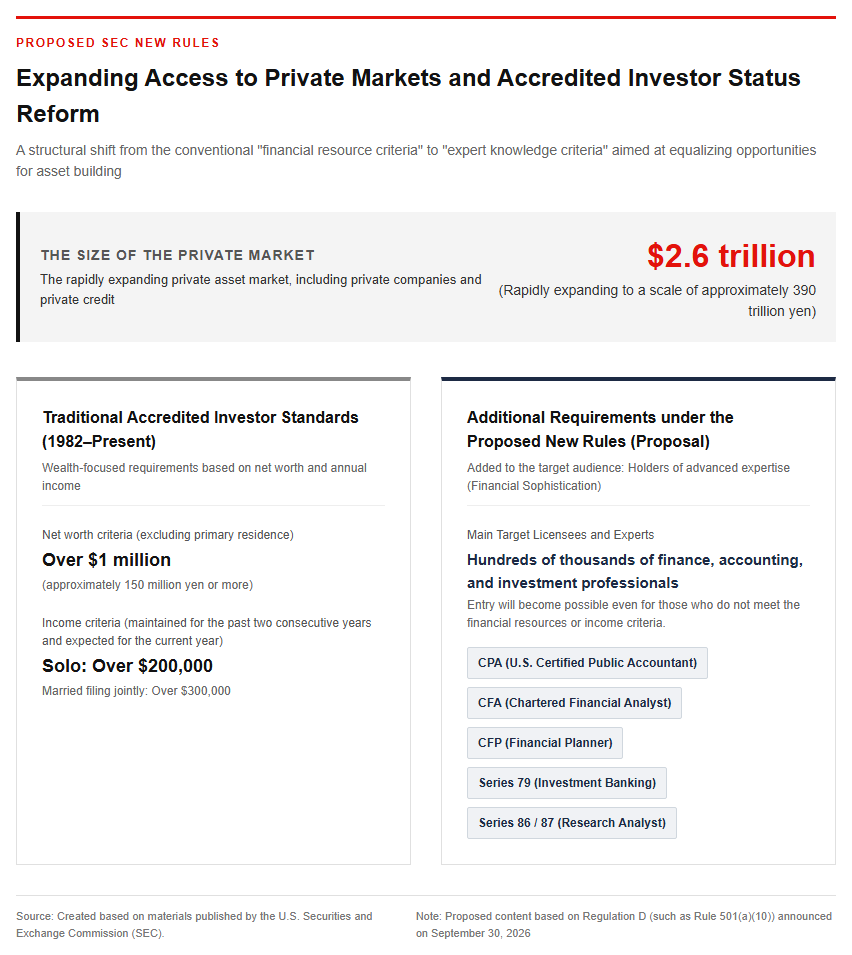
Until now in the United States, to become an accredited investor who invests in private companies and private equity funds, it has been necessary to meet financial criteria established since 1982. Specifically, eligibility was limited to individuals whose net worth exceeded $1 million (approximately 150 million yen), excluding their primary residence, or whose annual income exceeded $200,000 individually or $300,000 combined with a spouse for the past two years, with a similar level of income expected in the current year.
In the latest SEC proposal, a direction was set forth, based on Rule 501(a)(10) of Regulation D, to grant accredited investor status even to individuals who do not meet these wealth or income criteria, provided they possess advanced professional expertise in finance and accounting (Financial Sophistication).
Specifically, this applies to holders of the US Certified Public Accountant (CPA), Chartered Financial Analyst (CFA), and Certified Financial Planner (CFP) designations, as well as holders of the Investment Banking Representative License (Series 79) and Research Analyst Licenses (Series 86 and 87) regulated by the Financial Industry Regulatory Authority (FINRA). This paves the way for hundreds of thousands of qualified professionals to newly participate directly in the private equity and private credit markets. The overview is as shown in the image below.
Concept for Establishing a Specialized Exam: The “Certified Investor Exam”
Attracting the most attention as the most innovative measure in this announcement is the plan to introduce a new “Accredited Investor Exam” scheduled to be developed and administered by FINRA (Financial Industry Regulatory Authority).
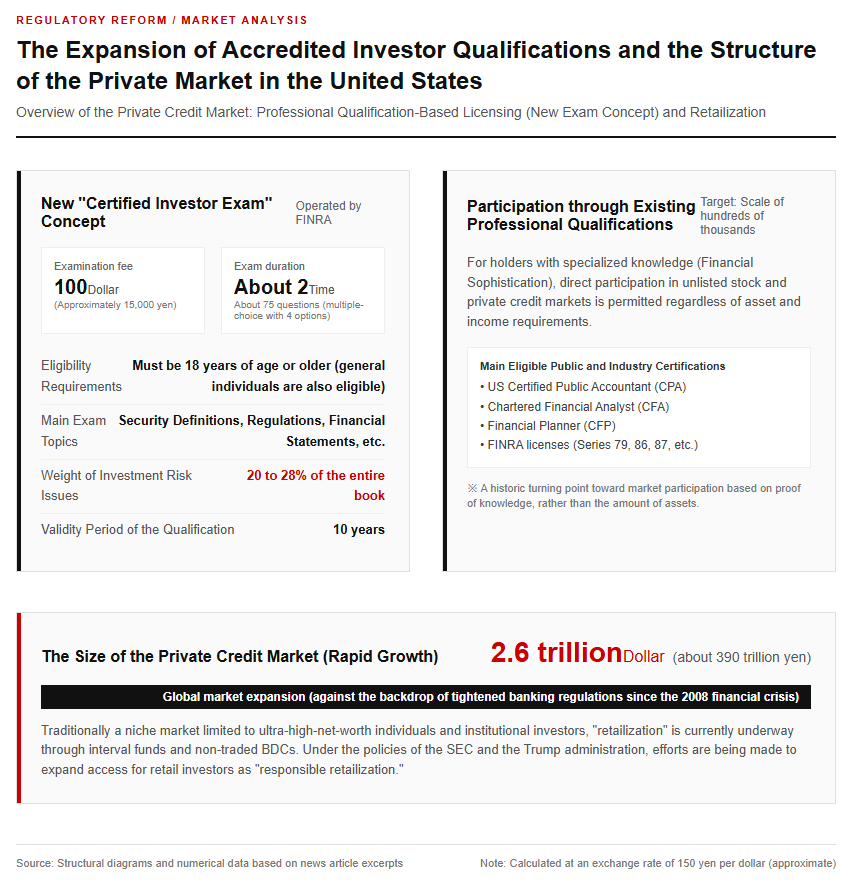
This exam is designed as a public test that anyone aged 18 or older can take, even if they are not affiliated with the financial industry or securities companies. Passing the exam makes it possible to obtain accredited investor status as an individual investor, regardless of asset amount or income level.
As for the overview of the exam, it is modeled after the existing Securities Industry Essentials (SIE) exam administered by FINRA, consisting of approximately 75 multiple-choice questions with a test duration of about 2 hours, and is expected to be set at a relatively low fee of around $100 (approx. 15,000 yen).
The examination scope includes definitions and structures of various securities, financial regulations, financial statement analysis, and corporate governance, as well as private placement and exemption mechanisms such as Regulation D, Regulation A, crowdfunding, and SAFEs. In particular, questions regarding investment risks are scheduled to account for the highest proportion, at 20 to 28 percent of the total. The validity period of the qualification granted to successful candidates is set at 10 years, marking a historic turning point that grants market participation based on the proof of knowledge rather than the amount of assets.
Background of Promoting Democratization and Operational System Reforms
Private Credit and Retailization Rapidly Growing to a .6 Trillion Scale
Behind the U.S. SEC’s shift toward easing entry restrictions for retail investors lies the rapid expansion of the private markets and the accompanying changes in investor demand. In particular, the private credit market, which provides direct loans to unlisted companies, has experienced rapid growth, reaching a scale of $2.6 trillion (approximately 390 trillion yen) globally, driven by tightened banking regulations and restrained lending following the 2008 global financial crisis.
Traditionally, investment in private equity and private credit has been a niche market limited to institutional investors and a select group of ultra-high-net-worth individuals. In recent years, however, “retailization” has been rapidly progressing to expand access to individual retail investors and wealth management clients through fund structures offering a degree of liquidity, such as interval funds, non-traded business development companies (BDCs), and evergreen funds.
At a public meeting, SEC Chairman Paul Atkins stated, “Growth opportunities driven by market vitality should not be reserved solely for the wealthiest segment,” and, in conjunction with President Trump’s executive order regarding access to alternative assets for 401(k) beneficiaries, he has clearly outlined his stance on promoting “Responsible Retailization.” Please refer to the diagram below for the overall picture of the institutional structure.
Modernization of Performance Fee Regulations and Overhaul of Fund Structures
This deregulation package goes beyond expanding the definition of accredited investors, and includes multiple investment regulatory reforms designed to make it easier for asset management companies to offer unlisted asset products to retail investors.
First is the modernization of rules regarding performance-based compensation received by Registered Investment Advisers (RIAs) from their clients. Traditionally, the receipt of performance-based compensation based on capital gains was restricted to “qualified clients” with a certain level of net worth. With this revision, the scope of application for performance-based compensation is also made more flexible for advisers managing public funds and retail-oriented funds, strengthening the incentives to incorporate high-quality private market strategies into retail products.
Second is the overhaul of the framework for “interval funds,” which are closed-end funds that periodically buy back their own shares. Improvements will be made to rationally align the liquidity profile of portfolio assets with investor redemption timing, and the issuance process for multiple share classes will also be simplified. This is expected to foster the development of diverse private asset products that balance liquidity and returns.
The Light and Shadow of an Expanding Market, and Future Prospects
Discussions and Concerns Surrounding Liquidity Risk and Investor Protection
While there are high expectations regarding the expansion of individual access to private assets, strong concerns and criticisms have also been raised from the perspectives of investor protection and risk management.
Private equity and private credit are inherently illiquid assets that are difficult to value and cannot be immediately redeemed or converted into cash during periods of market stress. In fact, between 2025 and 2026, unlisted funds managed by major asset managers have successively experienced redemption restrictions (gating) triggered by a surge in redemption requests, highlighting liquidity risks.
In terms of costs, while the annual management fee for a typical index fund is around 0.03%, private equity funds can reach 4% to 5% annually, including fees and performance fees. Investor advocacy groups and some experts have issued warnings that retail investors may be easily lured into illiquid, high-fee products and take on excessive risks.
Furthermore, there have been reports of cases in recent years where the investment performance of private equity funds has fallen below public equity indices (such as the S&P 500), making the assessment of risk and return more important than ever.
The 60-Day Public Comment Period and Key Points to Watch Moving Forward
The proposed rules and five notices regarding accredited investors announced this time will enter a 60-day public comment period following their publication in the Federal Register.
The biggest focus moving forward is how FINRA will flesh out the exam content, implementation structure, and verification process for the accredited investor examination it is developing, based on the feedback gathered through public comments. Additionally, as SEC Commissioner Hester Peirce points out, debates continue regarding the burden of renewing the qualification after its 10-year expiration and the government’s continued involvement as a gatekeeper for investment qualifications.
This regulatory reform is a major policy shift that steers away from the long-standing “investment restrictions based on the size of one’s assets” toward the “equalization of investment opportunities through knowledge and self-responsibility.” Once the final regulations are adopted following the public comment period, it will add new options for individual investors’ wealth formation in the U.S. financial market while simultaneously putting the overall transparency and soundness of the private markets to the test.
Reference Page
- 【SEC Proposes Amendments to Expand Responsible Retailization of Private Markets】https://www.sec.gov/newsroom/press-releases/2026-96-sec-proposes-amendments-expand-responsible-retailization-private-markets
- 【Statement at Open Meeting on Proposals to Expand Responsible Retailization of Private Markets – SEC.gov】https://www.sec.gov/newsroom/speeches-statements/atkins-statement-open-meeting-093026
- 【The Other AI: Remarks at the Open Commission Meeting on Accredited Investor Notices under Rule 501(a)(10) of Regulation D – SEC.gov】https://www.sec.gov/newsroom/speeches-statements/peirce-the-other-ai-remarks-ocm-on-accredited-investor-notices-under-rule-501a10-of-regd-093026
- 【SEC Takes Initial Step to Expand Accredited Investor Pathways – Ropes & Gray】https://www.ropesgray.com/en/insights/viewpoints/2026/09/102o3zg/sec-takes-initial-step-to-expand-accredited-investor-pathways-considers-cpas-c
【#USEconomy #SEC #AccreditedInvestor #PrivateEquity #PrivateCredit #RetailInvestors #FinancialRegulation】


コメント