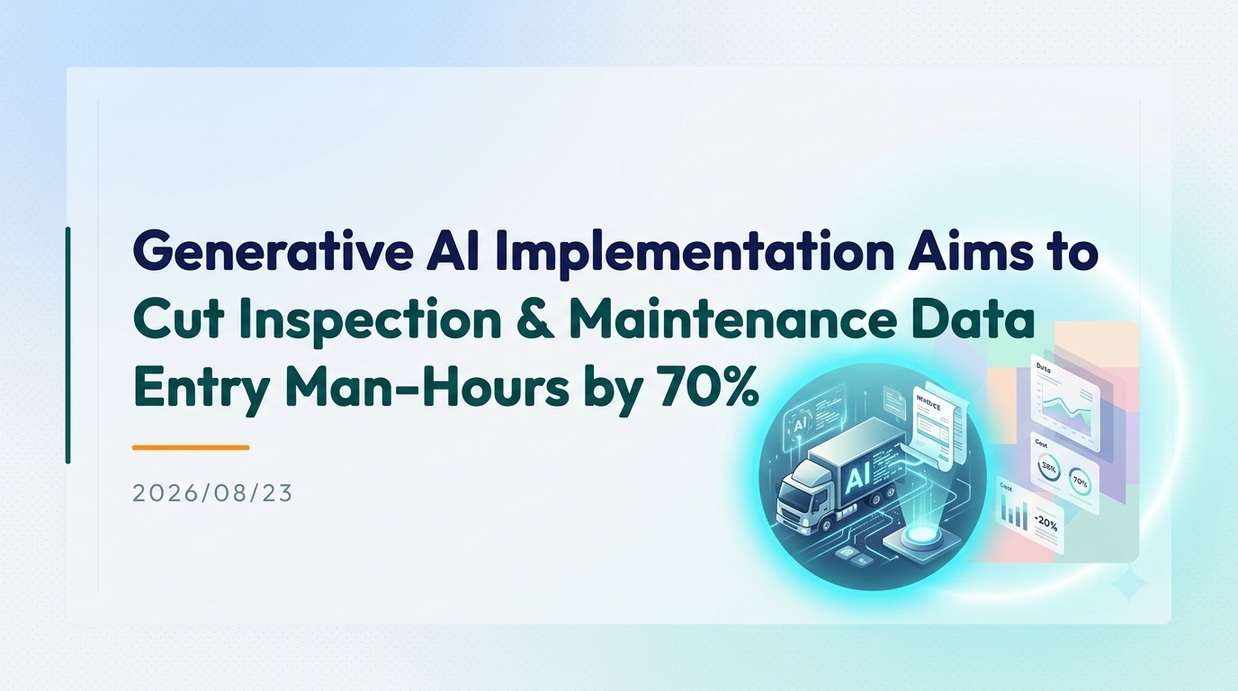
Ascend Co., Ltd. has added a generative AI-powered automatic import feature for inspection and maintenance costs to “Logix,” its dispatch planning and revenue analysis system. This update addresses the urgent need in the trucking industry to manage the rising costs of vehicles and repairs, while tackling the challenge that much of the data entry work still relies on manual processes.
- Key points of the event: Integration of generative AI into Logix and a 70% reduction in man-hours
- The current state of operation management relying on manual work and challenges in digitalization
- The Reality of Escalating Vehicle Maintenance Costs and Cost Data Utilization
- LLM’s Semantic Interpretation Capabilities Surpassing Traditional AI-OCR
- The Shift to High-Value-Added Operations Created by Freedom from Administrative Burdens
- Future Outlook: Expansion into the 4PL Business and Supply Chain Optimization
Key points of the event: Integration of generative AI into Logix and a 70% reduction in man-hours
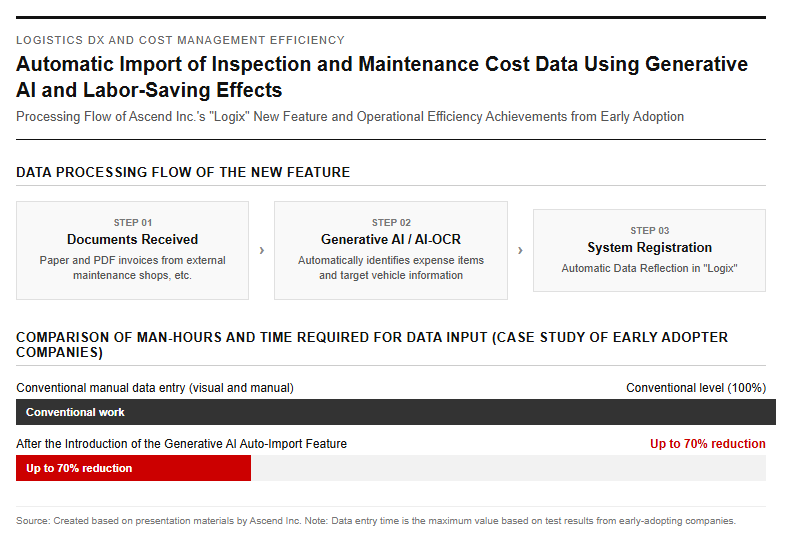
On August 20, 2026, Ascend Inc. announced that it has added an automated inspection and maintenance cost import feature utilizing generative AI to “Logix,” its dispatch planning and profit analysis system for transport operators. This new feature uses AI-OCR to scan invoices and maintenance statements sent from external maintenance shops and other sources, automatically identifies the cost items and target vehicle information listed therein, and registers them in the system. Companies that implemented the feature early as a practical test in actual operations have successfully reduced the time required to input cost data related to vehicle inspection and maintenance by up to 70% compared to conventional manual entry.
Traditionally, transport operators with large fleets faced a massive volume of maintenance-related documents, creating a challenge due to the mental and physical burden on administrative staff who had to visually inspect each document one by one and manually enter the data into a computer. With the introduction of the new feature, data processing for complex and differently formatted invoices will be significantly automated, achieving dramatic efficiency gains in back-office operations. The new feature is scheduled to be provided as a paid service. The following diagram illustrates the specific processing flow of the new feature.
The current state of operation management relying on manual work and challenges in digitalization
For many years, paper documents and manual data entry have remained deeply rooted in Japan’s trucking industry, serving as a factor that significantly depresses back-office productivity. Guidelines such as those for the digitalization of logistics operations for small and medium-sized logistics businesses, issued by the Ministry of Land, Infrastructure, Transport and Tourism, also strongly call for a departure from such analog management practices, and the industry-wide digital transition is regarded as an urgent task.
In particular, costs related to vehicle inspection and maintenance are generally prepared in different formats depending on the repair shop or dealer issuing the invoice. Consequently, it has been extremely difficult for conventional technologies to uniformly automate data entry, forcing personnel to visually inspect documents one by one and manually input amounts, vehicle numbers, and specific maintenance details into spreadsheet software or core systems. This simple yet time-consuming data entry task has become an operational bottleneck in back-office departments, with the burden increasing exponentially for businesses operating larger fleets of vehicles.
The Importance of Cost Management and LLM-Driven Technological Breakthroughs
The Reality of Escalating Vehicle Maintenance Costs and Cost Data Utilization
In recent years, soaring costs for fuel, vehicle maintenance, and parts have continued, making cost management to accurately grasp precise operating costs more important than ever for transportation operators. This is because, in order to conduct fair freight rate negotiations with shippers, they must present a detailed accumulation of how much maintenance and repair costs are being incurred by each vehicle.
According to a fact-finding survey on cost management among truck transport operators, jointly conducted in August 2026 by five companies including Ascend Inc., it has been revealed that approximately 90% of operators actually feel the rise in costs firsthand. However, the reality is that only one in four operators overall—or a mere 25%—reported being able to utilize the collected cost data for actual freight rate negotiations or management improvement decision-making. This highlights a structural problem in which many operators are barely managing just to record and input cost data, and are unable to allocate sufficient human resources for subsequent analysis and utilization.
LLM’s Semantic Interpretation Capabilities Surpassing Traditional AI-OCR
AI-OCR has long existed as a technology for digitizing paper forms, but it has suffered from significant technical limitations. Conventional AI-OCR could only accurately extract text information from predefined layouts and formats, meaning that even the slightest change in the format would cause extraction to fail.
However, the recent rapid evolution of Large Language Models (LLMs) has broken through this technical barrier. With the new feature, the LLM processes the text data read by AI-OCR, making it possible to autonomously interpret the context and meaning of the content—such as what the expense is for and which vehicle it pertains to—even for invoices and documents whose formats and expressions vary entirely from one client or vendor to another. This enables the automatic determination and sorting of appropriate account titles and expense items, even across diverse billing patterns. By having generative AI take over the interpretation process that humans once performed mentally, highly accurate automated ingestion practical for business use has been realized.
Future Developments and Key Points to Watch for the Future of the Logistics Industry
The Shift to High-Value-Added Operations Created by Freedom from Administrative Burdens
Reducing data entry man-hours by up to 70% holds a significance that extends far beyond defensive DX—such as mere cost-cutting or reducing administrative hassle. This is because freeing up as much as 70% of the time of talented back-office employees who were previously swamped with data entry makes it possible to shift human resources toward higher-value-added tasks that are more directly tied to driving sales and profits.
For example, by utilizing the freed-up time, they can conduct detailed analyses of accurate, vehicle-by-vehicle cost data automatically accumulated in the system, helping to strengthen preventive maintenance—such as identifying which manufacturer’s vehicles are prone to breakdowns at specific mileage thresholds. Alternatively, based on objective data summarizing detailed cost structures, it becomes possible to strategically conduct persuasive negotiations with shippers for appropriate freight rate increases. The automation of routine tasks transforms the role of administrative staff into high-value-added management support, turning it into a powerful management resource for small and medium-sized transport businesses to survive in the face of worsening labor shortages.
Future Outlook: Expansion into the 4PL Business and Supply Chain Optimization
Since its founding in March 2020, Ascend Inc. has continued to develop and provide “Logix” with the mission of realizing the ideal management for transportation companies. Starting in 2026, the company has begun full-scale deployment of its 4PL business—comprehensively contracting everything from strategic design to actual logistics arrangements aimed at optimizing the entire supply chain—and is taking on the structural challenges facing the logistics industry through multiple approaches.
Mizuki Kusaka, Representative Director of the company, has been driving both macro-level policy recommendations and micro-level operational support, having served on related research projects for the Ministry of Land, Infrastructure, Transport and Tourism as well as an expert committee member for industry organizations. The newly introduced generative AI-based automatic ingestion feature goes beyond the mere implementation of a single tool, serving as a foundation that enables transport companies to understand their cost structures in real time and dramatically accelerate their management decision-making. In 2026, where AI transformation is rapidly becoming a prerequisite for corporate survival, the ability to swiftly integrate such cutting-edge technology into practical workflows will likely be the decisive factor that creates a stark divide among logistics providers moving forward.
Reference page
- [Logix Product Information] https://logix.ascendlogi.co.jp/
- [Ascend Inc. Official Website] https://www.ascendlogi.co.jp/
- [Ministry of Land, Infrastructure, Transport and Tourism: Guide to the Digitalization of Logistics Operations for Small and Medium-Sized Logistics Businesses] https://www.mlit.go.jp/seisakutokatsu/freight/seisakutokatsu_freight_tk1_000234.html
【#Science #Technology #GenerativeAI #LogisticsDX #CostManagement #Ascend #Logics #OperationalEfficiency】
コメント