On August 31, 2026, the latest version of China’s first large language model specialized for the chemical industry, “Intelligent Chemical Engineering LLM 3.0 Pro,” was jointly unveiled by the Dalian Institute of Chemical Physics and its partners. The technological leap from simple query-answering to the autonomous execution of complex chemical tasks is driven by the industry’s demand for smart research and development that seamlessly bridges laboratories and manufacturing floors.
- Section 1-1: The First Industry-Specific LLM Unveiled by DICP and Partners
- Section 1-2: Evolving from Basic Q&A to an Autonomous “Action-Oriented AI”
- Section 1-3: Addressing Chemical Industry Constraints Beyond the Reach of Generic LLMs
- Section 2-1: A Four-Layer Technical Framework Automating the Entire Process
- Section 2-2: Objective Benchmark Scores Demonstrating Dramatic Accuracy Improvements
- Section 2-3: Connecting Laboratories directly to Factories for Future Smart Manufacturing
Section 1-1: The First Industry-Specific LLM Unveiled by DICP and Partners
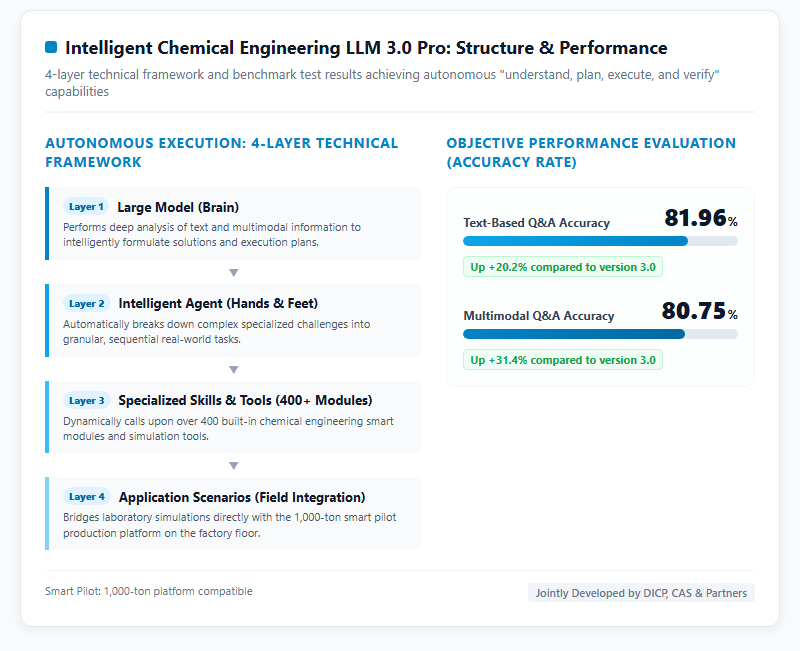
On August 31, 2026, the Dalian Institute of Chemical Physics (DICP) of the Chinese Academy of Sciences (CAS), in collaboration with leading institutions and enterprises including iFLYTEK and Alibaba Cloud, officially released the “Intelligent Chemical Engineering LLM 3.0 Pro.” This model marks the latest iteration of China’s first specialized large language model for the chemical industry, having undergone multiple progressive upgrades since the debut of version 1.0 in 2024. Real-world testing is already underway at DICP’s Changxing Island Park, utilizing embodied AI equipment integrated with these latest capabilities on a 1,000-ton smart pilot production platform. Please refer to the diagram below.
While previous chemical AI applications were limited to basic chemical symbol searches and literature-based question-and-answering, the newly released 3.0 Pro version breaks through these conventional boundaries. Its highly advanced intelligence has captured widespread attention across both academia and the industrial sector.
Section 1-2: Evolving from Basic Q&A to an Autonomous “Action-Oriented AI”
The most significant breakthrough of the Intelligent Chemical Engineering LLM 3.0 Pro lies in its transition from a passive assistant that merely understands and answers human queries to an active system capable of autonomously planning, executing, and verifying complex tasks. This shift elevates the AI from a tool for academic retrieval to an intelligent engineering partner that shares the workload in practical operations. When presented with a complex chemical engineering challenge, the latest model can formulate its own execution plan. It breaks down the high-level objective into granular, sequential steps while respecting multiple physical and chemical constraints, calls upon various specialized tools to execute the tasks, and autonomously validates the outcomes. If any issues or discrepancies are detected, the system immediately self-corrects. This ability to complete a closed-loop cycle of “understanding, planning, execution, and verification” represents the pinnacle of the new version’s technological progress.
Section 1-3: Addressing Chemical Industry Constraints Beyond the Reach of Generic LLMs
Chemical manufacturing environments involve exceptionally complex reaction processes governed by strict engineering constraints, such as temperature, pressure, and precise raw material ratios. Consequently, generic large language models designed primarily for standard text processing struggle to meet the rigorous physical laws and safety standards required in chemical R&D and production. In this sector, the tendency of generic LLMs to generate “hallucinations”—convincing but factually incorrect information—presents critical risks, as a single error could lead to catastrophic events like plant explosions or toxic leaks. To address these industry-specific challenges, LLM 3.0 Pro was trained on vast repositories of specialized academic literature and historical operational data. This targeted training has equipped the model with deep cognitive reasoning that respects physical boundaries, ensuring the high level of reliability required for actual engineering environments.
The Four-Layer Architecture and Practical Impact of LLM 3.0 Pro
Section 2-1: A Four-Layer Technical Framework Automating the Entire Process
The next-generation Intelligent Chemical Engineering LLM 3.0 Pro moves away from simple application formats to establish an innovative, four-layer technical framework: “Large Model – Intelligent Agent – Specialized Skills & Tools – Application Scenarios.” This architecture effectively provides the AI system with both a “brain” and “hands.” At the top layer, the large model acts as the intelligent brain, performing deep multimodal analysis of text and image data to formulate solutions and execution strategies. The intelligent agent layer then translates these strategies into action, breaking down complex engineering tasks into specific sub-steps. By dynamically calling upon more than 400 built-in chemical engineering modules and simulation tools, the system can autonomously solve intricate engineering problems across various practical application scenarios with remarkable precision.
Section 2-2: Objective Benchmark Scores Demonstrating Dramatic Accuracy Improvements
Rigorous benchmark testing across multidimensional evaluation criteria in chemistry shows that LLM 3.0 Pro has achieved a massive performance leap over its predecessor. Specifically, the model achieved an accuracy rate of 81.96% on text-based queries and 80.75% on multimodal queries that integrate text and images. These figures represent a staggering 20.2% and 31.4% increase in overall scores, respectively, compared to the previous 3.0 version. This substantial improvement in precision underscores the model’s immense practical value, ranging from analyzing specialized research papers to simulating complex chemical reactions. By dramatically reducing the risk of hallucinations, these objective metrics provide a solid technical foundation for safer decision-making and highly automated operations in industrial settings.
Section 2-3: Connecting Laboratories directly to Factories for Future Smart Manufacturing
The developer of LLM 3.0 Pro, the Dalian Institute of Chemical Physics, is already building China’s first comprehensive big data center covering the entire lifecycle of petrochemical and chemical engineering processes. Furthermore, the establishment of the nation’s first 1,000-ton smart pilot platform on Changxing Island allows for real-world validation of embodied AI devices powered by the model. This setup is paving the way for a brand-new paradigm in chemical R&D, bridging the gap between laboratory discoveries and factory assembly lines almost instantaneously. Looking ahead, this state-of-the-art model is expected to serve as a powerful catalyst driving the Chinese chemical industry from basic digitization to advanced intelligence. By drastically shrinking the temporal and physical distance between labs and production floors, it promises to significantly shorten development cycles for new chemical materials, optimize manufacturing processes, and elevate operational safety.
References
- 【People’s Daily Online】http://j.people.com.cn/
【#ChemicalEngineering #LargeLanguageModels #AIAgents #SmartManufacturing #ScienceAndTechnology #ChineseAcademyOfSciences】

コメント