
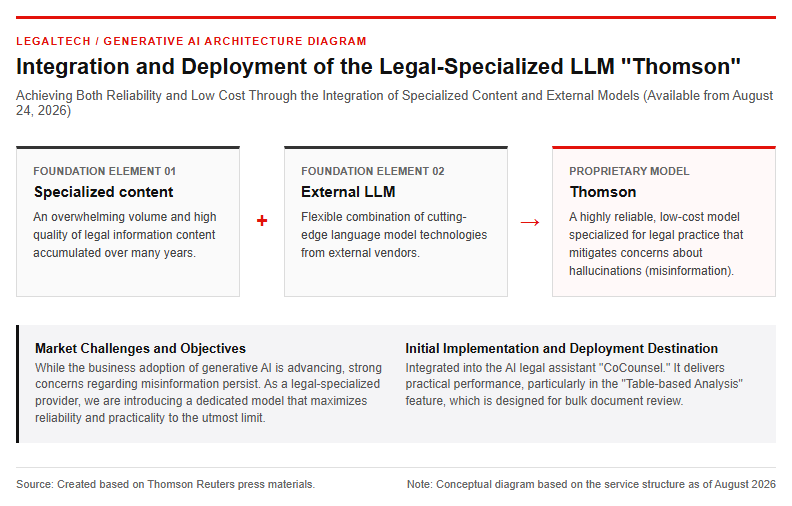
Major legal information provider Thomson Reuters has completed the development of and launched “Thomson,” its proprietary LLM specialized for legal work. By combining a vast amount of specialized content accumulated over many years with external models, it achieves both high practicality and overwhelmingly low-cost development.
- The Goal of Developing a Proprietary LLM and Key Points of Events
- How to use them differently from existing general-purpose AI and multi-models
- The Full Picture of a Million Project Over Two Years
- The added value of proprietary data and a high-security policy
- Standard Inclusion of “Table-Based Analysis” in Document Review Features
- Ensuring Reliability and the Future Vision of Legal AI
The Goal of Developing a Proprietary LLM and Key Points of Events
On August 24, 2026, major legal information vendor Thomson Reuters launched Thomson, its proprietary large language model specialized for legal operations. This new model is operated by combining the company’s advanced legal content with an external vendor’s language model, and was developed with the aim of significantly improving practicality and reliability in legal practice. As its initial rollout, it will be integrated into table-based analysis, a high-volume document review feature of the company’s AI legal assistant, CoCounsel. In recent years, interest in the business application of generative AI within the legal industry has grown tremendously, but at the same time, concerns regarding the output of false information—so-called hallucinations—remain persistent. To address these challenges, the company aims to directly respond to market needs by introducing a dedicated model that maximizes reliability and practicality, leveraging its strengths as a specialized provider of legal information. The image below illustrates this new development in legal AI.
How to use them differently from existing general-purpose AI and multi-models
Thomson Reuters has clarified its policy of maintaining a multi-model approach that continues to selectively use multiple models as appropriate, rather than relying solely on its proprietary models for all AI operations. For advanced tasks requiring deep legal expertise and rigorous processing, it will utilize its newly developed proprietary model, Thomson, while flexibly using language models from external vendors for other tasks such as general summarization and general-purpose drafting. Specifically, it will broadly collaborate with the world’s leading general-purpose language models, such as Anthropic’s Claude, OpenAI’s GPT, and Google’s Gemini. In CoCounsel’s table-based analysis feature, Thomson will be automatically set as the default model, but system administrators can easily switch to other general-purpose models as needed. By providing a framework that allows the optimal model to be selected for the right task according to the situation, legal professionals will be able to proactively build the most efficient workflows that match the difficulty and nature of their tasks.
Efficient development methodologies and overwhelming cost reduction
The Full Picture of a Million Project Over Two Years
Over the past two years, Thomson Reuters has invested a massive approximately $40 million into this Thomson development project. This breakdown of investment includes securing top-tier, highly specialized talent and procuring the necessary computing resources for training. Meanwhile, the final model training cost was successfully compressed to an extremely low level of about $450,000. The reason why such cost control was possible is that they avoided the method of building a foundation model from scratch and instead adopted an open-weight model as their base. By efficiently performing additional training on this existing model using high-end legal content exclusively owned by the company, proprietary training algorithms, and accumulated expertise, they simultaneously achieved a shortened development period and dramatic cost reductions. This approach will likely serve as an exceptionally strong role model for future industry-specific AI development.
The added value of proprietary data and a high-security policy
Built using a proprietary training methodology, Thomson demonstrated exceptionally high performance in internal tests compared to leading general-purpose language models, even under severely restricted conditions where access was limited solely to publicly available information on the web. The company’s centuries-old legal documents and highly reliable statutory and case law data have significantly contributed to improving the model’s accuracy. Furthermore, robust policies have been established regarding security, which is the primary concern for corporate legal departments. Thomson Reuters pledges that it will never use confidential customer data or input prompts for training the model. By owning and managing its proprietary model in-house, the company has established a framework that allows it to maintain direct and strict control over data deployment, governance structures, and even future additional development. This stance on data protection ensures the essential reliability required in legal practice, where confidentiality is paramount.
Significance for Practical Application and Future Developments
Standard Inclusion of “Table-Based Analysis” in Document Review Features
The impact of introducing Thomson in legal practice is first demonstrated through CoCounsel’s table-based analysis feature. This feature is designed to efficiently review large volumes of documents such as contracts and litigation-related materials in parallel, extracting necessary information for comparative analysis. In practical work, manually reading through hundreds of legal documents to identify issues and risks has required a massive amount of time and human cost. By making Thomson the default model for table-based analysis, legal professionals can quickly obtain high-precision analysis results, dramatically reducing the time required for review work. With AI autonomously supporting routine review tasks, human lawyers and legal staff can focus more on advanced strategic decision-making and client engagement. Through this transformation of operational processes, the productivity of the entire legal department is expected to improve dramatically.
Ensuring Reliability and the Future Vision of Legal AI
In the legal tech field, ensuring the reliability and accuracy of AI outputs is the greatest challenge. According to surveys, approximately 61% of legal professionals who do not use generative AI in their daily work cite concerns over reliability and accuracy as the reason. In particular, misunderstandings of point-in-time information, such as chronological relationships between dates or the timeline of legal revisions, can lead to fatal mistakes in practical work. Thomson, provided by Thomson Reuters, minimizes the risk of hallucination by using proprietary, highly reliable legal information content as its training foundation. This approach, which tightly integrates proprietary models and strictly manages data provenance, achieves a high-level balance between the convenience of AI technology and the strict accountability required in the legal field. Moving forward, the combination of such specialized models and advanced verification systems is expected to become the new industry standard for legal AI.
Reference Page
- 【Thomson Reuters Completes Acquisition of Casetext, Inc.】https://www.thomsonreuters.com/en/press-releases/2023/august/thomson-reuters-completes-acquisition-of-casetext-inc
[#ThomsonReuters #LegalAI #LLM #ArtificialIntelligence #CoCounsel #DocumentReview #ScienceAndTechnology]

コメント