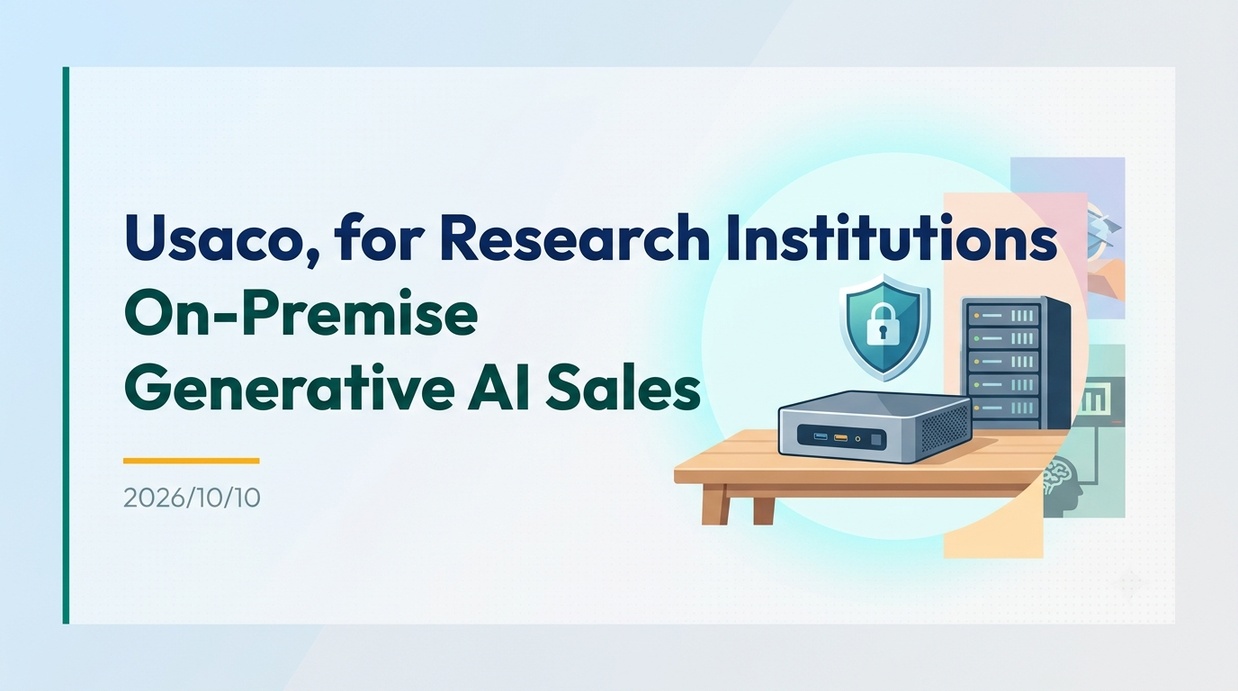
Yusako Co., Ltd. has launched sales of “Sovereign GaiXer,” an offline generative AI for academic and research institutions that does not transmit data externally. The background behind this includes concerns over the leakage of unpublished and patient data, as well as the difficulty of budget management due to the pay-as-you-go pricing model of cloud-based AI.
- Key points of the event and overview of Sovereign GaiXer
- Research data security challenges behind the introduction
- A lump-sum purchase model that eliminates concerns about pay-as-you-go billing
- NVIDIA Blackwell Platform and Palm-Sized High-Performance Hardware
- Safe AI Use Cases for Unpublished Papers and Clinical Data
- Future Developments and Prospects for AI Operations in Research Institutions
Key points of the event and overview of Sovereign GaiXer
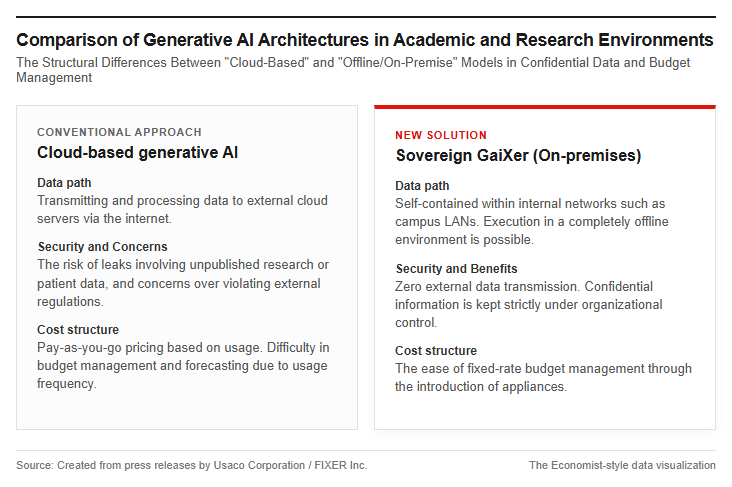
Yusako Co., Ltd., a provider of academic information services and paper-writing support, began offering “Sovereign GaiXer,” an on-premises generative AI appliance that completes processing entirely within an organization without connecting to the internet, starting October 7, 2026. Developed by FIXER Inc., the product is primarily targeted at universities, research institutions, and corporate research and development departments. The key feature of this product is its ability to execute advanced generative AI functions even in an offline environment installed on an internal network such as a campus LAN and completely disconnected from the network. It enables the safe processing of unpublished research data and patient data containing sensitive personal information under the organization’s strict control, without sending them to external cloud generative AI services. While the utilization of AI is progressing in academia, the risk of external leakage of confidential information and the increasing cost of using cloud services have become serious challenges, and this product is positioned as a solution that simultaneously resolves both of these issues. As shown in the diagram below, data retention and operational management within an in-house environment are regarded as extremely important in modern AI utilization.
Research data security challenges behind the introduction
Currently, in R&D departments at universities, medical institutions, and corporations, the demand for improving research efficiency by leveraging generative AI is growing rapidly. However, when using external cloud-based generative AI services, a critical security concern persists: users cannot completely control how their input prompts and data are processed and stored on external servers. Especially in scenarios involving unpublished research data prior to patent applications or sensitive personal information such as patient medical records, there is a constant risk of data breaches due to accidental transmission to the cloud. In fact, incidents have been reported in Japanese companies and organizations where personnel mistakenly entered patient data or confidential information into personal AI services for operational efficiency, resulting in reports and public disclosures to the Personal Information Protection Commission. Furthermore, various research institutions are establishing strict guidelines from a confidentiality perspective, and restrictions on feeding data into external AI have become a major barrier hindering researchers from utilizing AI. By adopting a completely closed architecture that prevents data from leaking outside the organization under any circumstances, “Sovereign GaiXer” provides an environment where researchers can leverage AI with peace of mind while complying with such security regulations.
Benefits of Deployment Provided by Outright Purchase and Compact Form Factors
A lump-sum purchase model that eliminates concerns about pay-as-you-go billing
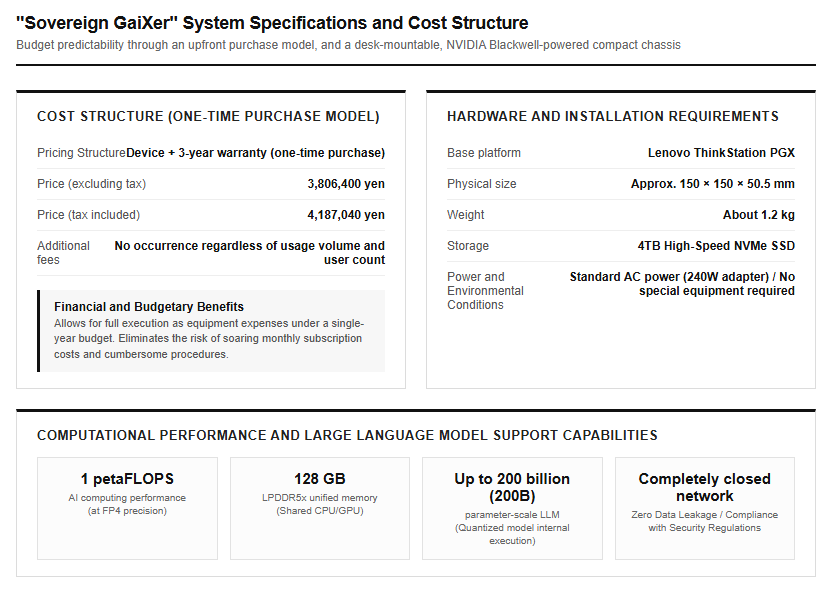
For general public cloud-based generative AI services, a pay-as-you-go pricing model is widely adopted, where costs are incurred based on the number of tokens used and requests made. As a result, frequent financial issues have frequently arisen where monthly costs unexpectedly skyrocket as internal usage increases, making budget forecasting for the next fiscal year difficult. Furthermore, research grants and public budgets in academic and research institutions often operate under a framework where budgets must be fully executed within a single fiscal year, and subscription-based services that require ongoing, fluctuating monthly payments over multiple years tend to have cumbersome procurement procedures. In contrast, “Sovereign GaiXer” adopts a lump-sum purchase (outright purchase) pricing structure that includes the main unit and three years of warranty costs. The base price is 3,806,400 yen excluding tax (4,187,040 yen including tax), and since costs are fixed at the time of implementation, research institutions can purchase it in a lump sum within their annual budget as capital equipment expenses. After implementation, no matter how much data is processed or how continuously it is operated, no additional fees are incurred based on the number of users or usage volume, making it possible to promote agency-wide or campus-wide AI usage without worrying about cost fluctuations.
NVIDIA Blackwell Platform and Palm-Sized High-Performance Hardware
“Sovereign GaiXer” combines ultra-high computational performance with a compact form factor by leveraging the Lenovo ThinkStation PGX as its base and incorporating the latest NVIDIA Blackwell architecture. Despite its palm-sized design, measuring approximately 150 × 150 × 50.5 mm and weighing about 1.2 kg, it delivers exceptional AI compute performance of up to 1 petaFLOPS at FP4 precision. Equipped with 128GB of LPDDR5x unified memory that shares memory space between the CPU and GPU, it can directly run large language models (LLMs) on the device with a scale of up to 200 billion (200B) parameters as quantized models. Furthermore, it is equipped with a high-speed 4TB NVMe SSD for storage. Because it operates on standard air conditioning and a regular AC power supply (240W power adapter), it completely eliminates the need for dedicated server rooms, special electrical work, or liquid cooling facilities that were previously required for installing advanced AI infrastructure. As shown in the system configuration diagram below, a major advantage is that it can be easily deployed on a desk or into an existing LAN environment without the need to install large-scale rack-mounted servers.
Vision for Utilization in Research Settings and Future Prospects
Safe AI Use Cases for Unpublished Papers and Clinical Data
The introduction of “Sovereign GaiXer” is expected to significantly advance the utilization of highly confidential research data that has been difficult to handle with conventional cloud-based AI. Specific use-case scenarios include the structuring and summarization of unpublished experimental data prior to academic presentations or paper submissions, the analysis of long-form English research papers, and comparative evaluations against one’s own data. In addition, medical institutions will be able to safely perform summarization and extraction processing on electronic medical records containing sensitive personal information and patient clinical course data without taking them outside the organization. Because the risk of data leakage when sending data to cloud services and concerns about internal data being secondarily utilized for model training by the service provider are completely eliminated, researchers are freed from the psychological burden of data management. By delegating routine writing and literature review assistance to AI, an environment is established where researchers can concentrate on the essential intellectual production activities they should truly focus on—such as experimental design, analysis, and empirical verification—drastically accelerating the speed of research and development.
Future Developments and Prospects for AI Operations in Research Institutions
In recent years, the importance of “AI sovereignty”—retaining independent control over one’s own data, models, and operations—has been emphasized globally, accelerating a shift of data back from cloud-centric systems to local and on-premises environments in both academic and industrial sectors. The launch of “Sovereign GaiXer” by Usaco Corporation will provide further momentum to the movement for securing AI sovereignty within domestic universities and corporate R&D departments. Moving forward, demand for similar appliance devices and on-premises AI infrastructure is expected to rapidly expand in sectors that require high levels of confidentiality, such as government agencies, defense, finance, and drug discovery. By lowering the barrier to adoption through a lump-sum purchase model, the widespread use of this product is expected to prevent the proliferation of shadow AI in research settings while establishing a sound, well-governed environment for AI utilization. Usaco intends to continue providing implementation support tailored to the needs of various organizations, thereby contributing to the reinforcement of Japan’s academic and industrial technological competitiveness.
Reference page
- [Usaco Corporation Sovereign GaiXer Product Introduction Page] https://www2.usaco.co.jp/shop/pages/product_sovereigngaixer.aspx
[#Usaco #SovereignGaiXer #OnPremiseGenerativeAI #ResearchAndDevelopment #SovereignAI #DataSecurity]

コメント