Nippon Express, a group company of NIPPON EXPRESS HOLDINGS, has added a generative AI-powered conversational feature to its logistics web application. This move is driven by the growing need for rapid decision-making and efficient data analysis amidst increasingly uncertain global supply chains.
- Logistics Web App “DCX” Adds Generative AI Conversation Feature
- Rapid decision-making support through natural language queries
- Data protection through a secure environment isolated from the outside
- Enhancement of prediction and visualization features starting from April 2025
- Integration of Predictive Models and Conversational AI Leveraging AWS Technologies
- Autonomous Agents: AI Shifting Its Role from Suggestion to Execution
- From a transportation company to a technology company designing the future of logistics
Logistics Web App “DCX” Adds Generative AI Conversation Feature
On August 19, 2026, NIPPON EXPRESS HOLDINGS, INC. announced that its group company, Nippon Express, has launched a new feature called “BI LLM Chat”—which utilizes large language models—within “Business Insight,” a data analysis optional service for its logistics web application “DCX.” The “DCX” logistics web application is a system that visualizes inventory status and work progress at domestic and overseas locations in real time, achieving centralized data management. For a screen image of the interactive AI feature, please refer to the figure below.
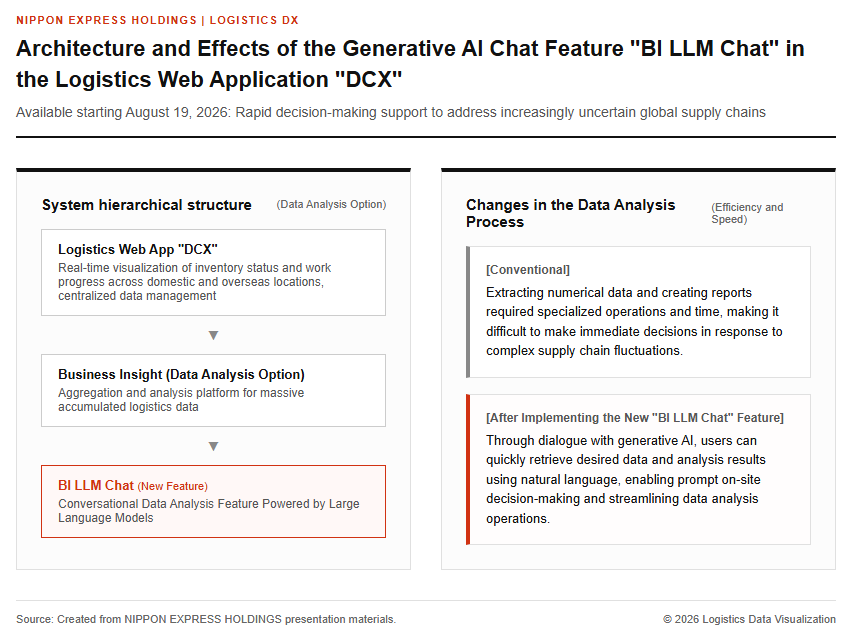
Up until now, utilizing the accumulated advanced data required aggregation work that took a certain amount of time and specialized skills. This new feature addition aims to make it easy for anyone to access such readily available data. Specifically, it has the following features.
– Chat-based data analysis that requires no specialized knowledge
– Integrated Analysis of Latest Internet Information and Proprietary Company Data
In an increasingly uncertain global supply chain, an environment has been established where advanced analytical insights can be instantly retrieved simply by talking to your company’s proprietary logistics data. By fusing cutting-edge technology with the physical capabilities that move goods, a system has been built to powerfully support the prompt formulation of inventory strategies and the efficient optimization of the entire supply chain.
Rapid decision-making support through natural language queries
A major feature of BI LLM Chat is its ability to analyze data in a conversational format by combining internal data, such as the company’s shipping performance and inventory status, with the latest external information from the internet. Even frontline staff without specialized IT skills or data aggregation knowledge can simply type questions into the chat screen and obtain analysis results derived from multifaceted perspectives in just a few minutes. For example, even for complex questions that combine internal performance with uncertain external factors—such as “Given the latest market conditions in a specific region, can we maintain delivery deadlines with our current inventory?”—the AI considers multiple constraints and presents specific insights or solution scenarios. This significantly reduces the man-hours required for report creation and factor analysis, which previously took several days when requested from specialized staff. It not only accelerates decision-making, but also makes it possible to bring about a transformation in operational processes where many staff members within the organization can raise questions themselves and repeatedly make rapid, data-driven decisions.
Data protection through a secure environment isolated from the outside
For many companies, information security is the most significant concern when having generative AI handle their internal logistics data. Logistics data contains detailed information such as client names, product items, quantities, and timing, which constitutes extremely important confidential information that reflects the very contours of the business. It has been explicitly stated that BI LLM Chat, which has now begun to be offered, is built in a completely secure environment isolated from the outside in order to alleviate these concerns. The customer-specific data entered and the dialogue contents with the AI will never be secondarily used for external AI training. Nippon Express had proactively disclosed information regarding the foundational models used and the data management configuration, such as revealing its utilization of Amazon Bedrock provided by Amazon Web Services starting from the announcement stage at the exhibition in June 2026. It is designed to allow companies to safely entrust confidential information—which can be considered the core data of the enterprise—to the convenience of generative AI with peace of mind while ensuring high safety standards.
Approximately 16 months of technical accumulation leading up to the announcement
Enhancement of prediction and visualization features starting from April 2025
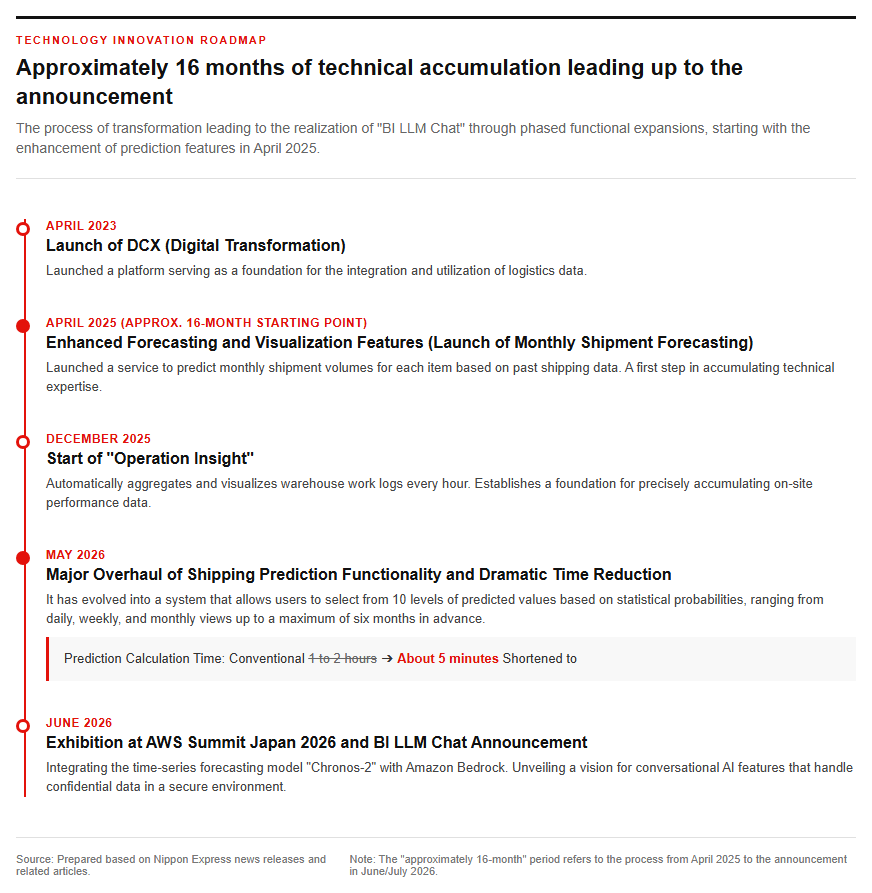
The recent announcement of BI LLM Chat was not achieved overnight. Nippon Express has steadily and progressively enhanced the features of DCX over a period of approximately 16 months starting in April 2025. After launching DCX in April 2023, the company introduced a service in April 2025 to forecast monthly shipment volumes for each item based on historical shipment data. Furthermore, in December of the same year, it launched “Operation Insight,” which automatically aggregates and visualizes warehouse work logs on an hourly basis, laying the foundation for the precise accumulation of on-site performance data. Then, in May 2026, it significantly revamped the shipment forecasting function itself, successfully slashing the calculation time for predictions—which previously took one to two hours per item—down to approximately 5 minutes. It is also equipped with a feature that allows users to select from 10 tiers of predicted values based on statistical probabilities, spanning daily, weekly, and monthly horizons up to six months in advance. In this way, the result of diligently building up technology step by step each time more data accumulated on hand has led to the realization of this conversational AI feature.
Integration of Predictive Models and Conversational AI Leveraging AWS Technologies
Behind the efforts to improve shipment forecast accuracy and connect it to advanced conversational AI, advanced foundational technologies provided by Amazon Web Services are being utilized. In its exhibition announcement at AWS Summit Japan 2026 held in June 2026, Nippon Express voluntarily disclosed that it uses “Chronos-2,” a time-series forecasting model that does not require individual training, for shipment forecasting, and that it is developing a conversational AI feature using Amazon Bedrock. This involves calculating highly accurate figures using a predictive model, linking that numerical data with visualized on-site performance, and further combining generative AI technology to enable interaction in natural language that humans can easily understand. By fusing these two AI technologies with different characteristics, a truly autonomous mechanism has been constructed that goes beyond merely presenting numerical data, capable of interpreting situations from multiple angles and creating concrete scenarios. For the overall configuration integrated with AWS cloud infrastructure, please refer to the diagram below.
The approach of advancing development while presenting materials to the public in advance that allow safety to be verified holds significant meaning as a pathway to steadily establishing logistics DX in society.
The Transition to “Autonomous Logistics” in the Logistics Industry and Future Outlook
Autonomous Agents: AI Shifting Its Role from Suggestion to Execution
As of 2026, the role of AI in the logistics industry has shifted from the conventional presentation of optimal choices to humans to “autonomous logistics,” where AI formulates its own plans and executes operations. The introduction of BI LLM Chat embodies the cutting edge of this trend. Version 1.2 of the AI Business Guidelines (published on March 31, 2026) also defines AI systems that act autonomously to achieve specific goals as AI agents. BI LLM Chat provides suggestions for optimal inventory allocation and transportation decisions based on conversational content and predictive data. In its current design, while the ultimate decision-making and responsibility remain with humans, a system is being realized in which AI agents support everything from planning to dynamic adjustments. This eliminates the operational reliance on specific individuals that previously depended on the experience and intuition of veteran staff, dramatically advancing the standardization and efficiency of business processes across the entire supply chain.
From a transportation company to a technology company designing the future of logistics
This initiative goes beyond merely enhancing the features of a single company’s logistics app; it holds the potential to transform the very raison d’être of logistics companies themselves. Until now, logistics companies have been in the position of users, so to speak, purchasing and using systems provided by IT vendors. However, major companies such as NIPPON EXPRESS Holdings have been advancing a project to develop and utilize their proprietary generative AI, “NX-Brain,” since July 2023, and as of August 2025, it has been deployed across 38 companies within the group. Furthermore, on June 25, 2026, they concluded a capital and business alliance with the AI startup Ricerca, embarking on the joint development of AI. By having the AI directly learn from irregular handling in logistics operations and the unique know-how accumulated through years of operations, they are attempting to cultivate a logistics-optimized AI with their own hands. Logistics companies are beginning to evolve from mere transporters of goods into technology companies that co-develop software and proactively design the future of new logistics.
Reference page
- [Nippon Express Launches “BI LLM Chat,” a New AI-Conversational Feature for the “DCX” Logistics Web App] https://www.nipponexpress-holdings.com/ja/press/768
- [Nippon Express Website Regarding DCX] https://www.nipponexpress.com/dcx/jp/top/index.html
- [Ministry of Economy, Trade and Industry (METI) “AI Business Operators Guidelines (Version 1.2)” Distribution Page] https://www.meti.go.jp/shingikai/mono_info_service/ai_shakai_jisso/20260331_report.html
【#LogisticsDX #GenerativeAI #NipponExpress #DCX #AutonomousLogistics #ScienceAndTechnology】
コメント