
Following the 2026 amendment to the Foreign Exchange Act and the world’s first successful deep-sea drilling, the Japanese government is rapidly strengthening integrated support aimed at preventing the leakage of advanced technologies and ensuring a stable supply of rare earths. Behind this lies an increasingly tense economic security environment and the acceleration of a national strategy aimed at breaking away from excessive dependence on specific countries.
- Defense of Sensitive Technologies and Critical Minerals Brought by the 2026 Foreign Exchange and Foreign Trade Act Amendment
- Establishment of the Committee on Foreign Investment in Japan to Strengthen Cross-Ministerial Frameworks
- World’s First Successful Deep-Sea Mining and Transition to Industrial-Scale Demonstration
- Establishment of Domestic Refining Processes and Ultra-High Technical Barriers
- Procurement Diversification Strategy to Counter Strained Chinese Export Controls
- The Prospects of Urban Mine Recycling and Green Domestic Circulation
Defense of Sensitive Technologies and Critical Minerals Brought by the 2026 Foreign Exchange and Foreign Trade Act Amendment
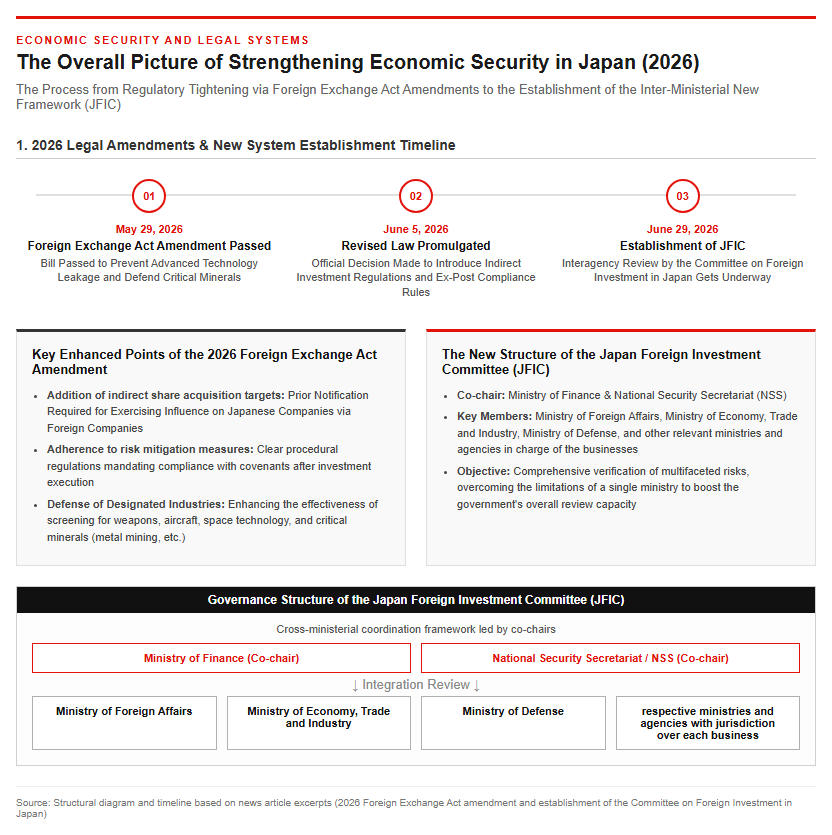
On May 29, 2026, a bill to partially amend the Foreign Exchange and Foreign Trade Act was passed to enhance the defense capabilities of critical businesses related to security-sensitive technologies and national security, and it was promulgated on June 5 of the same year. This amendment aims to appropriately address inward direct investments that could threaten Japan’s security in response to the rapidly complicating international situation and intensifying competition for advanced technology acquisition, while still adhering to the principle of economic activity liberalization.
As a primary pillar of the amendment, clear procedural regulations have been established to compel foreign investors to comply with pre-agreed risk-mitigation measures following the execution of their investments. Furthermore, indirect share acquisitions that exert influence over Japanese companies via enterprises in other countries have been newly added to the scope of prior notification requirements. This significantly enhances the effectiveness of investment reviews in designated industries—such as weapons, aircraft, space-related technologies, and metal mining involving critical mineral resources—thereby establishing a robust defensive framework to prevent the outflow of technology and information overseas through inappropriate investments.
Establishment of the Committee on Foreign Investment in Japan to Strengthen Cross-Ministerial Frameworks
In conjunction with the amendment of the Foreign Exchange and Foreign Trade Act, the Japan Foreign Investment Committee (JFIC) was established on June 29, 2026. While traditional investment screening was conducted separately by the Ministry of Finance and individual ministries and agencies with jurisdiction over specific businesses, risks in modern economic security are extremely multifaceted, making assessments by a single ministry or agency increasingly difficult. Under the newly established JFIC, the Ministry of Finance and the National Security Secretariat (NSS) serve as co-chairs, and a legal framework has been established to ensure close cooperation among key members—such as the Ministry of Foreign Affairs, the Ministry of Economy, Trade and Industry, and the Ministry of Defense—as well as various business-jurisdiction ministries and agencies. This cross-ministerial collaboration elevates the government-wide screening capacity and makes it possible to comprehensively verify impacts on critical material supply chains. As shown in the diagram below, this new system enhances predictability for foreign investors and serves as an important step toward further promoting sound inward direct investment.
The Reality of the Minamitorishima Project for Domestic Rare Earth Development
World’s First Successful Deep-Sea Mining and Transition to Industrial-Scale Demonstration
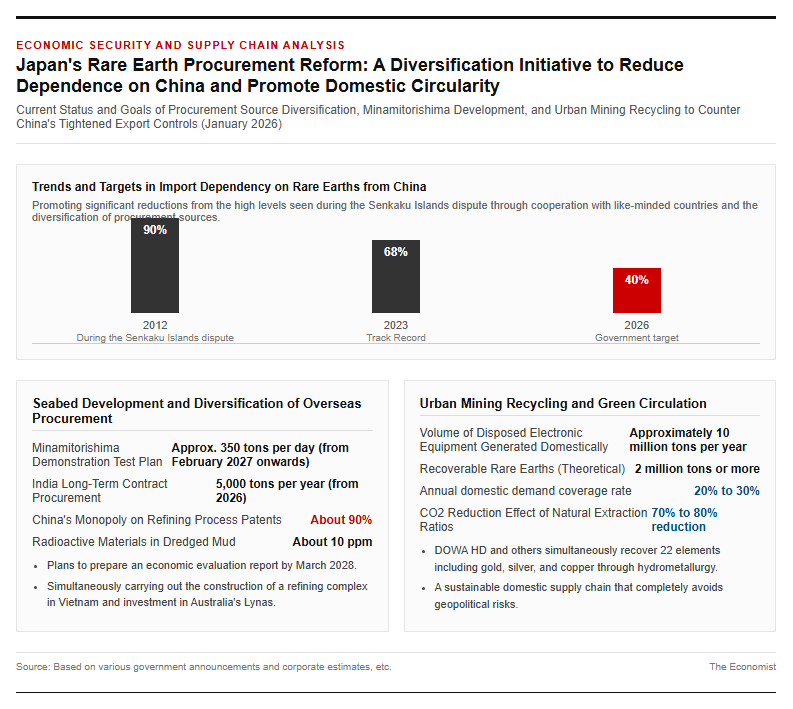
Vast deposits of rare-earth mud, equivalent to hundreds of years of global demand, have been confirmed to exist on the seafloor at a depth of approximately 6,000 meters off the coast of Minamitorishima in the Ogasawara Islands, Japan’s easternmost territory. Toward the development of these domestic resources, a historic milestone was achieved in January 2026. As part of the government’s Cross-ministerial Strategic Innovation Promotion Program, the deep-sea scientific drilling vessel “Chikyu” departed from Shimizu Port on January 12, 2026, arrived at the site on January 17, and began full-scale recovery operations on January 30. As a result, in the early hours of February 1 of the same year, it succeeded in lifting rare-earth mud from the deep sea for the first time in the world. During this test drilling, state-of-the-art technologies such as unmanned mining machines were utilized, confirming the normal operation of the equipment along with the continuous recovery of rare-earth mud. Building on this achievement, the government has outlined plans to transition to full-scale demonstration testing starting in February 2027, mining approximately 350 tons per day, rapidly accelerating momentum toward securing domestic resources.
Establishment of Domestic Refining Processes and Ultra-High Technical Barriers
While the Minami-Torishima project is buzzing with the success of its technical retrieval, extremely serious challenges remain in industrializing this into a market-competitive industrial product. The rare-earth-rich mud recovered from the seabed must undergo “separation and refining” both offshore and on land, and be purified into individual useful elements such as neodymium and dysprosium before it can be put to practical use. However, the current reality is that China monopolizes approximately 90% of the high-efficiency technologies and patent networks related to this separation and refining process. Furthermore, the retrieved mud contains around 10 ppm of radioactive substances such as actinides, and methods for disposing of the large amounts of residual mud (tailings) generated in the process of treating massive quantities of mud on the scale of tens of millions of tons per year—as well as an offshore management system for the strong acids used in the treatment—have not yet been established. On the path from technical success to commercialization and integration into the supply chain, there are dual walls of patent circumvention and environmental protection, and careful verification is underway toward the economic evaluation report scheduled to be compiled by March 2028.
Diversification and Urban Mining Recycling for Supply Chain Resilience
Procurement Diversification Strategy to Counter Strained Chinese Export Controls
For Japan’s high-tech industry, rare earths are essential critical minerals that dramatically improve the performance of EV motors, semiconductor manufacturing equipment, and other applications. However, the traditional import ratio has been overly dependent on China, raising constant concerns over geopolitical risks. In fact, in January 2026, export restrictions by China on dual-use items and other goods were once again tightened, heightening the risk of supply chain disruptions. In response to such situations, the Japanese government is strongly promoting the diversification of procurement sources to reduce this dependency. Specifically, the government lowered China’s dependency rate—which had reached 90% at the time of the 2012 Senkaku islands dispute—to 68% in 2023, and has set a target of keeping it down to 40% by 2026. Securing diversified supply routes in cooperation with like-minded countries has become an urgent task, including the construction of a refining complex in Vietnam, the establishment of a stable supply system of 5,000 tons per year starting in 2026 based on a long-term off-take agreement with an Indian state-owned enterprise, and the expansion of procurement shares through investment in Australia’s Lynas.
The Prospects of Urban Mine Recycling and Green Domestic Circulation
Alongside the diversification of procurement sources and seafloor development around Minami-Torishima, another powerful pillar of economic security is recycling from domestic “urban mines.” Used smartphones, personal computer hard drives, discarded electric vehicle motors, and other items across Japan contain vast amounts of extremely high-quality rare earths. According to estimates, theoretically over 2 million tons of rare earths can be recovered from the approximately 10 million tons of e-waste generated domestically each year, holding the potential to sufficiently cover 20% to 30% of annual domestic demand. Advanced companies like DOWA Holdings have established proprietary processes to simultaneously recover 22 elements, including gold, silver, and copper, using advanced hydrometallurgical technology. This recycling also boasts significant environmental value, reducing CO2 emissions by 70% to 80% compared to natural deep-sea mineral mining; as “green rare earths” that completely bypass geopolitical risks, it is expected to become the foundation of a sustainable domestic supply chain supporting future industries.
Reference Page
- Report on the Ideal State of the Inward Direct Investment Screening System, etc.
- [Foreign Exchange Act and Investment Screening System Annual Report] https://www.mof.go.jp/policy/international_policy/contents/pdf/index_5.pdf
【#EconomicSecurity #RareEarths #ForeignExchangeActAmendment #Minamitorishima #ResourceSelfSufficiency #UrbanMining】

コメント