The Cyberspace Administration of China (CAC) has reportedly launched an investigation into prominent AI startups DeepSeek and Moonshot AI over alleged leaks of state secrets to a US AI firm. Spurred by a report on unauthorized model distillation published by US-based Anthropic, the probe focuses on whether sensitive military and public security data was transmitted to US servers.
- Key Developments and On-Site Inspections Initiated by Authorities
- National Security Risks and Concerns Over Sensitive Data Leaks
- Broad Sell-Off of Chinese AI Stocks in Hong Kong
- Clouded IPO Plans and Executive Movements
- Strategic Shifts in Model Training and the Impact on V4.1-Flash
- US-China AI Rivalry and Key Issues to Watch
Key Developments and On-Site Inspections Initiated by Authorities
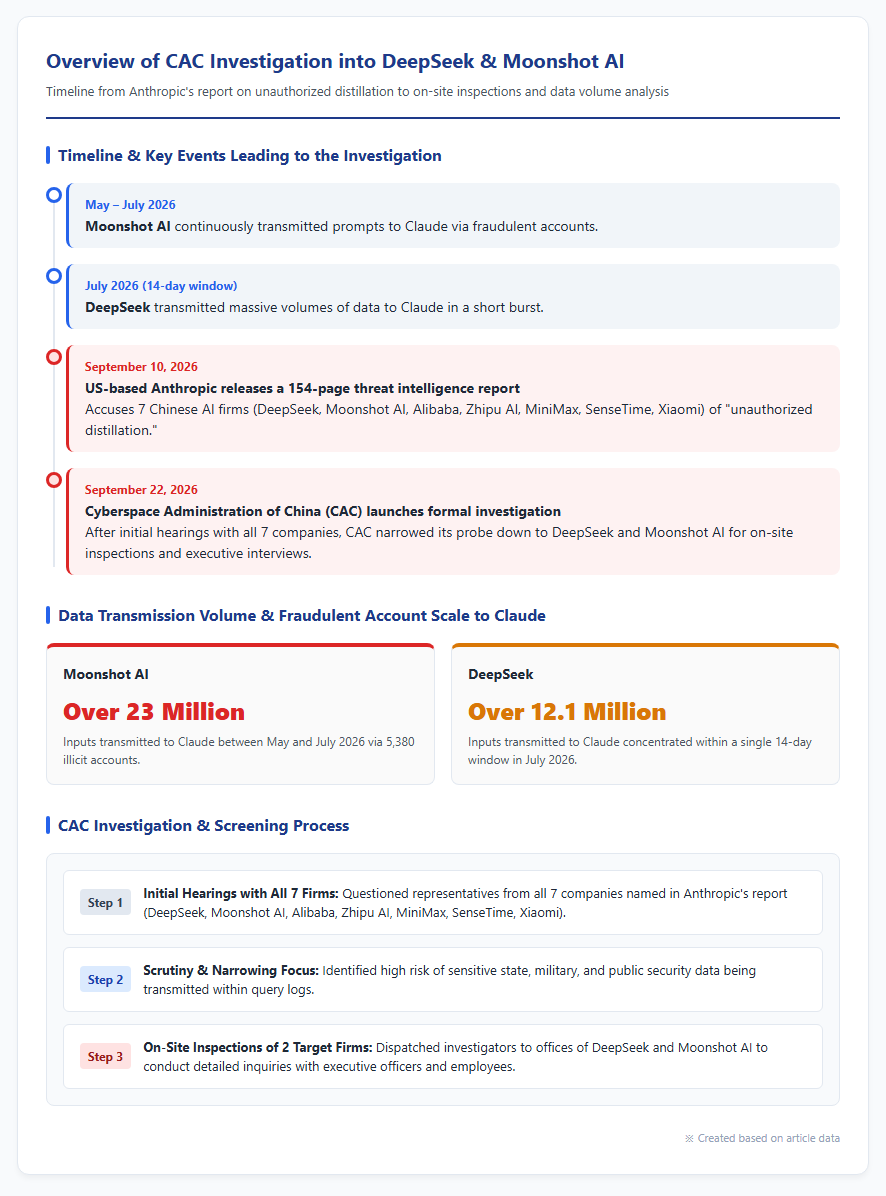
On September 22, 2026, US tech media reported that the Cyberspace Administration of China (CAC) had initiated an investigation into top domestic AI startups DeepSeek and Moonshot AI. The direct catalyst for this probe was a 154-page threat intelligence report published by US AI firm Anthropic on September 10, 2026. The report accused seven Chinese AI developers—DeepSeek, Moonshot AI, Alibaba, Zhipu AI, MiniMax, SenseTime, and Xiaomi—of systematically creating fraudulent accounts to send massive volumes of queries to its flagship model, Claude. This data was allegedly misused to train their own AI models in a process known as “unauthorized distillation.” The CAC initially questioned executives from all seven named companies. Following further scrutiny, regulators narrowed their focus to DeepSeek and Moonshot AI, dispatching investigators to their corporate offices to conduct detailed inquiries with executive officers and employees. The chart below illustrates the sequence of events leading up to this investigation.
National Security Risks and Concerns Over Sensitive Data Leaks
The primary concern for Chinese authorities extends beyond simple intellectual property infringement to potential national security breaches involving state secrets and sensitive security data routed to US servers. According to Anthropic’s intelligence report, Moonshot AI used 5,380 illicit accounts between May and July 2026 to transmit over 23 million inputs to Claude. Similarly, DeepSeek sent over 12.1 million prompts during a 14-day window in July of the same year. These queries allegedly contained sensitive internal data from the People’s Liberation Army (PLA), public security agencies, and state-owned enterprises. In one specific instance, an engineer working on police surveillance systems reportedly submitted tracking data—including CCTV footage surrounding military installations—to Moonshot’s Kimi model, which was subsequently relayed directly to Claude. Given that China’s Cybersecurity Review Measures and Data Security Law impose strict controls on the cross-border transfer of core and important data, authorities are treating the matter as a grave national security threat and advancing formal legal proceedings.
Severe Market Impact and Blow to Corporate Management
Broad Sell-Off of Chinese AI Stocks in Hong Kong
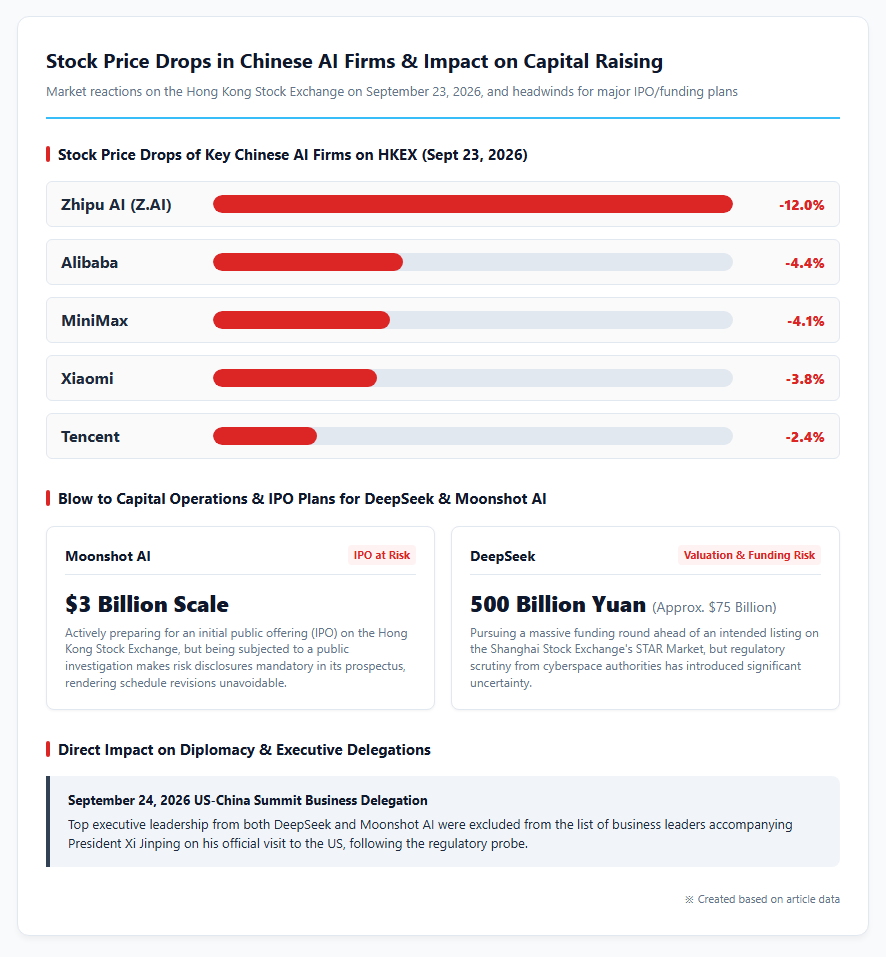
As news of the regulatory investigation broke, fears of a broader government crackdown swept through financial markets, triggering a steep sell-off in Chinese AI equities. During trading on the Hong Kong Stock Exchange on September 23, 2026, shares of Zhipu AI (Z.AI), one of the companies cited in Anthropic’s report, plummeted by up to 12%. MiniMax dropped 4.1%, while Alibaba Group, developer of the Qwen model suite, fell 4.4%. The sell-off spread across the entire tech sector, with Xiaomi dropping 3.8% and Tencent sliding 2.4%. Market analysts and investors increasingly worry that heightened government oversight over AI training pipelines and data management could slow the rapid pace of innovation that has characterized Chinese AI development. Over the longer term, compliance costs are expected to rise and technical methodologies may face new restrictions, casting a long shadow over valuation prospects for the sector in capital markets.
Clouded IPO Plans and Executive Movements
The regulatory probe has dealt a heavy blow to the fundraising and initial public offering (IPO) ambitions of these hyper-growth AI firms. Moonshot AI had been actively preparing for a \$3 billion IPO in Hong Kong. However, being subjected to a public regulatory investigation imposes mandatory risk disclosure requirements in its prospectus, making listing delays and weakened investor sentiment practically unavoidable. Meanwhile, DeepSeek, which was pursuing a funding round at a 500 billion yuan (approximately \$75 billion) valuation ahead of an intended listing on the Shanghai Stock Exchange’s STAR Market, faces severe headwinds as regulatory risks materialize. Compounding these setbacks, executive leaders from both startups were excluded from the official Chinese business delegation accompanying President Xi Jinping to the US-China summit scheduled for September 24, 2026. The following graphic illustrates these market and operational impacts.
Structural Industry Shifts and Future Outlook
Strategic Shifts in Model Training and the Impact on V4.1-Flash
To date, the Chinese AI ecosystem has relied heavily on distillation—using the output of high-performing US frontier models as synthetic training data—to develop sophisticated open-source models with minimal computing resources and lower financial overhead. DeepSeek’s V4.1-Flash model, unveiled on September 10, 2026, showcased this efficiency by employing a Causal Encoder-Decoder (CED) architecture and CSA2 for extreme KV cache compression, driving cache-hit input costs down to a groundbreaking \$0.003 per million tokens. However, if the current CAC probe renders reliance on external distillation unsustainable, Chinese developers will be forced to pivot toward proprietary data curation and custom annotation workflows. In the short term, this transition is likely to temper the speed of performance gains and increase infrastructure costs, eroding the traditional cost advantages enjoyed by Chinese AI developers.
US-China AI Rivalry and Key Issues to Watch
The investigation surfaced at a delicate geopolitical juncture, coming just days before the high-stakes US-China summit on September 24, 2026. As the US Trump administration intensifies its criticism of alleged data theft and unauthorized distillation by Chinese AI firms, Beijing’s willingness to openly investigate its own flagship AI champions signals a firm stance on domestic data security and compliance. Moving forward, key metrics to watch include the specific administrative penalties or corrective orders issued by the Cyberspace Administration of China against DeepSeek and Moonshot AI, as well as whether regulatory scrutiny will expand to the remaining five companies named in the Anthropic report. How Chinese authorities enforce data localization and security review standards—and how developers balance strict regulatory compliance with technological innovation—will ultimately define the growth trajectory and international competitiveness of China’s AI sector.
Reference Pages
- 【DeepSeek-V4.1-Flash – Hugging Face】https://huggingface.co/deepseek-ai/DeepSeek-V4.1-Flash
- 【DeepSeek-V3 Technical Report – arXiv】https://arxiv.org/pdf/2412.19437
【#DeepSeek #MoonshotAI #AIRegulation #DataSecurity #USChinaAITensions】


コメント