On September 2, 2026, Hitachi, Ltd. launched the “Cloud High-Reliability Solution” to achieve high business continuity in public cloud environments. The background to this is that, amid the rapid global expansion of AI demand, there is a growing need to utilize secure and flexible public cloud environments even for mission-critical systems that support social infrastructure.
- Overview of the new solution announced on September 2, 2026
- Automatic switching technology using the proprietary middleware “HVRD”
- A One-Stop Support System for Complex Cloud Incidents
- Rapid Cloud Migration Through Proven Best Practices
- The Social Significance for Companies Considering Cloud Migration
- Feature Enhancements and Future Outlook for AI Integration Toward Fiscal Year 2027
Overview of the new solution announced on September 2, 2026
On September 2, 2026, Hitachi, Ltd. launched the “Cloud High-Reliability Solution” designed to enhance the continuity of mission-critical operations for companies migrating their core systems to public clouds. This solution features an innovative mechanism that automatically switches to a standby system in an extremely short time of just tens of seconds in the event of a failure on the public cloud. It has successfully achieved a high-level balance of minimal downtime and the complete avoidance of data loss—which had previously been difficult to achieve outside of on-premises environments—within public cloud environments such as Amazon Web Services. The solution aims to enable businesses to safely utilize public cloud environments in social infrastructure sectors where even a momentary system outage is intolerable, including financial transactions, public services, transportation networks, power transmission grids, and supply chains. It serves as a robust foundation for safely and swiftly integrating digital technologies, including the latest artificial intelligence, into core business operations to enhance business agility.
Automatic switching technology using the proprietary middleware “HVRD”
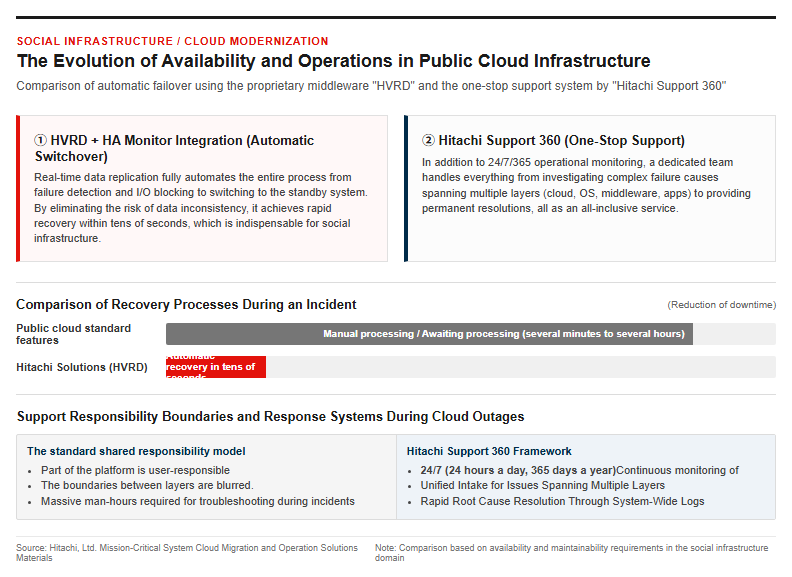
At the core of this solution is the “Hitachi Volume Replication Driver (HVRD)”, newly developed middleware by Hitachi. HVRD is a product that replicates and synchronizes update data from the production system to the standby Availability Zone in real time. With standard public cloud features alone, waiting for data update processing could occur during network failures, and it sometimes took time to switch systems to maintain data consistency. However, by closely integrating the newly developed HVRD with the proven “HA Monitor”, we have automated the entire process from failure detection, blocking of data input/output according to the update state, to switching to the standby system. As a result, even in core systems involving large-scale online processing or batch processing, rapid recovery within tens of seconds is reliably executed without requiring intervention from system operations personnel. This minimizes downtime associated with failures to the absolute limit and completely eliminates the risk of system data inconsistency.
A One-Stop Support System for Complex Cloud Incidents
When migrating core systems to a public cloud, identifying the cause of failures and performing recovery operations become extremely complex. In an environment where public clouds, operating systems, middleware, and applications are layered upon one another, the boundaries of responsibility tend to become blurred. Under a cloud vendor’s typical shared responsibility model, handling certain aspects of the platform layer falls under the user company’s responsibility. To solve this operational challenge, Hitachi offers “Hitachi Support 360”. In addition to 24/7/365 operational monitoring, a dedicated team for critical systems provides one-stop handling of issues spanning multiple layers—from accepting issues to rapid root-cause investigation using system-wide logs, and permanent resolution. This significantly reduces the operational burden on user companies, allowing even those facing a shortage of personnel with advanced expertise to safely operate and maintain core systems on the public cloud.
Modernization of Social Infrastructure and Future Developments
Rapid Cloud Migration Through Proven Best Practices
Projects to migrate existing systems to the cloud not only involve simply moving data, but also require the evaluation of non-functional requirements such as performance, availability, security, and maintainability, as well as large-scale application modifications. Drawing on its experience in system construction and migration within mission-critical domains—such as VOS3, a mainframe-exclusive operating system, and UNIX systems—Hitachi has systematized advanced best practices. For cloud migration, platform engineers thoroughly assess customers’ pre-migration non-functional requirements and propose configurations with an optimized balance between cost and reliability. In addition, when migrating large volumes of core data, advanced designs are implemented to minimize business impact and system downtime. While ensuring quality across every phase from design to construction and testing, we guarantee improved efficiency and a reduced timeframe for the overall migration project. Please refer to the figure below.
The Social Significance for Companies Considering Cloud Migration
Today, as many companies rush to transform their businesses, they are seriously considering migrating their mission-critical systems to the public cloud in order to benefit from advanced technologies such as generative AI. However, for systems handling critical data that support social infrastructure, there is a risk that the loss of updated data due to failures or system outages lasting several hours could cause major social disruption. This solution technically resolves the “concerns about reliability” that have historically served as a major psychological barrier to cloud migration. Even in areas such as finance, government administration, transportation, and electric power, where a momentary downtime can have a massive impact on many people, it enables the utilization of the flexibility and scalability inherent in the cloud while maintaining robustness equivalent to on-premises systems. This paves the way for the safe and highly reliable combination of core data and AI technology, holding significant social value by dramatically accelerating the modernization of industries and infrastructure.
Feature Enhancements and Future Outlook for AI Integration Toward Fiscal Year 2027
Hitachi has outlined a roadmap that looks beyond merely improving public cloud reliability to evolving toward an AI-native infrastructure. In the first half of fiscal 2027, the company plans to enhance secure data integration features with AI in its highly reliable relational database, “HiRDB”. Furthermore, it will strengthen support for the stable operation of applications leveraging the latest AI agents on the Web application execution platform “uCosminexus Application Server / Runtime” and “COBOL2002”. In operations, alongside promoting automation through the integrated system operations management product “JP1”, Hitachi aims to expand AI agents based on operational expertise through “Hitachi Application Reliability Centers (HARC)”. By continuously strengthening high reliability tailored to the latest architectures and driving operational autonomy through AI, Hitachi will continue to support the sustainable growth of enterprises.
Reference Page
- 【[Notice] Hitachi Launches “Cloud High-Reliability Solution” to Enhance Business Continuity for Mission-Critical Operations in Public Cloud Environments】https://www.hitachi.co.jp/products/it/CloudDX/modernization/news/202609_01.html
【#Hitachi #CloudReliabilityEnhancementSolution #Middleware #SystemMigration #Availability #SocialInfrastructure】
コメント