Norway’s sovereign wealth fund, which manages over \$2.3 trillion in assets, has proposed cutting the weight of government bonds in its benchmark bond index from 70% to 50%, a move that would reduce its US Treasury holdings by approximately \$80 billion. This proposed shift is driven by a strategy to diversify into higher-yielding fixed-income assets amid global interest rate pressures and persistent inflation concerns.
- Revision of Benchmark Indices and Scale of US Treasury Reductions
- Destination of Capital and Reallocation Across Sovereign Bond Markets
- Elevated Global Interest Rates and the Drive for Enhanced Yields
- Managing Concentration Risks in the Equity Portfolio
- Signals Sent by the Retreat of a Traditional Safe-Haven Buyer
- A Gradual Transition Toward a 2027 Execution
Revision of Benchmark Indices and Scale of US Treasury Reductions
Norway’s government pension fund, the Government Pension Fund Global (GPFG), which stands as the world’s largest sovereign wealth fund, is poised to embark on one of the most significant structural overhauls of its fixed-income portfolio in recent history. In September 2026, Norges Bank Investment Management (NBIM), which manages the fund, formally proposed to the Ministry of Finance a reduction in the government bond allocation within its benchmark bond index from 70% to 50%. If approved, this adjustment will slash the fund’s global sovereign debt exposure by approximately \$106 billion (roughly ¥16.6 trillion). The brunt of this reduction will fall on US Treasuries, the fund’s largest single asset class. Out of the approximately \$215 billion in US Treasuries held as of the end of June 2026, about \$80 billion (roughly ¥12.5 trillion) will be divested. NBIM reassured that even with the sovereign debt allocation lowered to 50%, the fund will maintain more than enough high-quality liquid assets to meet cash flow requirements, even during periods of extreme financial market distress. The capital unlocked by this divestment will be redeployed into other fixed-income sectors to capture diverse risk premiums and boost long-term returns.
Destination of Capital and Reallocation Across Sovereign Bond Markets
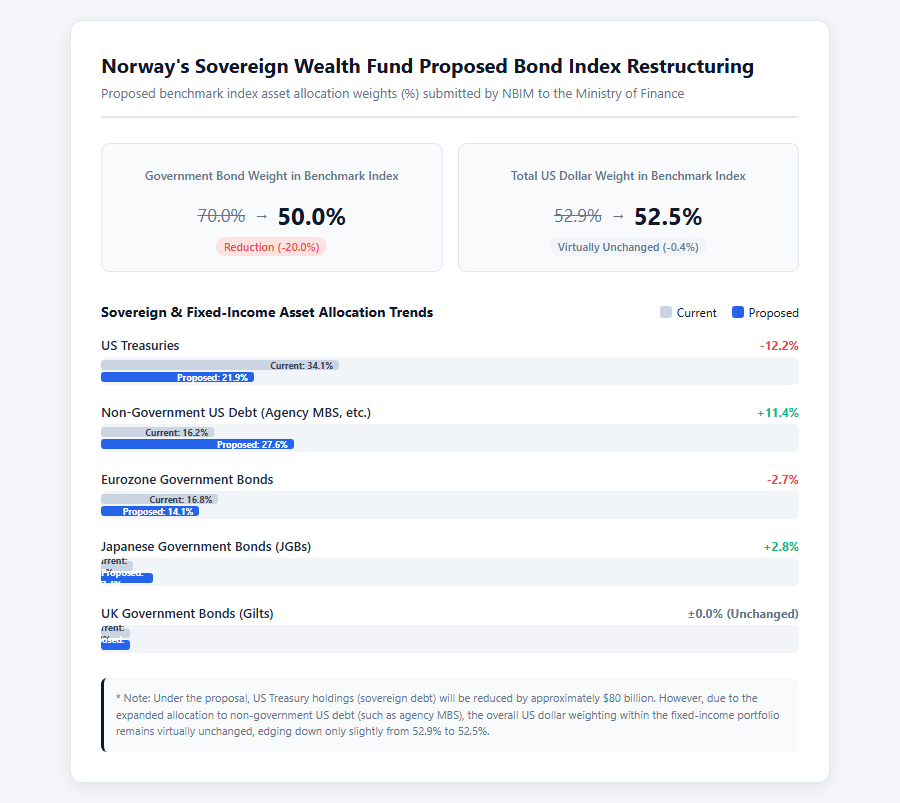
This portfolio restructuring does not represent a retreat from US dollar-denominated assets. While NBIM plans to reduce its target allocation for US Treasuries by 12.2 percentage points, it intends to simultaneously expand its exposure to non-government US debt assets. The primary adjustments to the sovereign debt and broader fixed-income allocations within the benchmark index are projected as follows:
- US Treasuries: Dropping significantly from 34.1% to 21.9%
- Non-government US debt: Rising sharply from 16.2% to 27.6%
- Eurozone government bonds: Falling moderately from 16.8% to 14.1%
- Japanese Government Bonds (JGBs): Increasing from 4.6% to 7.4%, a 2.8 percentage point increase
- UK government bonds: Remaining unchanged at 4.2%
Through this precise balancing act, the overall US dollar weighting within the fixed-income index will only edge down from 52.9% to 52.5%—a negligible 0.4 percentage point decline that preserves the fund’s fundamental US dollar exposure. To implement these changes, the fund has proposed constructing a new customized benchmark index where government bonds and other developed-market corporate or agency debt each comprise roughly half of the fixed-income portfolio. This highly calculated reallocation underscores the fund’s commitment to maintaining a robust, globally diversified investment structure that minimizes unnecessary foreign exchange volatility.
Strategic Motivations and Mitigation of Concentration Risks
Elevated Global Interest Rates and the Drive for Enhanced Yields
The fundamental driver behind this strategic pivot is the structural shift in global bond markets, characterized by widening government deficits and persistent inflation. Long-term borrowing costs have surged worldwide, pushing sovereign yields to multi-year highs. In early September 2026, the US 10-year Treasury yield surged past 4.75%, reaching its highest level since January 2025. Meanwhile, Japan’s 10-year government bond yield touched 3%, hitting a milestone not seen in three decades. Under these macroeconomic conditions, simply holding safe-haven government debt is no longer sufficient to meet the fund’s return objectives. Consequently, NBIM is shifting its focus to agency mortgage-backed securities (MBS) guaranteed by US government-backed entities like Fannie Mae, Freddie Mac, and Ginnie Mae. Because agency MBS carry prepayment risks, they offer a yield premium over US Treasuries while maintaining a highly comparable, near-sovereign credit profile. This allows the fund to generate higher coupon income while keeping incremental credit risk to a minimum, representing a highly rational adaptation to a regime of higher-for-longer interest rates.
Managing Concentration Risks in the Equity Portfolio
The urgency of diversifying the fixed-income portfolio is also closely linked to growing concentration risks in the fund’s equity investments. A historic rally in a select handful of mega-cap US technology giants has led to a highly concentrated equity exposure, tying a massive portion of the fund’s overall performance to the fortunes of the US tech sector. To counteract this vulnerability, the fund must diversify its return engines across other asset classes. In a separate letter, NBIM also proposed expanding its mandate to invest more heavily in unlisted and private assets. Given that the sovereign wealth fund owns an average of 1.5% of all listed companies globally and allocates approximately 70% of its total portfolio to equities, any strategic adjustment of this scale is crucial to safeguarding the fund’s resilience against sudden stock market corrections. To understand the fund’s overall asset allocation and structural balance, please refer to the diagram below.
Market Implications and Implementation Timeline
Signals Sent by the Retreat of a Traditional Safe-Haven Buyer
The proposal by the world’s largest sovereign wealth fund to shed \$80 billion in US Treasuries sends a powerful signal to global financial markets. US Treasury markets are already grappling with a decline in “reliable, long-term buyers” as foreign central banks and official institutions in countries like China and Japan scale back their purchases due to domestic economic challenges or geopolitical considerations. This has left speculative, highly leveraged hedge funds to absorb the marginal supply of US debt. With hedge funds holding an estimated \$2.6 trillion in US Treasuries and employing high leverage, the market’s underlying stability has become increasingly sensitive to short-term trading dynamics. While an \$80 billion divestment by Norway is manageable within the context of the highly liquid US Treasury market, the symbolic impact of a premier sovereign investor choosing to exit Treasuries in favor of yield-bearing agency MBS could prompt other global institutional allocators to follow suit, exacerbating the supply-demand imbalance in sovereign debt markets.
A Gradual Transition Toward a 2027 Execution
This massive portfolio adjustment will not occur overnight. NBIM has explicitly stated that any transition will be executed gradually and systematically over an extended period to minimize transaction costs and prevent unnecessary market disruption. The timeline for formal decision-making is already established. The proposal submitted in September 2026 represents an initial recommendation responding to the Finance Ministry’s inquiries. NBIM plans to deliver a comprehensive final report to the ministry in January 2027. This will be followed by a formal review, leading to the Finance Ministry’s final recommendation to Norway’s parliament in the spring of 2027. Just a few months prior, in April 2026, then-Finance Minister Jens Stoltenberg had downplayed expectations of any major changes to the fund’s US exposures. The fact that NBIM has now put forward such a concrete, substantial restructuring plan highlights a more active and urgent reassessment of the bond portfolio by the fund’s managers, contrasting sharply with the government’s earlier cautious rhetoric.
References
- 【Norway’s US\$2 trillion sovereign fund proposes deep cuts to US Treasury holdings】https://www.thestandard.com.hk/finance
【#NorwaySovereignWealthFund #USTreasuries #MortgageBackedSecurities #AssetAllocation #RisingInterestRates #NBIM】


コメント