The Ministry of Finance has announced a record-high FY2027 budget request totaling 143.0656 trillion yen. This historic expansion is driven by the Takaichi administration’s abolition of spending caps (“ceilings”), the integration of supplementary expenditures into the initial budget, and a sharp increase in debt-servicing costs triggered by rising interest rates.
- Key Highlights of the FY2027 Request and the Decision to Abolish Spending Caps
- Integrating Initial and Supplementary Budgets to Break Dependence on Add-ons
- The Scope of the “Strong and Prosperous Japan” Investment Framework
- Massive Semiconductor and AI Injections and the Implementation of Physical AI
- Redesigning Subsidies and a ¥900 Billion Investment Package for SMEs
- Rising Long-Term Yields and the Heavy Burden of a ¥36 Trillion Debt Service
- Defending the Nation: Year-End Security Debates and “Open-Ended” Requests
Key Highlights of the FY2027 Request and the Decision to Abolish Spending Caps
On September 4, 2026, the Ministry of Finance unveiled its general account budget request for fiscal year 2027, hitting a historic high of 143.0656 trillion yen. This marks the fourth consecutive year of record-breaking requests, representing a dramatic increase of over 20.6 trillion yen—or approximately 16.8%—compared to the initial request for the previous fiscal year, which stood at 122.4454 trillion yen. The primary catalyst behind this unprecedented expansion is a sweeping relaxation of budget guidelines introduced by the administration of Prime Minister Sanae Takaichi. Specifically, the government established the “Strong and Prosperous Japan” investment framework, targeting crisis management and initiatives to boost Japan’s potential growth rate, while effectively abolishing the traditional budgetary caps (ceilings) for these categories. Finance Minister Satsuki Katayama declared that “there is no longer anything that should be called a ceiling,” prompting ministries to submit requests without upper limits. Consequently, requests under this new investment framework ballooned to 12.173 trillion yen, far exceeding initial expectations. While this shift reflects a bold transition toward active fiscal policy, the liberalization of the entry point poses significant structural risks, dramatically raising the political cost of negotiations and the burden of rigorous screening by the Ministry of Finance ahead of the final budget formulation at year-end.
Integrating Initial and Supplementary Budgets to Break Dependence on Add-ons
A core pillar of the Takaichi administration’s fiscal strategy reflected in this request is breaking away from Japan’s chronic dependency on supplementary budgets. Traditionally, Japan’s budget formulation has operated on a two-tier system: keeping the initial budget artificially low to demonstrate fiscal discipline, and subsequently adding massive outlays mid-year through large-scale supplementary budgets under the guise of economic stimulus. In fiscal year 2020, supplementary spending spiked by approximately 73 trillion yen to combat the COVID-19 pandemic, and even in subsequent years, annual supplementary budgets of 13 to 18 trillion yen became the norm. To reform this opaque structure where supplementary bills receive less rigorous scrutiny under the banner of urgency, the Takaichi administration mandated that foreseeable, ongoing policies must be incorporated into the initial budget from the start. However, this idealized approach faces practical skepticism. Securing a larger initial budget does not eliminate the possibility of unpredictable emergencies such as natural disasters or pandemics. If the initial budget baseline permanently steps up, and the government still ends up piling on massive supplementary budgets when crises inevitably occur, Japan’s fiscal discipline risks becoming entirely obsolete.
The Scope of the “Strong and Prosperous Japan” Investment Framework
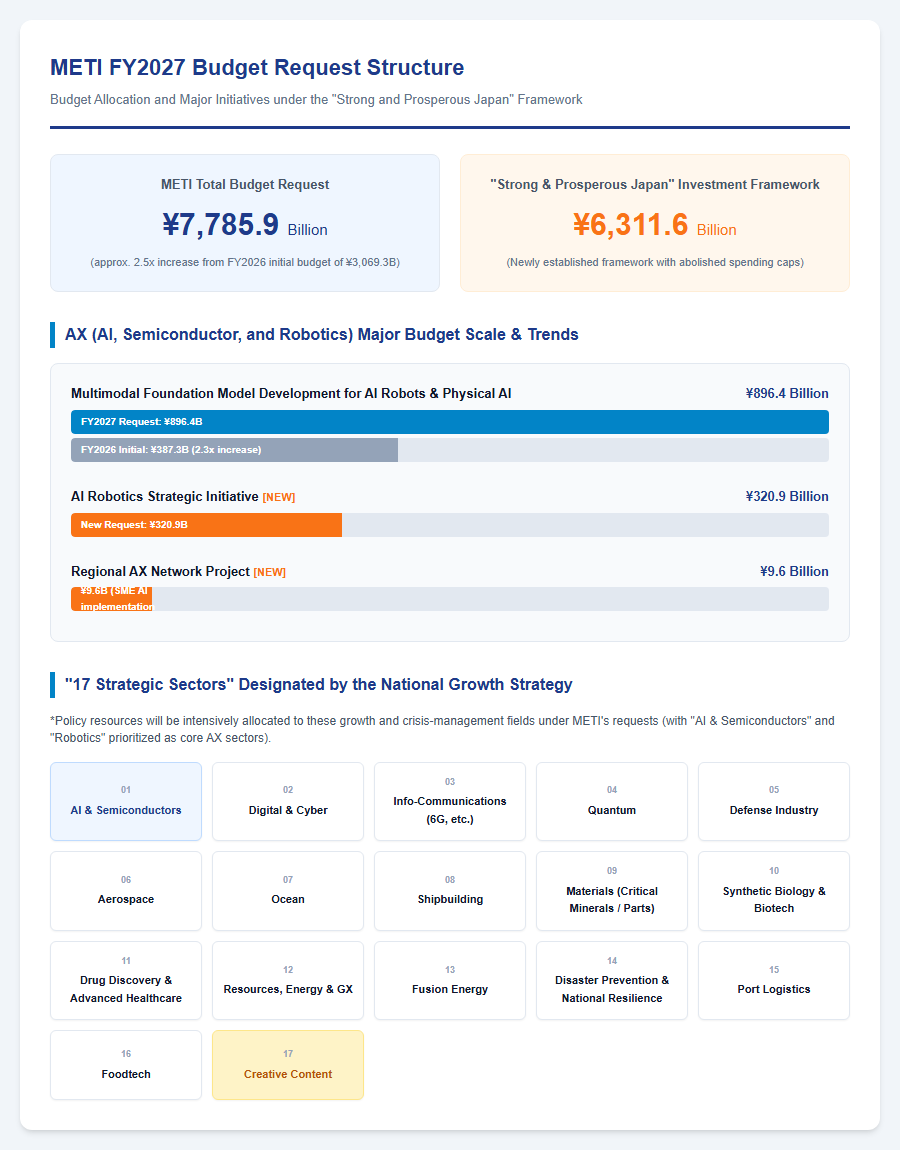
The newly minted “Strong and Prosperous Japan” investment framework, freed from traditional spending caps, attracted a staggering 12.173 trillion yen in requests from various ministries. A breakdown by ministry reveals that the Ministry of Economy, Trade and Industry (METI) led the charge with a massive request of 4.525 trillion yen, primarily for semiconductor and AI development, alongside securing critical minerals. The Ministry of Education, Culture, Sports, Science and Technology (MEXT) followed with 2.183 trillion yen, targeting research in aerospace and quantum computing, while the Ministry of Land, Infrastructure, Transport and Tourism (MLIT) requested 1.5804 trillion yen, and the Ministry of Finance requested 172.6 billion yen. Together, these four ministries account for approximately 8.461 trillion yen, with the remaining 3.7 trillion yen distributed among other agencies. For instance, the Ministry of Internal Affairs and Communications requested 503.3 billion yen for next-generation 6G communications research. These requests align with the administration’s “17 Strategic Sectors” outlined in the Basic Policy (Bonebuto) 2026, aimed at mobilizing over 370 trillion yen in public-private investments by fiscal year 2040. However, critics point out that designating 17 sectors—ranging from AI, semiconductors, and quantum tech to biotechnology, space, maritime, defense, and even content industries like anime—is overly broad compared to low-income countries that typically focus on an average of 13 sectors. This lack of selectivity raises fears of resource dispersion, potentially keeping unproductive, low-growth projects alive on state lifelines. A case in point is the Cool Japan Fund, a public-private fund in the content sector whose cumulative losses surged to around 40 billion yen by the end of FY2024, illustrating the severe consequences when exit strategies and rigorous post-evaluations are neglected.
A Major Paradigm Shift in Industrial Policy and its Impact on Businesses
Massive Semiconductor and AI Injections and the Implementation of Physical AI
METI’s budget request for FY2027, combining both the general and special accounts, reached a historic 7.7859 trillion yen—representing a massive 2.5-fold surge from the FY2026 initial budget of 3.0693 trillion yen. The absolute centerpiece of this budget is AX (AI, Semiconductor, and Robotics transformation). The most prominent initiative is the “Multimodal Foundation Model Development Project for AI Robots and Physical AI,” which saw its requested funding more than double from the previous year’s 387.3 billion yen to 896.4 billion yen. Furthermore, METI has introduced new projects such as the “AI Robotics Strategic Initiative” requesting 320.9 billion yen, and the “AI Robotics Core Hub Project” at 133.3 billion yen, signaling a serious push to deploy physical AI onto real-world factory floors and workplaces. To bridge the digital divide among smaller enterprises, METI also established the “Regional AX Network Project” with a 9.6 billion yen request. This project aims to build regional ecosystems connecting small-and-medium enterprises (SMEs) with local chambers of commerce, tax accountants, financial institutions, and AI providers to offer hands-on implementation support.
Redesigning Subsidies and a ¥900 Billion Investment Package for SMEs
Following early reports of a 900 billion yen investment package for small-and-medium enterprises, METI’s official request confirmed 1.2818 trillion yen under the “Strong and Prosperous Japan” framework specifically for SME-related support. The largest single chunk is the 698 billion yen allocated to the Organization for Small & Medium Enterprises and Regional Innovation (SMRJ) as operating grants, a massive jump from the previous year’s 18.8 billion yen. This funding will be used to merge the existing “Digitalization and AI Implementation Subsidy” (formerly the IT Subsidy) and the “SME Labor-Saving Investment Subsidy” into a unified, streamlined program called the “Labor-Saving, Digitalization, and AI Investment Subsidy.” This consolidation is designed to provide comprehensive, integrated support for SMEs seeking to adopt AI and labor-saving machinery to combat severe labor shortages. Crucially, the screening process for these subsidies will shift to evaluate “past and current wage hikes” rather than merely accepting future wage-increase promises. This represents a significant change in practical requirements for applicants. Together with tax reform requests—such as redefining the wage-hike tax credit threshold to focus on “wage increases per employee” rather than “total aggregate payroll”—the government is concentrating its policy tools to boost the earning power of SMEs over the next five years.
A World with Positive Interest Rates and the Fiscal Landmines Ahead
Rising Long-Term Yields and the Heavy Burden of a ¥36 Trillion Debt Service
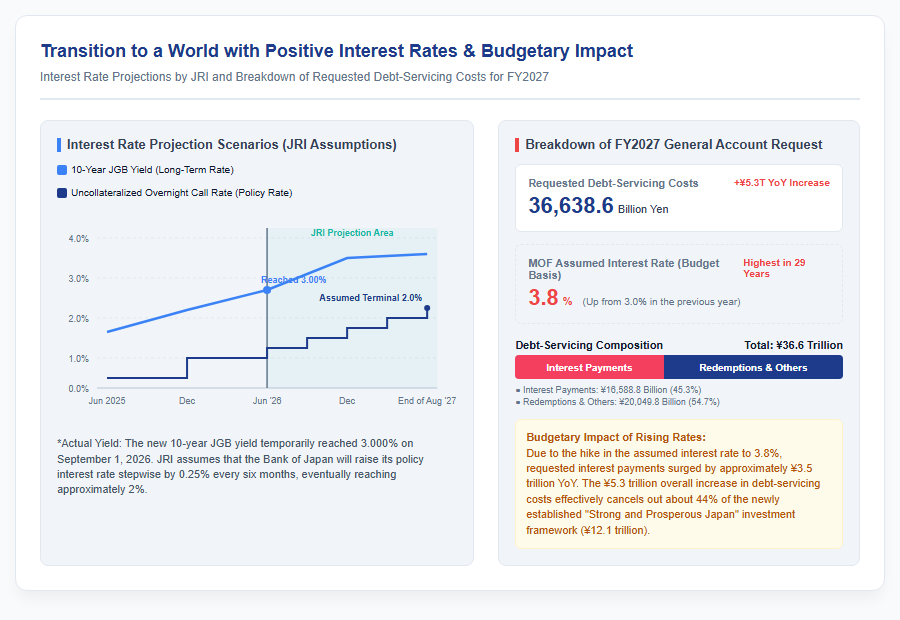
In response to this aggressive fiscal expansion, financial markets have flashed clear warning signs. On September 1, 2026, the benchmark yield on 10-year Japanese Government Bonds (JGBs) briefly touched 3.000% on the Tokyo debt market, reaching the 3% milestone for the first time in approximately 30 years. This spike was driven by a combination of high crude oil prices, expectations of early interest rate hikes by the Bank of Japan, and growing market anxiety over unbacked fiscal expansion. In light of this rising interest rate environment, the Ministry of Finance raised its assumed interest rate for calculating FY2027 debt-servicing costs from 3.0% to 3.8%—the highest level in 29 years since FY1998. Consequently, the requested debt-servicing cost (national debt service) surged to a record 36.6386 trillion yen. This figure now stands on par with the requested budget for the Ministry of Health, Labour and Welfare, which reached 36.5803 trillion yen due to the natural growth of social security expenses for Japan’s aging population. Together, these two non-discretionary outlays account for over half of the entire general account request, leaving very little room for strategic policy investments.
Defending the Nation: Year-End Security Debates and “Open-Ended” Requests
The final size of the FY2027 budget will ultimately be decided through intense year-end negotiations and political compromises, particularly regarding defense outlays. A major focus heading into December is the final pricing of “itemized requests” (jiko-yokyu)—items listed without specific monetary figures in the initial draft. While the Ministry of Defense has requested a record initial figure of 8.8908 trillion yen, key procurement programs—such as submarine construction and stealth fighter acquisitions—remain open-ended without specified costs. These figures will be finalized in tandem with the scheduled revision of Japan’s three key national security documents at the end of the year. Discussions are expected to center on whether to accelerate the target of raising defense-related spending to 2% of GDP, treat 2% as a floor rather than a cap, or further expand the nominal budget in line with recent nominal GDP growth. If these itemized requests are fully funded at year-end, the actual defense budget could easily surpass 10 trillion yen, pushing the total national budget far beyond the initial 143 trillion yen mark. Prime Prime Minister Takaichi has set a target to cap new government bond issuance at around 40 trillion yen, but maintaining market trust while managing these escalating spending pressures will be a critical test of her administration’s fiscal sustainability.
Reference Pages
- 【Ministry of Finance】Documents Related to the FY2027 Budget Request https://www.mof.go.jp/about_mof/mof_budget/budget/fy2027/20260828.html
- 【Ministry of Economy, Trade and Industry】FY2027 Budget Request and Tax Reform Requests https://www.meti.go.jp/main/yosangaisan/fy2027/index.html
- 【Cabinet Secretariat】Designated Critical Infrastructure Operators Under the Economic Security Promotion Act https://www.cao.go.jp/keizai_anzen_hosho/suishinhou/infra/doc/infra_jigyousya.pdf
【#BudgetRequest #TakaichiAdministration #ActiveFiscalPolicy #LongTermInterestRates #SMESupport #METI #DebtServicingCosts】

コメント