Japan and Taiwan have deepened their cooperation in the high-tech sector, reinforcing supply chain establishment and talent development that contribute to economic security. Behind this is proactive preparation—even in peacetime—for the risks of global cutting-edge semiconductor manufacturing being concentrated in Taiwan, as well as the surging demand for artificial intelligence.
- Key Points of Japan-Taiwan High-Tech Cooperation Revealed at the Symposium
- Economic Security and Strengthening Supply Chains in the Democratic Camp
- Current Status of TSMC’s Kumamoto Plant and Evolution to the 3-Nanometer Process
- Economic ripple effects exceeding 11 trillion yen and complex impacts on host regions
- The Role Played by the Kumamoto Prefecture Semiconductor Human Resources Development Council and Securing Human Resources
- Future Developments in Japan-Taiwan AI Collaboration and Key Points for Sustainable Growth
Key Points of Japan-Taiwan High-Tech Cooperation Revealed at the Symposium
On August 21, 2026, a symposium was held in Taipei to discuss strengthening cooperation between Japan and Taiwan in the high-tech sector. The symposium focused on further deepening cooperative ties in advanced technology fields such as artificial intelligence and semiconductors. In particular, amidst rising geopolitical tensions, participating experts and stakeholders strongly shared the view that it is crucial for the democratic camp to unite in building supply chains and break away from excessive dependence on specific countries. This discussion is set against the backdrop of the current reality where the manufacturing of the world’s most advanced logic semiconductors is concentrated in Taiwan—specifically at Taiwan Semiconductor Manufacturing Company (TSMC), the world’s largest foundry. This excessive concentration in Taiwan carries the inherent risk that supply chains for global electronic devices, telecommunications, and AI infrastructure could come to a complete halt in the event of geopolitical risks or natural disasters. Consequently, deepening close cooperation between Japan and Taiwan from the manufacturing and R&D stages, and establishing a resilient cooperative framework during peacetime to prepare for unforeseen circumstances, is positioned as a critically important milestone for the security of both parties.
Economic Security and Strengthening Supply Chains in the Democratic Camp
Economic security is a policy domain aimed at ensuring the safety of the state and its citizens through economic activities while preparing for the risk of supply disruptions during peacetime. In 2022, the Japanese government enacted the Economic Security Promotion Act, establishing a framework centered on the stable supply of specified critical materials. Under this law, semiconductors are explicitly positioned as vital materials that are difficult to substitute and support all industries in modern society. The manufacturing of semiconductors requires enormous investments, extremely advanced manufacturing equipment, and specialized materials, making a short-term return to domestic production or increased output no easy task. Therefore, national policies are needed to correct the concentration of procurement sources caused by the pursuit of private sector-led efficiency and to ensure redundancy. Aiming to build a stable domestic production framework, the government provides multi-layered financial support, including not only subsidies but also two-step loans, to companies whose supply security plans have been certified. From this perspective of economic security as well, balancing strict export controls to prevent the leakage of technologies—such as semiconductor manufacturing equipment—with the diversification of procurement networks serves as an essential safeguard for maintaining the supply chains of both Japan and Taiwan.
The Cutting-Edge Hub Emerging in Kumamoto and Its Multifaceted Impact
Current Status of TSMC’s Kumamoto Plant and Evolution to the 3-Nanometer Process
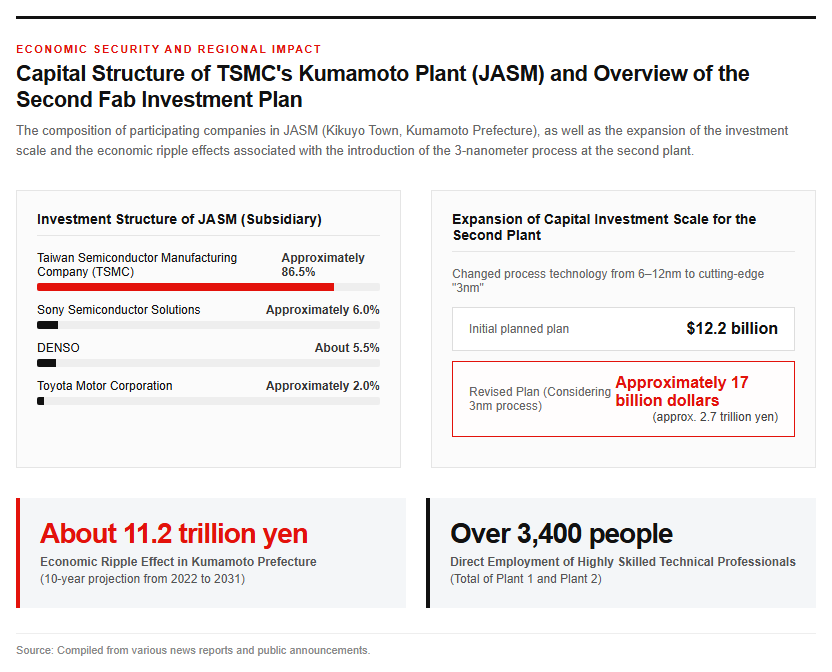
The most symbolic concrete example of Japan-Taiwan semiconductor cooperation is the construction of JASM’s semiconductor plant in Kikuyo-cho, Kumamoto Prefecture. JASM is a subsidiary backed by approximately 86.5% investment from TSMC, with Sony Semiconductor Solutions holding about 6.0%, DENSO about 5.5%, and Toyota Motor Corporation—which has newly joined as an equity partner—holding about 2.0%. Following the completion of the first plant in February 2024, it was officially announced that construction of the second plant on an adjacent site had already begun in October 2025. Furthermore, the production plans for the second plant were abruptly shifted from the initially planned 6-to-12-nanometer process to consider production using the cutting-edge 3-nanometer process. As a result, the capital expenditure for the second plant is expected to expand significantly from the initial $12.2 billion to approximately $17.0 billion (approx. 2.7 trillion yen). The 3-nanometer process is an indispensable state-of-the-art technology for AI data centers, autonomous driving, and high-performance computing, yet mass-production facilities did not exist within Japan. Securing this investment ensures a safe insurance policy of a cutting-edge semiconductor production base inside Japan, as the global restructuring of supply chains progresses.
Economic ripple effects exceeding 11 trillion yen and complex impacts on host regions
TSMC’s expansion into Kumamoto has brought an extremely significant impact to the regional economy, including Kumamoto Prefecture. According to estimates, the economic ripple effect within Kumamoto Prefecture, including the second plant, will reach approximately 11.2 trillion yen over the 10-year period from 2022 to 2031, and direct employment for highly skilled technical positions, combined with the first plant, will exceed 3,400 people. Please refer to the figure below.
However, this rapid development is also posing a complex set of challenges for local communities and infrastructure. In towns such as Kikuyo and Koshi surrounding the plant, traffic congestion caused by an increase in commuters and construction vehicles has become severe, and urgent measures such as widening roads are being demanded. In the real estate market, land prices and rental housing rents around the factory are skyrocketing, with some areas seeing growth rates that exceed those of Kumamoto City. Furthermore, the high salary levels offered by TSMC are triggering an outflow of talent from local small and medium-sized enterprises, forcing companies to take steps such as improving compensation. In addition, close attention is being paid to how to balance industrial development with the sustainability of the local environment, including the environmental impact of securing the large amounts of groundwater required for semiconductor manufacturing and the monitoring of chemical substances used in the manufacturing process.
Building a Sustainable Ecosystem and Future Expansion
The Role Played by the Kumamoto Prefecture Semiconductor Human Resources Development Council and Securing Human Resources
As the concentration of semiconductor-related companies progresses, the development and securing of specialized talent to support advanced technologies has become a top priority that must be addressed collectively by industry, academia, and government. To tackle this challenge, Kumamoto Prefecture established the “Kumamoto Prefecture Semiconductor Talent Development Council” in March 2022 as a regular forum for direct dialogue among the industrial sector, educational institutions, and administrative bodies. This council has repeatedly discussed specific talent profiles demanded by the industry and educational programs for talent development, with its sixth meeting held in October 2025. At the council, information sharing regarding the initiatives of the Kyushu Semiconductor Talent Development Consortium and the implementation of educational programs to promote understanding of semiconductors among younger generations, such as elementary and junior high school students, are being promoted. Cooperation in job placement events targeting local middle, high school, and university students is also actively carried out, aiming for sustainable employment creation and technology transfer in the region. In order to root the advanced technology ecosystem originating from TSMC within Japan, rather than just a temporary attraction, it is essential to build a system that maintains a long-term, high-level talent supply structure in close cooperation with educational institutions.
Future Developments in Japan-Taiwan AI Collaboration and Key Points for Sustainable Growth
The high-tech collaboration between Japan and Taiwan is evolving beyond mere factory recruitment into a joint defense strategy for the democratic camp to survive the AI era. The point of attention moving forward is the synergistic effect generated by the “two-track strategy”: mass production of the 3-nanometer process at TSMC’s Kumamoto plant and Rapidus, which aims for the domestic production of 2-nanometer semiconductors in Chitose, Hokkaido. By having TSMC ensure a stable supply of processes necessary for automotive and consumer electronics, and Rapidus develop the next-generation ultra-advanced domain, Japan can solidify its position as a strategic partner in the global supply chain. However, for sustainable development, the national and local governments must continue to work together to implement comprehensive measures against complex challenges, such as delays in infrastructure development, the drain of talent from local companies, and the mitigation of environmental loads like groundwater conservation. For Japan-Taiwan high-tech collaboration to achieve true success, it is crucial to overcome these challenges and co-create a new, sustainable semiconductor ecosystem in the Asia-Pacific region that merges Taiwan’s foundry production nodes with the industrial base where Japan holds strengths, such as advanced manufacturing equipment and materials.
Reference Page
- 【Regarding the Kumamoto Prefecture Semiconductor Human Resources Development Council】https://www.pref.kumamoto.jp/soshiki/58/212396.html
【#Semiconductors #AI #SupplyChain #EconomicSecurity #TSMC #KumamotoPrefecture #JapanTaiwanCooperation #Economy】


コメント