Rakuten Group and Rakuten Bank have reached a final agreement to reorganize their fintech businesses, transitioning to a structure where Rakuten Bank acts as the parent company, with Rakuten Card and Rakuten Securities Holdings becoming its subsidiaries. This move is driven by the aim to maximize intra-group capital circulation and profitability, as the value of the deposit base increases amid the rising interest rate environment accompanying the Bank of Japan’s rate hikes.
- Launch of the New Structure with Rakuten Bank as the Parent Company and the Background Leading to the Agreement
- The Role of Each Subsidiary in Financial Restructuring and the Excluded Businesses
- The Importance of Deposit-Gathering Power and Synergy Effects in an Era of Rising Interest Rates
- Comparing Approaches with Competitors and Structural Changes in Financial and Economic Spheres
- Specific Benefits for Consumers and Rakuten Ecosystem Users
- Post-Reorganization Management Challenges and Medium- to Long-Term Focus Points
Launch of the New Structure with Rakuten Bank as the Parent Company and the Background Leading to the Agreement
On May 20, 2026, Rakuten Group, Inc. and Rakuten Bank, Ltd. announced that they had reached a definitive agreement regarding the restructuring of the fintech business within the group. This reorganization, with an effective date of October 1, 2026, was carried out in a manner where Rakuten Bank will make Rakuten Card Co., Ltd. and Rakuten Securities Holdings, Inc. consolidated subsidiaries using a share delivery method. The two companies initially announced the start of discussions on April 1, 2024, but previously announced the termination of discussions on September 30, 2024, for the purpose of carefully considering the independence of Rakuten Bank as a listed subsidiary and the protection of the interests of general shareholders. Subsequently, based on changes in the financial environment and system readiness, they resumed discussions on February 25, 2026, leading to this definitive agreement. Through the reconstruction of the series of reorganization structures, Rakuten Bank has been positioned as the central axis of the entire financial business. Please refer to the figure below.
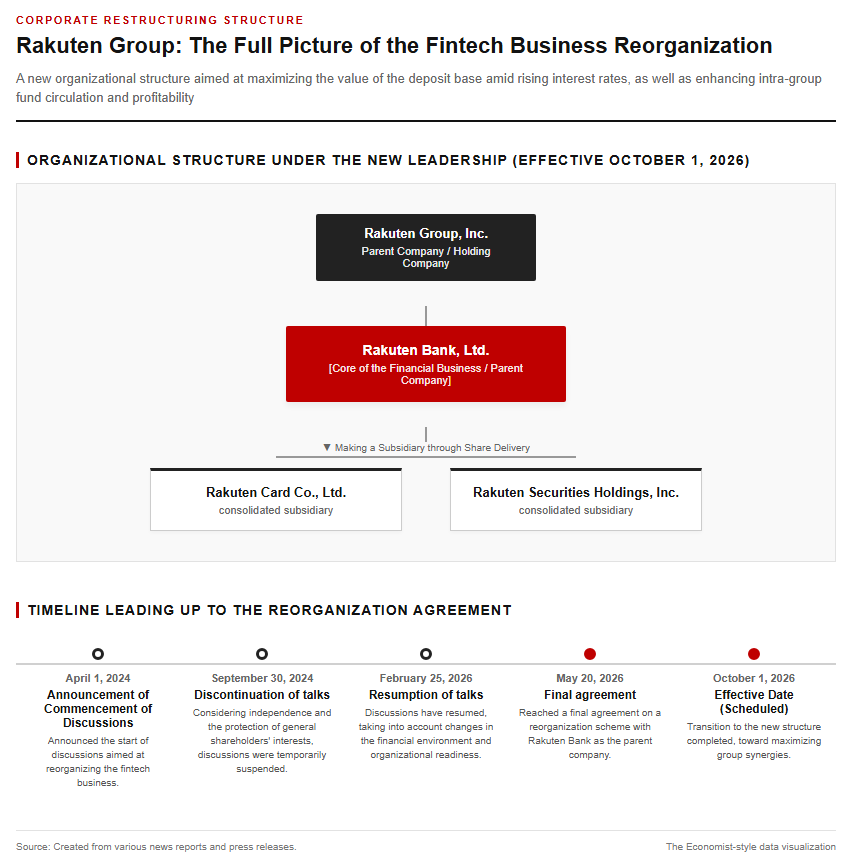
This reorganization has established a structure that accelerates decision-making among our financial businesses while maintaining governance as a listed bank.
The Role of Each Subsidiary in Financial Restructuring and the Excluded Businesses
In this corporate reorganization, not all finance-related services were consolidated under Rakuten Bank. Placed under Rakuten Bank are Rakuten Card, which handles the credit card business, and Rakuten Securities Holdings, which oversees the securities business. Meanwhile, Rakuten Payment, Inc.—which operates the “Rakuten Pay” cashless payment service—was excluded from the reorganization, and a structure was chosen for it to remain a direct subsidiary of the Rakuten Group. In addition, Rakuten Insurance Holdings, Inc. and Rakuten Wallet, Inc., which handles cryptocurrency trading, were also left out of the transfer under the bank’s umbrella. The Rakuten Group positions Rakuten Payment as the “gateway to the entire ecosystem,” guiding users to over 70 diverse services, including e-commerce services and the mobile business. By clearly separating daily micro-payment touchpoints from full-scale financial functions dealing with asset management and credit, the company aims to optimize the division of roles.
The Background of Banks Playing a Central Role and Changes in the Market Environment
The Importance of Deposit-Gathering Power and Synergy Effects in an Era of Rising Interest Rates
The primary factor behind Rakuten Group’s selection of Rakuten Bank as the protagonist of its financial reorganization lies in changes to the domestic interest rate environment. With the Bank of Japan lifting its negative interest rate policy and implementing additional rate hikes, competition to acquire deposits is intensifying across the financial industry. Rakuten Bank boasts a deposit balance exceeding 13.7 trillion yen, and when combined with the customer assets under custody at Rakuten Securities, its total customer financial asset balance reaches 57.3 trillion yen. In an era where interest rates have returned, having a bank with an abundant deposit base at the core—absorbing credit card settlement funds and account-linked funds from securities—directly contributes to suppressing funding costs for the entire group. Please refer to the figure below.
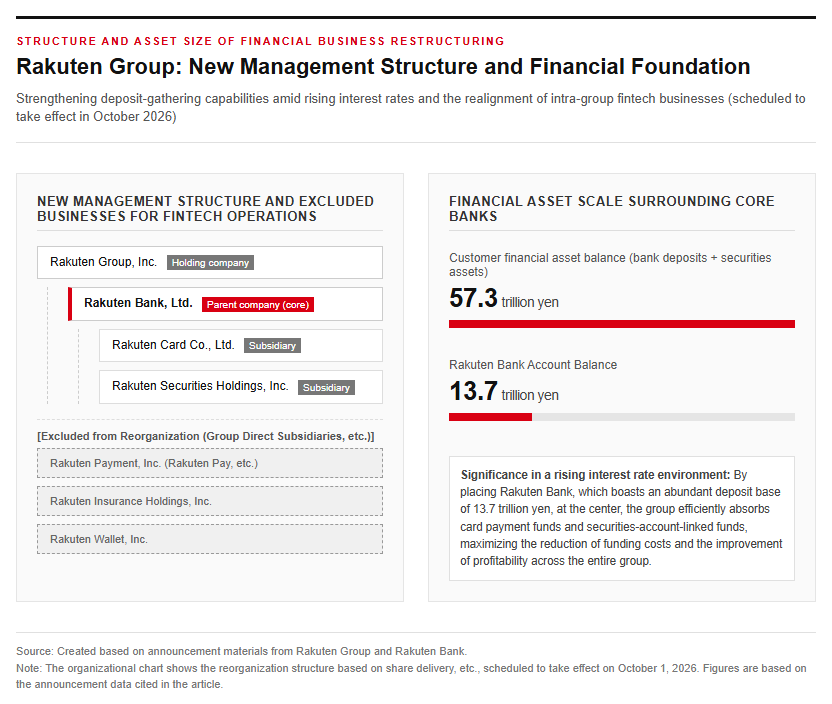
Rakuten Group is promoting the integrated operation of its three companies—bank, credit card, and securities—to promote cross-use and improve investment yields, expecting an annual synergy effect of over 85 billion yen.
Comparing Approaches with Competitors and Structural Changes in Financial and Economic Spheres
In Japan’s domestic financial and economic sphere, competing companies such as the SBI Group and PayPay (SoftBank Group) are fiercely rivaling each other. Armed with an overwhelming number of brokerage accounts, the SBI Group is expanding its economic sphere from the investment sector, while the PayPay Group’s strengths lie in gathering purchasing data and expanding its settlement ratio, starting from everyday QR code payments. In contrast, the Rakuten Group is deploying a unique strategy centered around Rakuten Bank—which possesses the “vessel of funds” known as deposits—based on its more than 100 million Rakuten member accounts. Previously, individual financial subsidiaries acquired users independently, but by making the bank the axis, an ecosystem is completed that smoothly channels funds deposited by customers into credit card payments and securities investments. A major characteristic is the attempt to transition from a model that competes on the volume of cashless payments to a high-profit model that generates revenue based on deposits and credit.
Impact on Users and Future Outlook
Specific Benefits for Consumers and Rakuten Ecosystem Users
This financial restructuring also brings numerous benefits to everyday consumers who regularly use Rakuten services. Enhancements will be made to “Money Bridge”—the popular account-linkage feature between Rakuten Bank and Rakuten Securities—along with further strengthening of preferential interest rates and point-reward programs tied to setting the bank account for Rakuten Card payments. Furthermore, by centrally analyzing credit data held by the bank, card usage history, and securities investment history, it will be possible to offer loan products and asset-building plans optimized for individual users. The conditions for linking financial services in the Super Point Up (SPU) program will also be intuitively streamlined, boosting the incentive to complete savings, payments, and investments within the Rakuten Group. Users will be able to reduce the hassle of managing separate financial institutions and seamlessly oversee their entire portfolio on a single app.
Post-Reorganization Management Challenges and Medium- to Long-Term Focus Points
The medium-to-long-term focus following the establishment of the new management structure lies in execution capability—specifically, whether the projected synergy effects of over 85 billion yen can be reliably generated. In particular, because Rakuten Bank is a listed company on the Tokyo Stock Exchange Prime Market, it is essential to maintain independence from its parent company, Rakuten Group, while preserving transparent intra-group transactions that do not harm the interests of minority shareholders. Furthermore, as the Rakuten Group as a whole faces financial challenges such as corporate bond redemption associated with upfront investments in the mobile business, the stable profitability of the fintech business will serve as a pillar supporting the group’s overall financial foundation. Moreover, as mega-banks strengthen their digital accounts and point-reward programs, the question is to what extent the Rakuten ecosystem can maintain and expand its customer lock-in capability. On the technology front, improving the accuracy of AI-driven credit screening and ensuring the security of data linkage hold the key to future sustainable growth.
Reference Page
- 【Notice Regarding Definitive Agreement on Fintech Business Restructuring – Rakuten Group, Inc.】https://corp.rakuten.co.jp/news/press/2026/0520_11.html
- [Notice Regarding the Resumption of Discussions Aimed at Reorganizing the Fintech Business – Rakuten Group, Inc.] https://corp.rakuten.co.jp/news/press/2026/0225_13.html
- [Investor Relations (IR) – Rakuten Bank, Ltd.] https://www.rakuten-bank.co.jp/corp/investors/
【#Rakuten #RakutenBank #Fintech #FinancialRestructuring #RakutenCard #RakutenSecurities #EconomicNews】

コメント