- Key Provisions of the Anti-Dumping Measures and Deposit Requirements on Japanese Firms
- Origins of the Investigation and China’s Evidence of Unfair Competition
- The Indispensable Role of Dichlorosilane in the Global Semiconductor Supply Chain
- Diplomatic Friction Over Taiwan and Rare Earth Export Controls as Catalyst
- Operational Fallout for Japanese Materials Suppliers and Chinese Device Manufacturers
- Strategic Defenses Under Trade Rules and Critical Watchpoints Ahead
Key Provisions of the Anti-Dumping Measures and Deposit Requirements on Japanese Firms
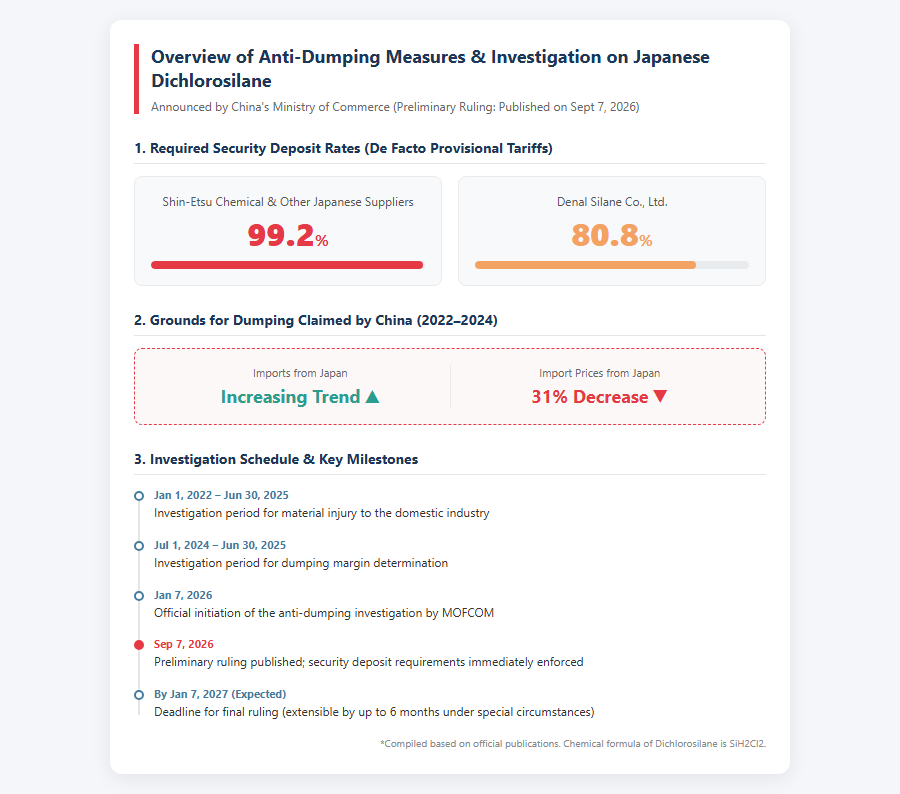
On September 7, 2026, China’s Ministry of Commerce announced the preliminary findings of its anti-dumping investigation into dichlorosilane imported from Japan. The ministry ruled that Japanese dichlorosilane had been dumped into the Chinese market at unfairly low prices, causing substantial material injury to domestic producers. Consequently, Beijing has immediately implemented provisional measures, requiring Chinese importers of Japanese dichlorosilane to place hefty security deposits with Chinese customs.
The required deposit rates are tailored to specific suppliers and function as de facto prohibitive tariffs that strip Japanese products of their price competitiveness in China. Specifically, imports from Shin-Etsu Chemical and other major Japanese suppliers face an exceptionally high deposit rate of 99.2%, while imports from Denal Silane are subject to an 80.8% rate. This aggressive enforcement follows a formal investigation that began in January 2026, initiated in response to petitions from Chinese domestic manufacturers. Please refer to the diagram below for details.
Origins of the Investigation and China’s Evidence of Unfair Competition
This provisional measure stems from an anti-dumping petition filed on December 8, 2025, by Tangshan Sanfu Silicon Industries, representing China’s domestic dichlorosilane producers. After a preliminary review under its anti-dumping regulations, the Ministry of Commerce officially launched a formal investigation on January 7, 2026.
As grounds for the dumping and subsequent injury to its domestic industry, China cited a significant surge in imports of Japanese dichlorosilane between 2022 and 2024, coupled with a cumulative price decline of 31% over the same period. The ministry defined specific parameters for its probe: the dumping investigation covers the period from July 1, 2024, to June 30, 2025, while the injury assessment spans January 1, 2022, to June 30, 2025. Although the final ruling is scheduled to be announced before January 7, 2027—one year from the start of the probe—China has reserved the right to extend the investigation by another six months if necessary. The newly imposed deposit requirements represent an interim ruling ahead of that final decision.
The Indispensable Role of Dichlorosilane in the Global Semiconductor Supply Chain
While dichlorosilane (chemical formula: SiH2Cl2) remains virtually unknown to the general public, it is an indispensable specialty gas that underpins the global semiconductor supply chain. It is used primarily during the chemical vapor deposition (CVD) process on silicon wafers to grow high-quality epitaxial layers, silicon oxide, silicon nitride, polycrystalline silicon, and silicon carbide (SiC) thin films. The purity and consistency of this gas directly dictate the performance, reliability, and yield of the final semiconductor devices.
To put this in perspective, if patterning and lithography are akin to erecting the superstructure of a building, and the silicon wafer serves as the foundation, then dichlorosilane is the critical leveling process that ensures the concrete base is perfectly flat. Even the slightest microscopic defect or unevenness at this foundational level will destabilize the entire architecture built above it, rendering the final chips useless. Japanese manufacturers are world-renowned for their ability to produce ultra-high-purity dichlorosilane. The global market is dominated by a select group of Japanese suppliers, including Shin-Etsu Chemical, Taiyo Nippon Sanso (under Nippon Sanso Holdings), Sumitomo Seika, and Air Liquide Japan.
Geopolitical Spillover and Future Trade Policy Implications
Diplomatic Friction Over Taiwan and Rare Earth Export Controls as Catalyst
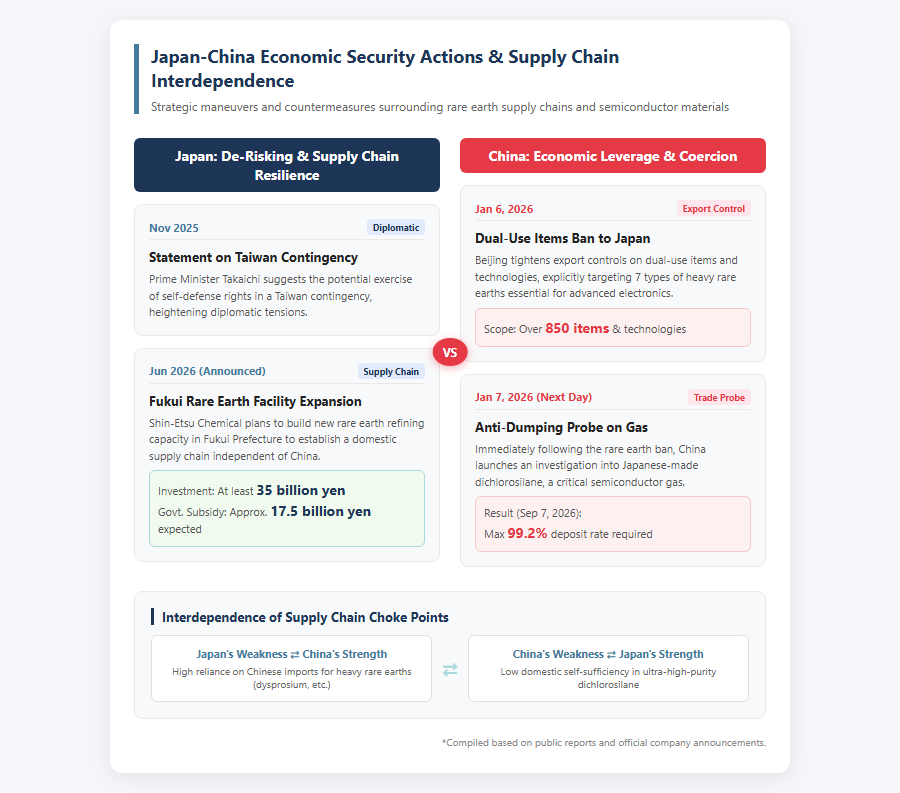
China’s decision to pursue this anti-dumping investigation and impose provisional measures on dichlorosilane cannot be viewed in isolation from the broader diplomatic and political gridlock between Tokyo and Beijing. The direct catalyst for China’s aggressive economic retaliation was a parliamentary statement made in early November 2025 by Prime Minister Sanae Takaichi, who suggested that Japan could exercise its right to self-defense in the event of a military conflict over Taiwan.
The timing of Beijing’s trade maneuvers strongly suggests a coordinated strategy of economic coercion. On January 6, 2026, China announced immediate export restrictions on over 850 dual-use items and technologies, specifically targeting seven types of heavy rare earths vital to advanced manufacturing. The very next day, on January 7, Beijing announced its anti-dumping probe into Japanese dichlorosilane. Concurrently, Shin-Etsu Chemical has been aggressively pursuing a “de-risking” strategy, investing at least 35 billion yen (with an expected 17.5-billion-yen government subsidy) to expand its rare earth refining and magnet manufacturing capacity in Fukui Prefecture. By targeting a niche but vital semiconductor chemical, Beijing is signaling its readiness to disrupt Japan’s tech sector in response to Tokyo’s security and supply chain alignment. Refer to the relational diagram below.
Operational Fallout for Japanese Materials Suppliers and Chinese Device Manufacturers
The newly enforced security deposits will severely disrupt operations on both sides of the East China Sea. For Shin-Etsu Chemical, a massive enterprise whose China-dependent revenue runs in the hundreds of billions of yen, the near-100% deposit requirement drastically erodes its pricing power and threatens to squeeze its profit margins. Reflecting these concerns, Shin-Etsu’s stock price tumbled by nearly 4% immediately following the news, amid fears that the trade dispute could widen to include other high-value electronic chemicals.
Conversely, the operational fallout is equally severe for Chinese chipmakers. Dichlorosilane is a highly specialized “design-in” material. Once a semiconductor fabrication line is optimized and calibrated for a specific specialty gas from a particular supplier, substituting it with a domestic alternative is incredibly difficult. Such transitions require extensive qualification testing, take months to complete, and carry significant yield and defect risks. While Chinese device manufacturers may try to stockpile Japanese gas in the short term, a forced transition to domestic Chinese dichlorosilane over the medium term could permanently erode the market dominance and leverage Japanese electronic materials firms have historically enjoyed.
Strategic Defenses Under Trade Rules and Critical Watchpoints Ahead
The primary focal point for global market observers will be the Ministry of Commerce’s final determination, which is due before January 7, 2027. In the intervening months, the critical question is how the Japanese government and affected companies will coordinate their defense, and whether they can effectively leverage World Trade Organization (WTO) rules and international trade law to challenge China’s dumping allegations and prevent the provisional duties from becoming permanent.
For multinational corporations and trade analysts, four critical variables require close monitoring: first, the official updates and milestones published by China’s Ministry of Commerce; second, the precise scope of transactions subject to the deposit requirements; third, the actual enforcement mechanics of the de facto tariffs; and fourth, whether Beijing will expand similar investigations to other high-purity chemical agents or specialty gases. Unassuming electronic chemicals and consumables represent the quietest and most lethal choke points in the modern geopolitical landscape. As semiconductor materials become increasingly politicized as strategic weapons, governments and tech enterprises must work in tandem to secure foundational supply chains and actively diversify their sourcing networks.
References
- 【Disputes Involving Japan | Ministry of Foreign Affairs of Japan】https://www.mofa.go.jp/mofaj/gaiko/wto/funso/funsou.html
- 【Ministry of Commerce of the People’s Republic of China】https://www.mofcom.gov.cn/
【#Semiconductors #Dichlorosilane #ShinEtsuChemical #AntiDumping #EconomicSecurity #GeopoliticalRisk #Chemicals】
コメント