- The September 2026 Accusations and Targeted US Entities
- Escalating Diplomatic and Political Tensions Ahead of the Bilateral Summit
- The Technical Mechanics of Distillation in Slashing Development Costs
- Large-Scale Extraction Attacks by Alibaba and Moonshot AI
- Financial Market Turmoil and the Threat of “Cheap AI” to Semiconductor Stocks
- Future Outlook: Export Controls and the “AI Model Theft Deterrence Act of 2026”
The September 2026 Accusations and Targeted US Entities
On September 8, 2026, the US government issued a formal statement accusing six Chinese AI firms of systematically and maliciously replicating advanced American AI models to accelerate their own technology development. The list of accused entities includes prominent Chinese AI startups such as DeepSeek and Moonshot AI, alongside the e-commerce giant Alibaba. According to US intelligence and law enforcement agencies, these Chinese firms have been utilizing derived datasets and outputs from leading US models to train their own systems at an industrial scale. The targeted US technologies belong to the country’s most advanced AI research organizations, including Anthropic, OpenAI, Alphabet’s Google, and the aerospace manufacturer SpaceX. US officials strongly warned that this aggressive, target-driven campaign has been executed with the likely knowledge and approval of the Chinese government, presenting a direct and severe threat to US national security.
Escalating Diplomatic and Political Tensions Ahead of the Bilateral Summit
The timing of this formal accusation introduces immense political complexity into the delicate diplomatic relations between Washington and Beijing. Both nations had been actively preparing for a series of high-level mid-September 2026 talks to address safety risks associated with frontier AI models. Furthermore, a highly anticipated summit between US President Donald Trump and Chinese President Xi Jinping is scheduled for September 24, 2026, in Washington. Coming just weeks before these critical negotiations, the public indictment of Chinese tech firms significantly intensifies geopolitical friction. The move signals a broader shift in US policy, which is expanding its focus from hardware-centric semiconductor restrictions to the direct protection of software, algorithms, and intellectual property. While the Chinese Embassy in Washington did not immediately respond to requests for comment, this escalation is set to dominate the upcoming bilateral agenda.
The Mechanics of Model Distillation and Allegations of Copying
The Technical Mechanics of Distillation in Slashing Development Costs
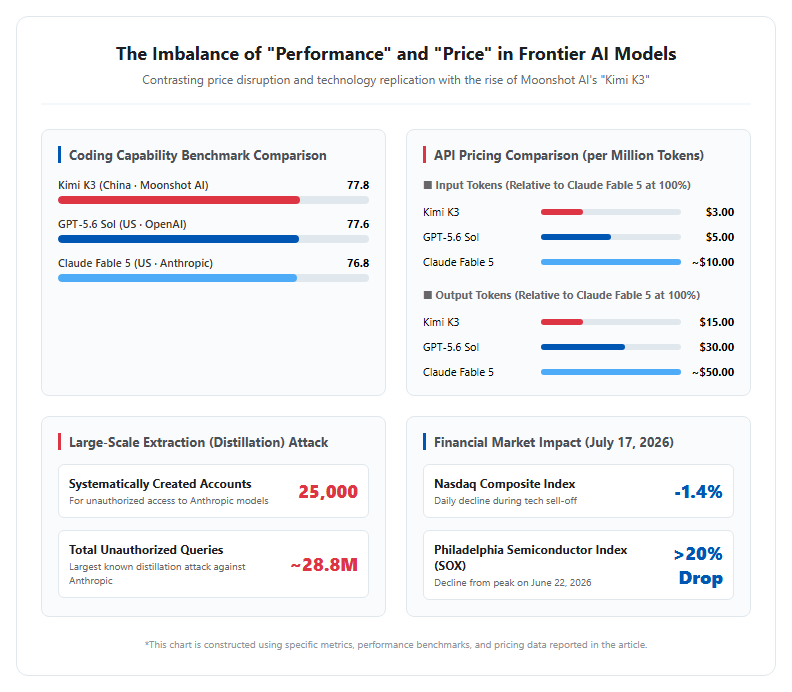
The technical core of the US government’s accusation centers on a practice known as “model distillation”. In AI development, distillation is an optimization technique where developers use the outputs of a massive, highly expensive “teacher” model to train a smaller, computationally efficient “student” model. This allows developers to replicate the capabilities of cutting-edge AI systems without incurring the massive R&D costs and computational infrastructure required for training a frontier model from scratch. A prime example of this trend is Moonshot AI’s “Kimi K3” model, released on July 17, 2026, which boasts 2.8 trillion parameters and performance closely rivaling leading US models. While Anthropic’s Claude Fable 5 costs approximately \$10.00 per million input tokens and \$50.00 per million output tokens, Kimi K3 is priced at just \$3.00 for input and \$15.00 for output, offering comparable intelligence at a fraction of the cost. US policymakers argue this massive price drop is a direct result of technical free-riding on American intellectual property.
Large-Scale Extraction Attacks by Alibaba and Moonshot AI
US developers have reported highly organized and systematic query patterns from Chinese entities that they classify as severe security breaches. Specifically, Anthropic disclosed that Alibaba created approximately 25,000 fake accounts to execute a massive extraction campaign, querying its models 28.8 million times to systematically distill their underlying logic. Described as the largest known distillation attack to date, this incident prompted US Treasury Secretary Scott Bessent to condemn distillation as a form of intellectual property theft that warrants severe sanctions. US officials also alleged that Moonshot AI built a dedicated internal platform designed specifically to distill Anthropic’s Fable model on an industrial scale. Furthermore, Moonshot AI reportedly bypassed US semiconductor export controls by acquiring servers containing restricted Nvidia GB300 Blackwell chips and accessing them remotely through routing setups in Thailand. The rapid dissemination of these highly advanced open-weight models without safety guardrails has triggered intense alarm among national security experts.
Financial Market Fallout and Evolving Regulatory Responses
Financial Market Turmoil and the Threat of “Cheap AI” to Semiconductor Stocks
The rise of cheap, high-performing Chinese models combined with escalating regulatory friction has sent shockwaves through global financial markets. On July 17, 2026, the New York stock market experienced a broad tech sell-off, dragging the Nasdaq Composite Index down by 1.4%. Crucially, the Philadelphia Semiconductor Index (SOX) plunged more than 20% from its June 22 peak, signaling a technical transition into a bear market. Investors are increasingly anxious that if Chinese firms can replicate top-tier performance at a fraction of the cost through distillation, US cloud giants will struggle to justify their massive, multi-billion-dollar investments in GPU infrastructure. This growing skepticism has driven significant volatility in stocks like Nvidia and Micron Technology, prompting a fundamental structural re-evaluation of high AI valuations and the long-term return on investment for hardware builders.
Future Outlook: Export Controls and the “AI Model Theft Deterrence Act of 2026”
In response to these technological leaks, policymakers in Washington are moving swiftly to construct new legal barriers to safeguard American software. The “U.S. AI Model Theft Deterrence Act of 2026” has been introduced in the House of Representatives, designed specifically to prevent the unauthorized extraction and replication of US AI models by foreign adversaries like China and Russia. Under this proposed framework, any foreign firm caught engaging in unauthorized distillation would be added directly to the US Department of Commerce’s Entity List. Simultaneously, the Bureau of Industry and Security (BIS) has launched a formal investigation into Moonshot AI’s illicit chip procurement and distillation operations. As tech competition shifts from physical hardware chokeholds to software APIs and model safety screening, these measures represent the new frontline of national defense, as visualized in the diagram below
.
References
- 【Lists of Parties of Concern – Bureau of Industry and Security】https://www.bis.doc.gov/index.php/policy-guidance/lists-of-parties-of-concern
【#ArtificialIntelligence #USChinaRivalry #IntellectualProperty #ExportControls #NationalSecurity #TechHegemony #ModelDistillation】

コメント